In the field
Small team, big campaigns: inside Sandwich’s secrets to scaling creative
July 2025
4 mins

Table of contents
- From Dropbox chaos to seamless collaboration
- Building automation on a foundation of consistency
- The publish tool: from manual uploads to one-click sharing
- The comp builder: from blank projects to ready-to-render setups
- The business impact of smooth workflows
- Flexible until the final frame
- What can you take away?
Your files, faster.
Access any file instantly, anywhere. Collaborate in real-time from one always-up-to-date, secure cloud filespace.
When you're watching a slick, high-concept ad from a top tech brand, you're probably not thinking: "I bet a four-person post team pulled this off."
But that’s exactly how Sandwich — the creative agency behind standout work for Slack, Square, Airbnb and pretty much every buzzy tech brand — gets it done.
With just four people in post, they're delivering around 50 campaigns a year. Their secret? A smart, automation-powered workflow that treats organization like a creative tool, not a necessary evil.
In our latest Magic Hour session, we sat down with Sandwich’s Chief Post Officer, Zach Hobesh, and VFX Supervisor, Dan Sturm, to dig into the scrappy, smart systems that let their small team scale like a much bigger one — without losing their creative edge.
Watch the full conversation below, or read on for the highlights.
So I'm Marcy. I am on our community marketing team. I'm so thrilled you're all joining us for magic hour today. Magic hour is all about inspiring you, our community, with people in the LucidLink community. So largely storytelling based, and I'm really excited to have the sandwich team here today. We've been working with them for years. Dan and Zach are amazing, and I can't wait for you to learn from them. We have Gurgaon, our fantastic director of growth to host our conversation today. But the main crux of our conversation is gonna be so sandwich has just four core team members, but they have built a scalable production model that keeps budgets lean, freelancers happy, and quality is sky high, which is the most important thing for your clients. Worse, and you're like, Marcy, that sounds great. But how do they actually do that in practice? And that is what we're gonna be talking about today. So with that, Gregana, I would love to hand it over to you for, our main discussion. Thank you so much, Marcy. First of all, I wanna thank you, Zach, and then for, joining us today and letting us into your world, a little bit, deeper than what we've seen before. And, yeah, I would love to, start with, asking you to tell us a little bit more about what Sandwich does, and what your role is, at the company. Yeah. For sure. Well, I'll start. I'm Zach. I'm, EP of post, at Sandwich. I've been in the role for, a while, with a brief, year long sabbatical where I went and worked at the mill, right after COVID. And, yeah. We make, Sandwich makes commercials kind of at its most, at the, you know, base. We're also kinda at the moment, we're starting to work and branching out and making maybe maybe making some apps for the Vision Pro. We're also doing some AI software. I think we're an ad agency, but we're an ad agency of tech fans. And that kinda reflects in our clients and also the way that we approach our workflows and work. So it's kind of a good intersection of, filmmaking and Apple fans, who like tech. And what is your role for Oh, sorry. I'm e I'm executive producer for Post. And, and that basically just means that I run the the Post team and, and all sort of related, processes around that. Awesome. And then? Hi. I'm Dan. I'm the visual effects supervisor. I have a background in VFX. So I came in sort of managing our, freelance staff. So I'm the the main person on staff to manage, a lot of the online stuff, but it's mostly VFX for our finishing work, you know, conform color or any of those sorts of things that need to run back through online. And, Yeah. I I as I mentioned earlier, I'm kind of a nerd when it comes to automation stuff. So I I get wild ideas and start building tools that help us make our pipeline a little easier to use and add some features here and there. Yeah. So when when we think of an idea of, you know, something that's gonna make work easier or smoother or solve a problem for us, I like to dig into that kind of stuff with Zach. Awesome. And we'll definitely dig into, that work and, productivity and efficiency for your team, in this conversation. But I wanted to also ask you, what are the things that are, most most exciting to you to share with the audience today and whoever is watching the recording later? Yeah. For sure. I mean, I I think, like, Dan kinda touched on, I'm personally really proud of our sort of DIY pipeline and automations that we built. And I think, like, like, obviously, LucidLink is a big part of that. That kind of, like, jump started what we had been doing previously. I think, like, the you know, both Dan and I and also the founder of the company, Adam, are we have VFX backgrounds. We've worked at bigger shops. We've seen, you know, I think, like, the really good things that bigger shops do and then the sort of inefficiencies that might be present at a at a at a bigger company. So, like, our I feel like the whole the whole reason for us building any sort of pipeline or automation is sort of born out of the desire to make our jobs easier, more efficient, and create more time for whether it's iteration or just creativity. And okay. So how many people work actually at Sandwitch, and how many people do you typically bring in for a project, maybe as freelancers or, other consultants? Yeah. For sure. So I think the overall, headcount for the whole company is fifteen. And in post, we have four four people in our department, me, Dan. We have an editor, Ben. And then we have sort of a, a post creative type person, Jenny, who does basically everything else, which is great. And in terms of freelance, we bring on, I would say, two to three freelancers every project. Usually, an editor, a motion graphics person, a visual effects comp artist to help Dan. I guess we also I I'm I'm forgetting about our go to freelancers for color and sound. But we also we also have those as well. Amazing. What is the, besides the, Apple piece, the latest project that you worked on, is that the Perplexity ad? Maybe not the latest, but perplexity. We did do perplexity earlier this year. And I think I mean, one of the things about our, I guess, our business model is we always have, like, three to four projects kind of in the in the, in the cooker at once. So we do kinda churn out, I think, close to usually around fifty campaigns a year. And those often involve, I guess, you know, three, four videos each, kinda varies. And at what point of the process does the post production team get, involved? Because we tend to think, like, everything is already done, shot, and uploaded, and that's when your team accesses it and Mhmm. Starts working. But I have a feeling with a small team like yours, you probably need to get involved a little bit earlier and help streamline from the get go. Yeah. For sure. And I think that's actually a huge benefit of working at, like, a smaller agency where, and also working at an agency that does, you know, that we write the scripts, we shoot the spots, we do the post production. So, like, for me, it's a huge it's a huge benefit to be able to be involved from, like, the very first call just to hear what the client is hoping for. And and then I think also Dan Dan and I will usually have a conversation before the shoot about, like, what kind of spec we wanna ask for. We're we're actually we're we're involved in, like, camera choice a lot of the time just to decide what's the right camera. A lot of time these days, a lot of times, the camera choice comes down to if the client wants, like, nine by sixteens, and so we're gonna shoot with a larger sensor or something like that. So, or if there's heavy visual effects, maybe we might choose to shoot at a higher resolution. There's a bunch of things that kind of go into that. And so, like, I think being able to, like, being able to have that space to think about that and make that decision really early in the process is such a benefit and hopefully gets us out of the culture of, we'll just fix it in post, and more into, you know, you know, like, having production do what they do best and shoot all these practical elements that are really gonna help us, in post to enhance and build the world. Awesome. To to get back to the Flexity ad, maybe to nerd out a little bit because I really love that that piece. We actually if anyone is not familiar, this is, the the piece with, featuring the the actor from Squid Game, and it made its rounds on the Internet. Our social media team actually did an, like, a analysis of the piece before we actually knew that you guys made it. That's how we were about it. So, I'm just very curious what part of this piece was VFX and what was shot, on set? Yeah. So a lot of it was on set. We actually, the director and creative director from Sandwich, flew to South Korea to shoot this there with, the actor and the the crew. We built most of that. The the hallway, is all practical, but needed a fair amount of, you know, standard cleanup, you know, just making the walls look nice. Well, we wanted to do wanted them to look kind of worn in and kind of old and grungy, but you don't want them to have dirty handprints of whoever set the walls up a couple days ago. So we cleaned all that stuff up. The all the screens are in post. We do all of our screens in post. We have some practical references, but we were, dialing all of the look in for, you know, the the, whatever you call this, DRT, the sort of robot voice that's talking to him. We were we had some ideas for that, but that took a little time to iterate. So that was all post. But, you know, the phones are all post. We do an extraordinary amount of screen comps. So we are, we are built to handle all that stuff in post. But, I think the big one for us on this one was the environment effects, the, the sort of, cold breath and the, fog or steam coming down the walls and across the floor. That was all three d FX simulation stuff and, composited in, along with the the screen. So it wasn't, it wasn't a ton of different things, but there were certainly basically every shot in the in the project was touched. Very cool. Thank you for sharing that. Alright. So I'm curious about the process maybe from on a typical project, doesn't have to be this one. But when it comes to, you know, from aviation to postproduction, what are the tool sets that you use? Obviously, you guys are a LucidLink customer. When does LucidLink come in play? And keep in mind that, likely a part of our audience doesn't know what LucidLink is, maybe, and and how it's different from, other collaboration and storage tools that they might be using. So maybe through your process, you can shed some light on on what LucidLink is and what it's used for. I think, like, I guess, LucidLink LucidLink for us is sort of the the the hub, kind of, you know I think pre pre pandemic, we worked a lot off of, like, a NAS, like, I'm sure many people. And LucidLink to me is sort of the, continuation of that and a sort of a new world where not everybody wants to work from the office. And, you know, we wanna have the capability to hire people from anywhere. So I think any sort of cloud workflow like that was sort of the inevitable, way that we were gonna go. But the the way that we immediately did it after the pandemic was off of Dropbox. So losing link was a big upgrade, from that. But, yeah. I'm sorry. I might have gotten a little bit off of that. That's totally totally in line with what I'm asking because, people need to know what you are comparing to when you when you say that, this is a upgrade of your workflow. So you have a team. People are working remotely at the start of the pandemic. And maybe even before that, they have the desire to, but, didn't have the opportunity. So you were looking for a solution that would allow you to do that. Finding LucidLink, I guess my question is, what made it feel different from other things that you've tried? You mentioned Dropbox. People have tried other solutions similar to that that you sync your media with your local workstation, fill up your drive. And yeah. What is what is making List Link different in that environment? Okay. For sure. Yeah. I think and I think I think Dan maybe has some opinions on this as well because So many opinions, but you could start. I think that for me, the the thing that I the thing that I desperately wanted to get back to post pandemic was sort of that feeling of real time collaboration of, you know, being in the same room. And I think, like, there's a lot of there's a lot of apps that have that have tried to make that possible. We made, you know, we made videos for something that I'm thinking about, like, Tandem. I'm sure no one's heard of that. But it was sort of a live chat walkie talkie app. But I think, you know, the the real thing that we were trying to get after was sort of that, you know, the ability to, oh, I'm gonna jump out of this project, and you can jump in. Or, you know, or, you know, here's the file. It's available to you right away as opposed to having to send a link and download. And, you know, that that that became very hard to manage. And I think even on a small team, it's really I feel like in post production, I think one thing that I found over the course of my career is not everybody is gonna be the type of person to, you know, be super organized. Usually, that's a few people on the team who are doing that for everybody. So now the fact that we work off of all the same folder, you know, we can keep it organized for everybody even if not everybody is a perfect file organization superstar. So just like little things like that, I think that kind of improve the experience for everybody, are just a really big part of collaboration. So, pre pre any sort of shared NAS, shared server, shared folder, we were, you know, kind of operating in the dark. No one really knew what everybody else had. It was sort of just you know? So I think, like, having a shared folder is is really the is the first step. And then our whole workflow is sort of built off of the idea that we all have access to the same files, and we can reliably know where they are on somebody else's computer. Maybe, Dan, you can share a little bit from your perspective how how that works and also what have you built on top of, you know, the core feature of just having a shared space where everything lives. What is the next phase for improving the workflow for Sandwitch? Yeah. For sure. I mean, it sounds very simple and, like, reductive to say that, like, having everything in the same in, like, one place just simplifies everything and makes it easier. But, like, until you experience the chaos of, like, sharing a folder via Dropbox and then someone says, where's that thing? It's like, I don't know. Where did you put it? Like, it's there's Dropbox and similar solutions are not built for the same sort of collaboration that you have at a studio where everyone is connected to the same sort of stuff like you may or may not have the same files but like it's not the same shared storage and lucid link it mounts as a drive on your computer you just go to it and like everyone else would like the experience is the same for everybody and the the consistency and the predictability is essential for building any sort of workflow on top of it like the naming conventions you know that was the big thing I think once we started getting into lucid link what it sort of enabled us to do was you know we didn't have to be super strict about a lot of things when it was dropbox because like people had to manage their own dropbox but when it's lucid like no we have project templates we always did but but this is the project template here's the naming conventions like we were very strict about that upfront and as long as everyone abides by the agreed upon naming conventions and where things go we can build automations on top of that that make everyone's life easier like and it's simple enough to say like, here's a Wiki, read the Wiki, put the stuff there. And now we have automations and actions all over the place that can, you know, do things to make everyone's life easier. And we can build small things for individual artists that make their life easier like if anyone has a feature request on a project we can usually build it pretty quickly but it really comes down to everyone having the same stuff in the same places you know, LucidLink's taking everyone to the same file in their, you know, browser, their finder, their whatever Windows calls their version of finder. Or file explorer, I think. Yeah. Whatever it is now. It's changed, I'm sure. But, like, again, it just sounds so silly to say, like, everyone has the same files in the same place, and that makes it sane. Like, it's all cloud storage. I mean, LucidLink is cloud storage, but it acts like local. It acts like we're all in the same room connecting to the same server. It just, it removed so much headache from managing managing the data and managing the people and their data. And it's like, okay, so where did you save your shared folder in your Dropbox? It's like, oh, I did it over here and that sort of thing. It's like, that doesn't work. Like, I can't spend, you know, days writing multiple versions of some regular expression that's going to like figure out where a file is on someone's computer versus another computer. Like, that's insane. Like, we just all need to have the same stuff in the same place And LucidLink's simplicity of just, like, you connect to it and it's there is is the thing that made us it it gave us the freedom to start building on top of that. And, you know, I mean, we can get into all of the individual pieces of the stuff that we have built, but like, you can't even start thinking about that stuff until you have a reliable base level. Like, until you know that the storage is fast and connected and the data is there for everyone, you can't even really start thinking about, like, what would be nice to have on top of this? You just spend your time chasing down where did that thing go or who got shared on what. And now it's just like, no, you're either on you're on that project, or you're not. Like, we share individual project folders with our freelancers. They all get a shared assets folder when they join our our company as a freelancer as well, which includes, automations. It includes some of our internal tools, just some of our basic workflow stuff. And it's just like it it's it's simple and repeatable, and that gives us a lot of freedom to do do different things. I think I may have wandered off topic there, but, like No. This is perfectly on topic, and it's very, very interesting because this is an area where I feel like there's a bit of an oversight, when when people think about postproduction and just overall creative work. And when you are on your own and you're doing your I have a background in as a video editor and then post supervisor and managing a team of editors. So I very well know that when you are the only person doing things, you can be as messy as you want, and it doesn't matter. The the second you add another person to this process, that doesn't fly anymore because you end up wasting more time, looking for things and and trying to coordinate and then conversations and actually doing work. Or I mean, even if you're the the only person working on it, but then you have to come back to something and two projects later, and you're like, where did I put that thing? It's like, it should be in the place where that thing goes. And if it's not, you're like True. I don't know, man. Just start searching, and that's that's chaos. Yeah. And people often think that, another tool will help them, meaning, like, a media asset management tool or an AI for searching some some pieces of media. But the truth is that if you have the proper naming convention, as you mentioned, and project templates, and everybody's following the same process, things will get a lot easier. So this is really good practical advice. I would love for you guys to give an example. Obviously, you've built a lot on top, of listening for your workflow in terms of automation. But maybe if you can give us one example, of something that's been really helpful, even if it's, like, something in your project management system or, yeah, how you share media. I don't know what sort of automate automations you have. Yeah. I mean, I guess I'll I'll definitely mention that our, our published tool, which is a a Dan something that Dan built. And it's sort of like a v two iteration of something that we built years ago. But, essentially, what it is is, you know, we have a a a variety of freelancers working on projects, editors. And, we share them on the LucidLink folder. We also still have Dropbox for external sharing and public links and things. So we use, but we don't necessarily wanna share every editor on our Dropbox folder as well. So the when the editors want to upload something to Dropbox, there's a we have a slash command in Slack, and that pushes it down to Dropbox from LucidLink, and then additionally updates our database. So we have sort of this, like, constantly updated database of all of our most recent cuts. The links are published right back in Slack so that everybody can see that a new cut is available. This is sort of like I think it's, like, kind of built from something that we've seen at bigger companies where, you know, maybe you make a link and it emails the whole project team or something. But, but I think the the way the way that it works is really straightforward and simple. It's it's exactly what we've been talking about the whole time since we we have a computer that can rely that the when a, like, a LucidLink path is the same from computer to computer, that it can just grab that path on a shared computer, bring it down to Dropbox, and then send the link back to everybody on Slack, then the the the individual editors don't need access to our Dropbox. They can still they can still upload to it via the tool. So, I mean, I think it's just, like, a really simple thing that just makes every you know, there's there's there's a bunch of side benefits of using it in terms of, like, having a having, like, updating our database with our most recent cuts. So we can ask the database, hey. Give us the most recent cut for every single project. That's really useful when you're looking at looking to review everything across all your projects that are happening all at once. And, and then, you know, editors like it because it makes it really easy for them to get a link to send to the creative director, send for review, or you know? And and I'd assume clients like it because it also turns it into a little cute little vanity link that says, you know, SNDW for sandwich. So Awesome. Is that your favorite piece of automation that, that That might be my favorite piece of automation that we've done only because it does it does really help to not have to, like, manually upload every single cut to Dropbox or, you know, drag it over to Frame. Io or something. So, So, yeah, I mean, that's actually that's one thing we wanna add is we wanna add sort of, like, automated publishing to Frame. Io from LucidLink, via Slack in Portland. Because we're in Slack all the time. So I think, like, you know, it's nice it's nice to have things that are built into Slack that kinda make your job easier. Then do you have a different favorite automation, or this is kind of in the same line? The publish tool is is nice because, again, it's just, you know, slash command, drop in a Lucid link, and it does a bunch of stuff for you. It's cool. No. I'm I'm the VFX guy, so I I like to build all the cool VFX stuff. And, you know, we have a a shot management database. So, like, when a project goes from offline to online, we break down the project into every single shot, whether it needs comp, roto, paint, tracking, all those different things, they all get tagged in there. We we built, we Zach built this whole thing basically for us. And, you know, it's the only way to keep your wits about you when you're doing project management or multiple projects at the same time to see, you know, what's ready for review, what's in revisions, you know, giving feedback to artists. But on top of that, we were able to connect the database to our local web app that we created. It has all of these little bits and pieces. Like, the publish tool is, sort of one endpoint on this internal web app that we built. But in our shot database, we have the ability to say, like, alright, this project has fifty shots. Click a button, and it'll make a folder for every shot because when we're doing VFX work, each shot needs a folder. So it puts the it names that the right thing. It puts it in the right place on LucidLink. It will create individual references from the offline cut and put them in all the right folders on lucid link. It'll create thumbnails and re upload those back to the database so we can see in the database what we're looking at. We even have a button that will say like I can tell it this project was shot on Sony Venice and we're working in log click the button and it'll make all of the new comps for every single shot and put them in the folders for us. And again this is the part that like the reliable storage it's like when an artist gets onboarded they don't even have to make a new project like the project is sitting there waiting for them they just open it up the log plates there it's connected to the the right node in nuke. I'm getting into the nuke weeds here, but, like, they just open the project, they do the work and they hit render. They don't have to tell it where to go. They don't have to tell it what format to put it in, what color space to put it in. It's just built. And all of this is because we have lucid link, we have a predictable file structure and we have a database that can talk to that and just connecting those blocks. I am not a computer engineer, I dropped out of engineering school extremely quickly in college and went back to film school. But even I was able to figure out how to use LucidLink's API to connect, you know, my portion of it to Zach's, database portion of it. And we basically built ourself a web API where we can send requests back and forth and create little modules that do all kinds of different things. But the the comp setup, the comp builder is something that is it's it's crazy to think that we used to open a blank project, bring in a clip, connect it up, make sure everything was set up correctly. Because nine times out of ten, you would just put something in the wrong folder or it would be in the wrong color space. And it's like, I don't wanna spend time tracking those stuff down. Like, this is known, predictable, dumb stuff. And now it's just it's not a thing that we have to think about anymore. And it makes me very happy. But, you know Yeah. I mean, I think that kinda gets to exactly what we're what we're trying to do, which is whatever can be automated, do it so that we, you know, can focus on actually doing the comp or, you know, not having to track down any sort of mistake that was that was made because somebody wasn't familiar with our structure or workflow or whatever. So I I have that. I mean, just, you know, a lot of this is invisible to me because, obviously, Dan is doing all this work. But I do think that adding all these tools is sort of, like initially, when you start working on it, it's it can be a little bit frustrating. Oh, the tool broke. Oh, the automation didn't work. Oh, you know, etcetera, etcetera. But I think if you stick with it, then you do start to see the benefits. And it just means bait for me, it means that I'm just hearing less, from the artists. I'm hearing less complaints. I'm hearing you know, it's just more like, oh, that's done. You know what I mean? So I guess it's the, no news is good news. Yeah. You wanna talk about, like, not everyone has good file structure hygiene, but, like, on top of that, every artist is gonna have very different preferences on how things get done. And I don't have I mean, like, I don't want to sound like a jerk or anything, but I don't have the time or the inclination on a project to debate the merits of a workflow with an artist. Like, we got stuff to get done. So, like, I'm not I'm not gonna I'm not gonna debate where the project goes or what it should be named or what the color space should be on this project. Open you just open the comp and you do your work and then you hit render. And, like, that's all we have to do. Like, I I we don't have to say, like, I don't have to get questions. Like, where should I save this and what should I call it? Like, no. It's it's already there. Don't worry about it, buddy. Just open the thing and do your do your stuff. And having a smart workflow, you know, this is a very smart workflow. You guys make it sound easy, to build, but, and and maybe it is to you. But, sure that a lot of companies out there are looking to make their teams more efficient, for a variety of reasons. And I'm curious how for for the sandwich team this translates into business value. Has it has this type of workflow made it easier for you to produce the fifty campaigns that per year that you mentioned that you're working on, constantly? Has it, well, obviously, it's made your team happier. But what is the value that is tangible and measurable that you can, you know, say this is a successful workflow for the business, and it's worth investing in it. Yeah. You know, I mean, I wish I I wish I had more tangible numbers about how, you know, like, maybe our like, I think one thing one thing I can say pretty reliably is that the number of VFX shots that we are able to complete in, you know, two weeks is significantly increased. I should track that, I suppose. Although, I'm not sure how I would. But, but I like, just the the amount we're able to complete in two weeks is definitely higher. And and I think that, you know, it's it's definitely not an overnight process where, you know, you you you install a tool and suddenly you're you're that much more efficient. I do think, like, you know, it has taken us time to kind of get used to how we wanted to do things and and, you know, kind of shake out between team members, like, different you know, getting getting rid of old ways. And I think, like, a a culture shift also takes a little bit of time even in a small team. So but, but, yeah, I do think, like, the number of shots that we can complete is definitely increased. The the, the other thing I think that is really obvious to kind of on the producer level, I suppose, would be that onboarding a new freelancer, it there's significantly less friction. So and I think for that, like, that just means I'm sure if anybody if anybody has ever worked with freelancers before, sometimes you hire a freelancer you're really excited about. For whatever reason, they you know, it doesn't work out or, you know, they they don't really vibe with the rest of the team. And I think sometimes a lot of that is is, you know, you didn't give them the tools to succeed. So I feel like for us, that happened significantly less. I would say it would be impossible to completely eliminate that sort of event. But the you know, people are able to jump in without very much hand holding and start to work and start to do what they're best at. And I think that for us is a has has been a really big, shift and kind of encourages, you know, encourages when you're overloaded. Hey. Maybe we bring somebody on to handle this. It doesn't seem like such a there's not since there's since there's less friction to hiring freelancers, we're more likely to bring on additional help. And that speeds up a project that, you know, that encourages us to work with more more people, which is always kind of a which is always a good thing. You don't wanna get we're not over relying on your core on your core team because it kind of shuts you off from other opportunities. Anything to add, Dan? No. It's I mean, it's the other side of the same thing. It's just like that that sort of like institutional rigidity of some of the tech stuff that we don't wanna think about. When we do have a bunch of projects going on at once and, you know, I do reviews of every shot just as as as my visual exec supervisor role there. I've got my timelines and when new stuff comes in, I need to update all of the timelines with the latest stuff. And, if I had to like go hunt and find stuff and it was named wrong or in the wrong place, like I wouldn't I would be wasting time with things that I don't that are not actually adding value to the project here. But since everything is built in a way that it goes where it needs to go and is it named it's named what it needs to be named. I can open up my Nuke Studio timeline and hit version version up on everything And my timeline just updates, and then I can just watch everything and give notes. And then I can switch to the other project and version up. And and, you know, the same thing for, when there's new comps, for the editors or color comes back or whatever. You know, everything is where it needs to be and I can hit a button and update an XML for the editor so they don't have to conform fifty shots every time there's a new version of something, available for them on lucid. Like, it's just that stuff is, we take it for granted now for sure. Just but trying to think back to, like, you know, where's that thing? Has it syncs? What's it called? Like, did somebody mistype something? Like, it's the kind of stuff that makes you, like, wanna walk away from your desk for the day. Like but, like, if you need to get stuff done, you need to have all these pieces in place. And, you know, it was and continues to be sort of a cultural thing that you have to sort of institutionalize. But like you feel a little weird going like I'm gonna take away an artist's ability to have control over certain things. But like the artist doesn't want to have to deal with naming conventions and folder structures either. Like they're like please just like make this stuff work so I can do my art stuff and we can we can all leave work at a certain hour and, like, not tear our hair out at the end of the day. But, like, all of that stuff, you know, we we reap the benefits of it too. Like, it helps us prep stuff for, freelancers. We can bring people in, like, you know, we don't have to explain stuff. They've got a little like, here's five steps if this is your first day to getting up to speed, working with Lucid and our tools. And once they've got that, it's pretty much, off to the races. Like, we can talk about creative stuff and that's that's what we want to do. Like, as fun as it is to say, like, we've got all these cool workflows and, like, look at all these cool things you can use. Like, we want all that stuff to just blend into the background and let people do the work that they're here to do, because getting sidetracked with a technical problem, it doesn't help anybody. Like, it's just, it just makes everything more difficult. That's a that's a great segue into my next topic, which is how do you think of the creative process when you are collaborating with you mentioned that oftentimes, the the post production team will be brought in to talk to the clients so you hear, what the requirements are and you're part of the process. So what is it what is important for creative teams that are more on the execution side to know, when it comes to working directly with clients, working directly with marketing teams? And, like, do you have any practical advice outside of the technical workflow just for how to collaborate, with each other? Yeah. For sure. I mean, you know what? It's something that I think about a lot just because I feel like, a lot of times, just the kind of person that I am, I really I like the workflow stuff. I like the technical stuff. I like all of the, I like kind of, you know, getting into the weeds a little bit with that. And a lot of this is invisible to the client. The client is never gonna see how we they you know, they don't really care how we do the work. So I think, you know, consciously removing yourself from that and trying to see, like trying to find trying to really find what's important to your client and what they are what they are looking for when they review the spot, I think, will kind of help. You know, I don't I I mean, I'm not sure if anybody else has experienced this before. But when I when I came into a position where I had to look at things, review things, and pass feedback, I have to, like, I have to pass feedback from several different viewpoints. I have to pass feedback from the client viewpoint to say, like, okay. Well, I know the client is gonna want this shot to do this. So now I have to then I have to take that feedback and of reword it in the way that I know that we're gonna execute on it. Whereas maybe, you know and then maybe I'm also passing feedback from just, like, a technical visual effects perspective. Hey. I see a tiny little glitch in this shot. And then finally, I'm passing feedback from just, like, a manager of people perspective where I'm, like, where, you know, where, hey, I think this is gonna this is gonna happen quicker. This is gonna be able you know, this is gonna be a little bit easier for you or whatever it may be. So, you know, I think putting on wearing all your different hats to try to remember, you know, what the what the purpose what the purpose of the project is. A lot of times, our purpose is to make a video that is going to tell somebody about a new product, sell something. You know? So, like, making sure that we're still, we're we're still we know what the client's aim is so that we can then, through feedback, through iteration, through through the storytelling and filmmaking that we're doing, make that happen however we can. Awesome. And before we step into the area with, with q and a, from the audience, Just maybe what makes, Sandwich a unique studio, a unique company, in your view? Obviously, the content is very unique. And but but but what is unique about the company that helps make that content unique? Yeah. I don't know. That's really that's a really that's a really hard question just because, I feel like we have such a back catalog of spots that we I mean, we're in such a privileged position where clients sometimes come to us and say, hey. We loved your work. We loved this spot. We wanna do something similar for our company. And I think that is such a, like, it's such a it's an ego boost, honestly. It's like, hey. Cool. We're doing we're doing some work that is somehow resonating with some people that, you know, we can we can replicate. And so we've gotten really good at doing what we do best. We also like trying new things. You know, if there's any clients out there who are interested in us seeing something different. But, you know, I think, like, the I I don't I don't know. I don't know if I can put my finger on exactly one thing that makes Sandwiches unique. But I think it's, like, you know, still a small team. We're definitely older than when I started at Sandwich ten years ago. But I still kind of think of us, and I've said this before of, like, just a bunch of kids making movies. It still kinda feels like that. And, and, yeah, I mean, you know, it's it's kind of a it's a it's a fun place to be. And, hopefully, a little bit of that is reflected in the work. Maybe it's reflected in the projects that we enjoy. And, yeah, hopefully, people can see that. I got one from a from a technical angle a little bit. And I probably shouldn't say this to the marketing people because it's kind of like giving them permission to act badly. But, like, one of the first things that surprised me when working with Sandwich is, this is a cultural difference with Sandwich than other places is that, we're not locked on anything really until we deliver the project. Like, and that's kind of like that sounds like a horror story when you talk about like a project, but we we built that into our creative process with pride. Like, you know, if it's delivery day and we decide that we need to rethink something, we've built our our setup and our our culture and our infrastructure in a way that we can tackle that where it doesn't make us wanna bang our head against the wall. Like, we know that it's in service of making a better product or better video or whatever or a client note. And if we know that that's the way we wanna work or that we get the most benefit out of being able to be flexible right up until the last minute, and and we built our tools to enable us to do that kind of thing. We can keep improving the product all the way up until we hit that send button on the email that says here's your video. And I think when I say that it sounds like a failure of process, but it's not like that is our process. And I don't want to say like you have permission to never lock a creative decision until the last day because that's that's chaos. Like that's not what we're talking about here. What we're talking about is having the the ability to like I don't have to say like we deliver this in a week you need to stop touching the CG. Like you can't say that to certain creative people. Maybe some of this is related to commercials where it's sort of like a fast turnaround thing. We expect things to be malleable but knowing just from the very beginning like that's just kind of a cultural thing for us is that if there's a way to improve, anything in the video, like, right up until the end, we wanna be able to do that. And we don't wanna I I don't wanna be the guy on the other end of Slack going, we don't have time to do that. We can't fix this, You know, we can't fix that color thing. We can't fix this tech glitch. Like having these these tools and, you know, continuing to build tools that enable us to do that kind of thing, is important to us because, like, we want to be able to do stuff whenever we feel like doing it. Like, we don't wanna arbitrarily handcuff ourself with technical reasons. Yeah. Absolutely. Yeah. I mean, our our our entire workflow is designed to be flexible, basically. And I can speak, as a client of Sandwich. We have a video that you guys created for us about a year ago that's still a fan favorite. And working with your team, everything was approached by your team with such curiosity and helpfulness and just excitement. And it's really, visible in the piece of work where you and the rest of your team actually star. So I'll encourage the audience to find the video of Sandwich about listed link, on our YouTube channel. And with that, I will summon Marcy back on stage. Awesome. That was that was such a great discussion. Thank you all. It's also so fun to watch Zach and Dan, like, hear each other's answers because there's just, like, a look of trust and, like, respect on your faces, which I think is another side effect of having such a small team that works so closely together. I can just tell how much you love working together, which is really special too. Okay. So we have a lot of great questions for you guys, both about how a sandwich operates as an agency and about how you use LucidLink. So I'm gonna kinda popcorn around if that's okay with you guys. Sure. So Rafa is asking, how do you how do you manage not getting overcapacity, especially if you have six or seven small projects at once? Yeah. I can speak to that. I think, you know, it's a a I try we try to make it sort of more of a producer problem, in the sense that we proactively will reach out to the client and say, hey, do you really have a hard deadline? Or is that not true? I'm I'm sure anyone who's ever worked in a client facing sort of business knows that occasionally clients will say, like, yeah. We want this immediately. And you're like, okay. But what does that really mean? And so we do a lot of that. We do a lot of side eye, and we do a lot of, are you sure? Because, so I think, you know, being upfront and transparent about what's possible. And and then also, you know, like, we do like like, a lot of a lot of what we mentioned is, you know, being able to scale and being able to hire additional freelancers. And if we are ever in the amazing position to have too much work, then we, you know, we bring on additional producers. I have sort of a roster of post producers who can help me out when we're overloaded. And then we bring on more we bring on more motion graphics folks, more editors, more visual effects folks. It is it is for sure hard to scale and sort of keep everything exactly the way that we want it. But even despite everything we've said, sometimes a little chaos is good. I mean, plus, if everyone's shared on the same stuff all the time, like, if an artist is waiting for notes on one project, I can just assign them a few shots from another project to to get them get some help over there. It's like we're all just hooked up. It's like you just got three extra shots. It just happens to be different stuff that you're doing over there. But yeah. Yeah. Absolutely. That's actually a really good segue into Carlos's question, which is, are you hiring freelancers? And what do you look for in a freelancer that you would love to work with? Yeah. For sure. We keep a massive database of, just rosters of editors, motion graphics, visual effects, CG, basically anything involving video. We even have VO artists, in there, because they tend to be some of the most proactive, people to reach out and say, hey. Do you need VO? So we give them a little space to put in them in our database. And, yeah, we can we'll shoot the we'll shoot the link if, if there are any freelancers in the audience who who wanna get on the get on our radar. Cool. That's awesome. I love this question from Ben. So Ben really enjoyed listening to how you have created your own automations. How did you teach yourself to work with an API to make those custom automations? Well, I'll start Try to cbt. Answer to everything these days. Thanks, Andy. Dan and I do both have a background. At least we knew Python going into the job, which I think helps a lot. And then JavaScript, especially working with Airtable, JavaScript is sort of a necessity. So and then and then JavaScript, truly, I taught myself using ChatGPT. Yeah. I don't wanna get too much into the weeds about, like, how our thing works. But, when I say ChatGPT, basically, I didn't really know what Flask was, which is a module in Python, which basically lets you build web apps. So sorry. I'm gonna go into the weeds for a second. I apologize. So we use a service called I think it's called ngrok, n g r o k. And basically, what it does is it lets you forward web traffic to a local IP address. So I built a a Python script that is a Flask app, which basically just listens on a port. And we use this service and GROC to just forward requests from wherever into that port. And, each little function is its own little endpoint on that app and it just listens for whatever the little blob of requests, comes in. And yeah, then that hands off to its own individual Python script. But yeah, the background in Python because again, I'm a new compositor and nuke the whole app is written in Python. So it's just sort of the you kind of need to know that to do what you're doing. Oh, sorry. My WiFi went down for about thirty seconds. So I missed that entire answer. But I trust that you answered it really well. You look like you were smiling at my answer. So I'm gonna pretend that you you appreciate it. Great. Okay. I probably would have been anyway. Okay. Great. So question for Mike. He is asking about the backup process for LucidLink. Are you backing up to an s three or locally? Or, like, what is that process like for you guys? Yeah. For sure. We, so the way that the way that we work is we kinda treat LucidLink as our live, what's it called, Dan? Like, our, you know Online storage or production. Yeah. Work in progress storage. Yeah. Yes. And then we all and then we typically just change this. By the way, if anybody has any tips, we back up projects after they are kind of done, locked, gone forever. We back them up to one LTO tape and one archive drive. The archive drive, in practice, is what we use to go get those files. And the LTO tape is sort of in case everything burns down. We do keep the drives and the tapes in a separate location. Although, you know, we're not great about that, to be honest. But the LTO tapes are stored off-site. And so, you know, if a client needs something that is ten years old, we have it. Awesome. We have one more q and a. If anyone is holding on to their question for the end, this is the end. So be sure to submit it, in the next thirty seconds or so. I'm gonna actually add this one to the stage because it's a little more technical, and I wanna make sure everyone can see the wording. So how do you manage cache or remote editor machines? Do you store it on your local machine or on a mounted storage cloud? Have you found a performance improvement one way or another? This is a good question. I think so one thing that I one thing that I have found is that, like, and I joked about this, a lot with the LucidLink folks is that we don't really send very much instructions to people when we send them their LucidLink login instructions. We just say, download the app. I think we link to a video that LucidLink has about, some premier tips. But we don't tell them anything about the cache. And I know this is actually this is a very important setting for for Dan and for our editor. They like to increase that cache amount pretty substantially. But, like, the short answer is people use their cache on their own local machine. And, I mean, you know, we haven't really looked into how we might do that on mounted storage. Maybe Dan can kinda speak to that a little bit. So I would say the the benefit here is that we don't need to specify any way that somebody wants to do it. And if somebody has an issue, then we I might sometimes I I encourage them to increase the size of their cache, which does help. Yeah. Part of this is, is is workflow related because we are we we do have an offline online workflow. The files that most people are working with are not absurd. So editors can pin their dailies folder and those are, you know, a reduced resolution. So they're not putting eight ks files in their timeline because that's not a workflow that we think is sane. And the reason we do things the way we do in VFX is because each shot has its own folder. So we can pin the individual shots that we're working on. So we don't have to fill up a cache that way. I mean, I'm lazy and I pin the whole project because I have whatever eight terabytes or something in my computer here and I just want the performance but like yeah we we build we we're we think through how best to like, we we don't we don't waste data arbitrarily just because it's the cloud and we can put as much there as we want. I mean, we we do actually pay attention to the size of files and, you know, for speed and for caching purposes. But, it's very rare that we run into people who are having cash issues like you run out of, you know, cash because you pin too many things or whatever. And if it is the case that somebody runs out of cash because they pin too much, it's probably just because they're still running the default cache size and we just show them where that number is and the preferences, and they turn it up, and then they're good to go. Or show them how to unpin stuff. Like, it's not it's not crazy complicated. I think one time somebody asked me, like, can I put my cash on another drive? And I was like, yeah. Put it wherever you feel like you wanna do it, but put it on your fastest drive. That's really all there is to it. But, yeah, it's, it's not a huge problem generally for us. Great. All right. Those are all the questions we have for you today. But one last question for me. Is there anything we didn't ask you today or the audience didn't ask today that you want people to know about working with a small team at a high performing agency or post house? I I don't know. I mean, I I think we we covered quite a lot. I guess I you know, we, it is funny how much, how much how much of our job is is just organizing workflow, in order to then create the space to actually do the work. And, you know, I don't know. Maybe that will change one day, but I do think, like, it it it does seem like a pretty big part of postproduction. And, yeah. I mean, you know, I don't know. That's my that's my closer. Workflow is important. Yeah. It is. Yeah. I think, I don't know. One of the things that I I think, there's a bit of a misconception about is I think people are people think a lot of this stuff is, like, secret. Like, what's what's your secret internal, stuff that you do to make you faster or better or whatever? And it's not a secret. Like, I'll tell anyone whatever it is that they want to know about what we do. I think when you talk to, like, larger facilities, like, the reason they don't tell you is just because, like, they want to put their head in their hands and go, like, don't even ask. Like, it's a mess. But, just like every time we bring on freelancers and they work, you know, on the commercial or movies or or whatever. Like, I say, like, what are they doing over there that's cool that you wish you had here? Like, just talking to people in the community and getting ideas and, like, stealing those ideas and integrating our own versions of them because we're not going to build the same stuff that they have because we don't have the teams or the software or whatever. But, like, you know, people are surprisingly open about the things that they want, whether or not they know how to solve those problems is a separate thing. And, you know, we have the ability to solve some of those problems. It's just, like sometimes it never occurred to me that, like, you wanted to have a button in nuke that, like, opens the finder to that file. It's like, okay, cool. I can write that. That's fine. Like, whatever little small things there are. But like talking to artists, talking to other people that, you know, has been very valuable for us to get, like, just ideas of, like, what would make this simpler and easier for people? Dare I say, that's the power of community, which is why we're all here today. So, Zack and Dan, thank you so much for being here. Gorgona, thank you so much for facilitating such a great discussion. I am launching a poll right now just to get a vibe check of how today was for all of you watching. That just makes us be able to do our jobs better when you tell us how you enjoyed things. So please be honest. It's anonymous. But thank you all again so much for being here, for sharing, all about your automations and your workflow. And we will send out some info about sandwich if folks wanna work with you or hire you. So look out for that coming soon. Alright. Have a great day, everybody. Thanks, Paul. Thank you. Bye.

From Dropbox chaos to seamless collaboration
"Pre-pandemic, we worked off a NAS like many people," says Zach, Sandwich's EP of post. "But when remote work hit, we immediately went to Dropbox. LucidLink was a huge upgrade from that."
The difference wasn't just technical — it was cultural.
"Until you experience the chaos of sharing a folder via Dropbox and someone says 'where's that thing?' — it's like, I don't know, where did you put it?" explains Dan, their visual effects supervisor. "Dropbox and similar solutions aren't built for the same collaboration you have at a studio."
The breaking point came when file management started eating into creative time. Not everyone on a creative team is naturally organized, and that's okay — but someone needs to keep the ship running smoothly.
LucidLink changed the game by giving everyone the same view of the same files in the same place. No more hunting through personal Dropbox folders. No more version confusion. Just reliable, predictable access that lets them build something bigger.
Building automation on a foundation of consistency
Once they had reliable shared storage, Dan's automation instincts kicked in.
"I'm kind of a nerd when it comes to automation stuff," he admits. "When we think of an idea that's going to make work easier or solve a problem, I like to dig into that."
But automation only works when you have consistent foundations. They established strict naming conventions and project templates — not to constrain creativity, but to free it up.
As long as everyone abides by the agreed-upon naming conventions and where things go, we can build automations that make everyone's life easier.
Dan Sturm,VFX Supervisor
The publish tool: from manual uploads to one-click sharing
One of the team’s most-loved automations is a simple Slack command. An editor types a slash command, drops in a LucidLink path and the system:
Uploads the cut to Dropbox
Updates their project database
Sends a branded link straight back to Slack
"Editors like it because it makes it really easy to get a link to send for review," Zach says. "And I'd assume clients like it because it turns into a cute vanity link that says SNDW for Sandwich."
No digging through folders. No broken handoffs. Just fast, reliable sharing that works the way creative teams actually work.
The comp builder: from blank projects to ready-to-render setups
For VFX, Dan built something even more ambitious: a system that breaks projects into individual shots, creates the folder structure, generates reference files, makes thumbnails and even builds Nuke compositions with the right settings.
When an artist gets onboarded, they don't even have to make a new project. The project is sitting there waiting for them. They just open it up, the log plates are there, it's connected to the right node. They just open the project, do the work and hit render.
Dan Sturm,VFX Supervisor
This eliminates blank project anxiety, wrong color spaces or misnamed files. Now the team has clean, consistent setups that let artists focus on the art.
The business impact of smooth workflows
Sandwich’s workflows aren’t just about making life easier (though they do). They’re about working at scale.
"The number of VFX shots we can complete in two weeks is significantly increased," Zach notes. More importantly, onboarding freelancers became friction-free.
Sometimes you hire a freelancer you're excited about, but it doesn't work out because you didn't give them the tools to succeed. For us, that happens significantly less. People can jump in without much hand-holding and start doing what they're best at.
Dan Sturm,VFX Supervisor
When scaling up is simple, they're more likely to bring on help when needed. That speeds up projects and opens doors to bigger opportunities.
Flexible until the final frame
Most teams think tighter workflows mean less flexibility. Sandwich proves it’s the opposite.
We're not locked on anything until we deliver the project. If it's delivery day and we decide we need to rethink something, we've built our setup so we can tackle that without wanting to bang our heads against the wall.
Dan Sturm,VFX Supervisor
This isn't chaos — it's intentional flexibility. They've engineered their workflow to support last-minute creative decisions because that's when the best ideas often strike.
"We don't want to arbitrarily handcuff ourselves with technical reasons," Dan adds. "We want to be able to do stuff whenever we feel like doing it."
What can you take away?
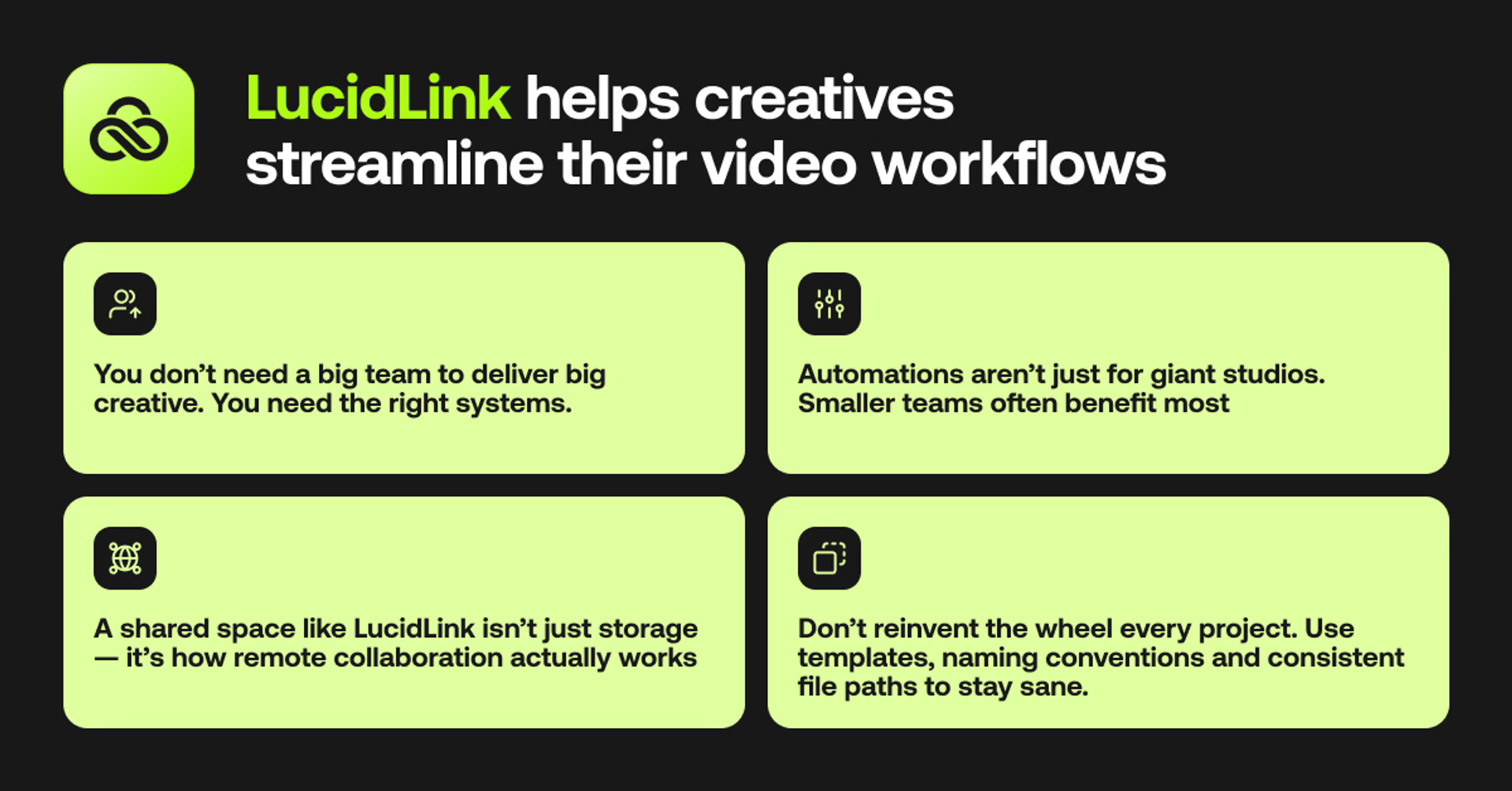
If you work in post (or any tech for that matter), Sandwich’s approach proves a few simple truths:
Ready to see it in action?
Want to dive deeper into Sandwich's workflow philosophy and see their automation tools in action?
Watch the full Magic Hour conversation where Zach and Dan walk through their setup, share more automation examples and answer questions from the creative community.
Keep reading
Collaboration
In the field
Madecraft’s post-production hacks for smooth workflows
Discover how Madecraft slashes hidden costs of post-production, boosting efficiency, saving time and keeping creativity flowing.
21 November 2025, 6 mins read

Creative production
In the field
How post houses are integrating AI into modern workflows
Discover how post houses are using AI to streamline workflows, save time and boost creativity with real-world examples and practical insights.
23 October 2025, 5 mins read

In the field
Collaboration
How The Finish Line reclaims time to make work-life balance a reality
Discover how The Finish Line uses cloud workflows to support remote post-production, creative collaboration and make every second count.
10 April 2025, 6 mins read
Join our newsletter
Get all our latest news and creative tips
Want the details? Read our Privacy Policy. Not loving our emails?
Unsubscribe anytime or drop us a note at support@lucidlink.com.