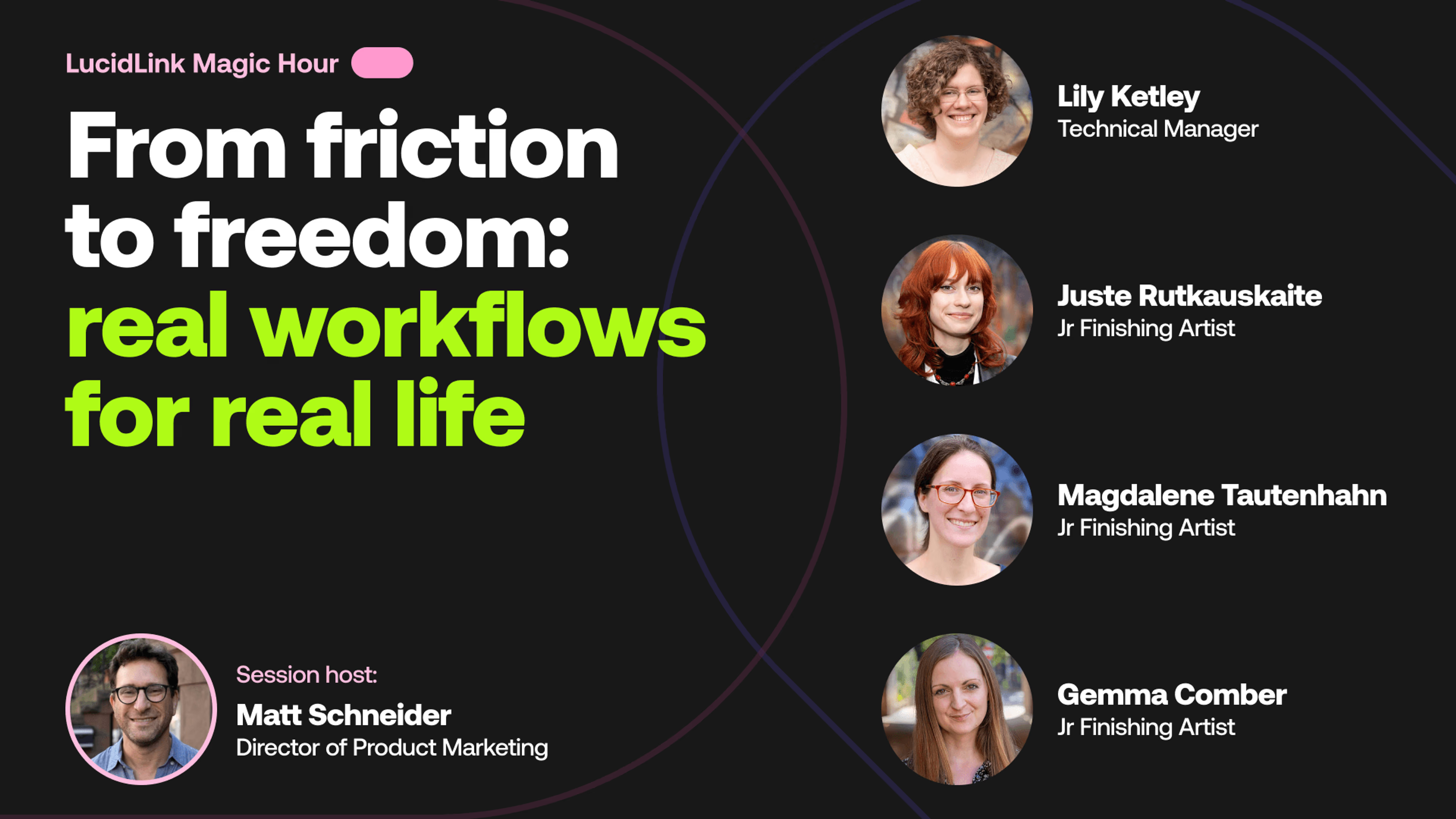
thank you for joining us, everyone. My name is Matt Schneider. I am product marketing for LucidLink.
I'm based in Brooklyn, New York. I'm joined by my colleague, Marcy Walker in Denver, Colorado, who is our community manager here in the US, and a fantastic team from the finish line, in London, UK. I'm gonna breeze through a few quick slides. And then as quickly as I can, I'm gonna turn over the baton to our amazing guests, and we're gonna dig into our conversation.
So welcome to Magic Hour. If this is your first time attending Magic Hour, you may be wondering, what is magic hour? Well, magic hour is our LucidLink live event series presented by LucidLink.
We want this to be a learning experience, typically, that focuses on artists and tools and their workflows.
Our sessions can really be about anything. It can be about artists and their and their workflows and workflow experts. We invite thought leaders, technologists, all kinds of people throughout the industry. What we're looking for in magic hour is people who are passionate about what they do and how they do it, and they're interested in coming on to magic hour and sharing what they know and what they care about.
That's really what magic hour is all about. So if you are in the industry and you would like to join us in magic hour, please consider yourself invited as a cohost. You don't even have to be a customer. We're always happy to hear about what people are working on today.
Now if you're new to LucidLink, you may not know what we are. So a quick word on what LucidLink is. LucidLink is the storage collaboration platform.
We are cloud storage for media and entertainment workflows. You store your heavy media files in the cloud, but it looks like a regular hard drive on your desktop and performs like a regular hard drive on your desktop. And this empowers real time collaboration for teammates no matter where they are. It provides instant access to shared files no matter where you are, and it does this safely and securely.
So that's LucidLink. If you are interested in trying LucidLink, you can certainly go to lucidlink dot com. We have a a free thirty day trial, and would love to hear what you think. So now to our guests, I'm joined by Lily, Juste, Magda, and Gemma, who work for The Finish Line.
I'll say a quick few things about The Finish Line, and then I'm gonna turn it over to our team. They are based in London.
I also come from a post production background. I also worked for a finishing facility here in New York City. So I know these workflows pretty well, and that's why I'm so excited to have these folks here. Here's a quick, a few quick photos of their beautiful facility, and Zeb, their founder. And he has very kindly, shared his team to join us here, at Magic Hour.
I think we lost you stay. Okay.
She's reached back.
She's come back. Fantastic.
Also very much on theme today, we're gonna be talking about work life balance and how we all find ways, to manage our personal lives, our families, and work in a very intense and busy post production, life. And to that effect, the finish line has won the best places to work in TV three years in a row, twenty twenty three, twenty twenty four, and most recently in twenty twenty five. So they must be doing something right when it comes to work life balance. So I and I'm someone who struggles with work life balance, so I'm really excited and eager to hear, what these folks have to say about how they have found work life balance, working in the busy field of postproduction.
So on that note, I'm gonna stop sharing my screen. I'm gonna kick off the conversation with Lily. Would you mind telling us telling us a little bit about the finish line and then a little bit about what you do as the technical manager?
Yeah. Of course. So, we're at the finish line. We're a post house specializing in online grading QC and delivery.
One of the key things about our business model is that we are distributed. So we have a central hub in London. However, almost everyone is either remote or hybrid, which is obviously a massive challenge if you are dealing with media flying around the country. You have to have something in place that makes that manageable.
We focus on trying to put as much of our money into the talent and the tools that we have available rather than into unnecessary office infrastructure.
So that is part of the reason why we have a hub in London, but everyone can be working from the comfort of their own homes without needing to always be in an office space.
As you mean as you mentioned before, we do come from an industry that is notorious for overworking, long hours, unhealthy work practices.
And at our company, we're very much committed to making sure that does not happen to our staff because if you are constantly overworked and you're constantly feeling pressured by the amount of work, you're not gonna get as much done, and it is not healthy for your mental well-being.
So we're committed to putting things in place that make that easier for people so that they do have time to, you know, spend with friends, with families, with loved ones, like, especially for those who have children as well, which quite a lot of people do. We don't obviously want to be taking up more of their time by saying, you know, commute into London, like, an additional couple of hours. And, anyway, I'm going off a lot. But, but, yes, so we've been we've been using LucidLink for about five years.
And as of twenty twenty five, Lucid is now our primary active storage location, which is kinda cool.
But, yeah, essentially, that means that we can work anywhere that has a network connection. So but, yeah.
As far as what I do, so I am a technical manager, which means I look after all of our computers, all of our anything to do with tech, basically. So all of our networks, all of our storage solutions, all of our computers, making sure everything's at the same, like, version level for everything.
Yeah. Anything admin, anything tech is very much my bag. So, yeah, that's me.
Fantastic. Now it wasn't always like this. You know, it wasn't that long ago that we were all pretty much still in still accustomed to and working in traditional brick and mortar facility workflows.
When it came time to transition, I'm sure you've been asked this question many times, but it's worth repeating, I think. What was that like? I, you know, I know what it was like for us when I worked in post. What was it like from a technical standpoint, and what was it like supporting creatives so that they could keep doing what they were doing when the time you know, when you realized, okay, I think the world is changing. We have to adjust.
Yeah.
Share us share with us a little bit about what that experience was both for technical and creative folks.
You see, Matt, that's a very interesting question because most traditional post houses were originally brick and mortar. However, one of the key things about Finish Line is that we've almost always been hybrid remote. So we have, yes, we have a a centralized hub, but very much from the start, the Finish Line was about, let's get suites into people's homes and develop workflows where people can be distributed without the need for them to be in the offices. So, for example, when COVID hit and everything went into lockdown, not a huge amount changed because we were already remote. So we were already one step ahead in that regard. So we already had workflows in place. Most of our people were already distributed.
So it's interesting that you say how things changed for us because they didn't really change that much because we were already doing that stuff before all of this happened. But, I mean, I will talk at length about, how much stuff goes into making it workable because, obviously, there are many challenges that come with having people spread out all over the place.
But, yeah, I will I'm gonna leave that for a little bit later because I'm aware we've not done other introductions yet. I don't wanna start start going on. But, yes, we'll definitely come back to that, though.
Fantastic. Thank you. I wanna turn to Magda.
Could you introduce yourself and tell us where you where you are based? And then I wanna ask about what that's like.
My name is Magda. I'm based in Scotland. I'm a finishing assistant transitioning into a finishing artist's role with The Finish Line. I've been with The Finish Line, just over six years now. I haven't looked back to the other companies I've been, really.
And I moved up to Scotland about two years ago, which was a big transition for my family, also work wise. But I was remote before, like Lily said, because since COVID, we were completely remote even though I was living in London at the time. And then we thought, well, we're being remote anyway. Why not move that step further just to make it work for the family and maybe even branch out, find other avenues in the industry?
So, yeah, I've never looked back.
Fantastic. And as a creative person, somebody who's doing creative work all day, you are separate from the mothership. You're in Scotland. The mothership is in London. What does that mean for you creatively, technically?
Are there is there an aspect of the experience that you absolutely love or an aspect of the experience that really is not quite what you were used to before?
I absolutely love the collaboration. I think at the finish line, we're very tight knit. And because of how how the company works, how it's set up, how it's structured, and how our workflows work, everybody can jump onto a project. For example, one of the other finishing artists might say, oh, I've got a lot of blurring to you.
Can you just give me a hand? And I can literally just jump into the project. I've got everything there that I need to. Even collaborative projects, you can collaborate.
You can work in the same time. No. One does the grade. One does something else.
And I don't have to sync down all the media beforehand. I can literally just jump in, help out, and then jump out again. And the other person continues, and I jump on the next job. Before, there were workflows where you had to sync everything down, you know, sometimes terabytes of media just to be able to do it.
Whereas now you can literally just help others out. And you talk we we talk a lot. We talk through, Slack mainly and we literally just you're constantly in communication about all sorts of projects that are going on. And if you see something, oh, I might have some input into this one.
I can help you out there. And, yeah, instantaneously, you're there. You'd like to collaborate and to help.
So from that point of view, I don't really miss, miss out from the company life as it were. I fly down from time to time to see, you know, the team, which is lovely.
But apart from that, yeah, I don't feel like I'm completely removed or anything like that.
Just probably Do you think thank you for that.
Do you think collaboration has changed, or is collaboration really the same, perhaps wearing different clothes, for example? Is there an aspect of collaboration that you had to adjust to, or does it feel normal now?
It feels normal now. It's it has probably had to change a little bit, just because if everybody works on projects in the office, I'm very aware that they're cons you know, they might still be talking in between booths and in the office itself.
But because all our communication is on Slack, I can still jump in and say, oh, I know I know this. I've worked on this before. I can help you out there. So I think it's it's shifted slightly, but not a massive amount. No.
It's fascinating because we hear so many companies, especially large companies, not necessarily in our industry, but in all kinds of industries, are now mandating that people go back to the office. My wife, for example, her job is now mandating five days a week. So it's interesting that, ironically, film and television post production, which is probably one of the more complex professions in terms of the technical requirements, the equipment, and all that stuff, there is still a strong drumbeat to continue to work in this remote fashion.
My sense is that there must be a benefit. There must be a value in terms of things like work life balance that help keep it keep that flame alive despite some other pressures to send people back to the office.
Yeah. Absolutely. I mean, I'm a mother of two. My husband works also works in a different industry. He's being demanded to come back into the office, which puts a lot of pressure on, you know, the partner, basically.
So working at the finish line and working remotely has really opened up this opportunity to stay in the industry and believe so I can do what I love doing, and I can still progress within the industry and within my career. Whereas before, it was either find something else if you have to, you know, or live in London. So we made the move to to Scotland because for family. We've got family here. And, you know, with school holidays and illnesses and all that, you'd have to take a lot of days off of your working days to then look after the children. Whereas now being closer to family and actually having this, you can actually focus on your work when you're working and you have family helping you out, other friends, you have other possibilities, I'd say.
Being able to work work remotely and still have that family time. When I when I've when my son was born, my first son, I still remember I had to commute just over an hour into London. That's an hour each way. You know, running into London, I felt like I was not really present at work, and I was not really present at home. I felt like I was not a good parent, and I wasn't really a good, employee either. Whereas now I think I can be completely present here because I'm not having to commute for an hour either end to do this.
And I can still collaborate and be with the team without, you know, sacrificing anything, really. And it's made such a huge difference.
I can totally relate to that feeling. I used to feel that way too where I felt like when I was at work, I was preoccupied by family needs. When I'm home, I felt preoccupied by what my work required.
And, you know, the commute that I used to have, which was not terrible, but it was still a commute and it still required this kind of split life. I really developed an appreciation for working at home in terms of finding that balance. I totally relate to that.
Yuste, I wanna turn to you. So you also work remotely from the finish line facility, but it's a little closer to the mothership, and perhaps for different reasons.
Could you talk a little bit about the work that you do, as a finishing artist, in a client location?
Yeah. Of course. So, hi. I'm Juste.
I'm also a finishing assistant slash I'm currently, transferring into a junior finishing artist position. I recently completed my first series as a colorist slash an online editor, which has been a super exciting opportunity, and super nerve wracking, of course.
But, yeah, I only very recently joined the finish line, actually. I've been in the finish line only for a year, and I came to this company from a very different company, a more, I guess, traditional company, which, sort of didn't have any remote working. It was all based in the office.
And, I had to work night shifts. I had to work weekends. So it was very much sort of grunt work down to the ground. And coming to the finish line was really eye opening, I guess.
I was really weirded out at first by how things worked and how everybody was remote and how just brief remote it was, which, which sort of it it was it was definitely a shock to the system, that's for sure. But now after being in this company for a year, this is just a new norm for me. And I guess now that I'm sort of transition transitioning into this, finishing artist role, essentially, I usually work in our HQ in Camden Town, in London. But whenever I do, for example, client reviews, I go to their facilities.
And now we've integrated the system where we use ListenLink, that connects our HQ to essentially the client site, which makes the whole collaboration and reviewing aspect seamless.
So for the specific series that I did and for the specific client, one of the things that we sort of had to do before the review day is we usually did, you know, our finishing work. And then we had to take out at least two hours of that time to then get all of the media on a drive. And then after that, you wanted to relink all your medias to that drive in your project, export that project, and then you take that drive physically with you to the client site.
And now, obviously, that's that was sort of a very strenuous activity. You had to make sure that you had the time to transfer all that media over, and it just took a lot of time. You know, it's hours that I could use whilst grading or onlining and sort of finessing the the product.
And, and then if you go to the client side, like, god forbid you missed a bit of media and now you have offline media, and you and the client are both staring at the computer being like, what what the hell is this?
With LucidLink, that's sort of been made completely seamless, and it was very funny, when I came to do my first review, and I didn't bring a drive. I opened the project, and the media was just all there mirroring what we have at our headquarters pretty much. So, obviously, the clients were also used to the old system of us having to bring a drive over and everything. And this just removed that bit of sort of nervousness from a technical standpoint, if that makes sense. Because I was already pretty nervous to do my first finishing job and having that lifted off with just knowing that the media is already there waiting for me, and I don't have to spend time faffing around with the drive really it was it was just like a weight of my shoulders, essentially. So it was a very pleasant surprise for both me and the client. But, yeah, this is how we're now sort of connected with the client side of things.
Thank you. I was actually gonna ask you exactly that. What was the client's reaction when you said, oh, no. No.
No. We don't have to here. I I saved this for a prop. Remember these? Okay.
I literally have this. I can't remember the last time I actually turned it on. I I literally have it on my desk as a prop to kind of remind us of the the old way of doing things.
Tell us more about what the reaction was when you said if you if you just use LucidLink, everything will be there. Was there doubt? Was there curiosity? Were there concerns about security? What was their what was your client's reaction? What was their journey when they realized, oh, wait a minute.
That sounds easier. Let's hear more about this.
I think I think it was definitely a bit of the doubt as you mentioned, because I think, of course, like, when a new workflow gets introduced, everybody can be a bit unsure. It's like they're waiting for proof that it's worked, and that and they feel like they're waiting for that moment. So I think both me and the clients were sort of, holding our breaths when we were opening the project. But as soon as everything sort of lit up and everything was online, it was both sort of relief and the sort of moments where, okay, this is now gonna be the very much more seamless than it used to be. So I think, it just introduced, like, a new layer of trust because we introduced this workflow for them, essentially. So they were thankful that we removed that one step that usually took a bit of time of the reviews, and now me and the client have more time to actually review the show, make changes, and make sure that we're delivering the best thing possible.
Do they have any concerns about things like security? Sometimes that's, you know, we talk about initial doubt or or curiosity, I suppose.
In terms of how it all works. Do they express any worries about that? Excuse me.
So, actually, no.
They were they were pretty clear. They knew that all data on LucidLink was encrypted because, obviously, it was all run past Lily, and Lily did all, did a whole introduction with them and sort of ran through how things work. And we use LucidLink with multiple clients now, so they kinda knew beforehand that's that this would be all encrypted and safe, and then no media would end up floating somewhere where it's not supposed to be.
So and what's also good is that, the way that we work with LucidLink on the client sites is that we have very specific read and write permissions.
So that allows us to know as well that our that the media that we upload in our headquarters, for example, won't go a miss if somebody on their side accidentally wants to scavenge through some folders, and no accidents happen. So, it's it was all pretty sort of tight, and that was the understanding between us and the client. So that's why it was, like, super seamless to implement in the first place.
Fantastic. Thank you, Juste.
Gemma, I wanna turn to you. So couple weeks ago in the broadcast tech, trade journal, you published a really beautiful, heartfelt article about what it means to be a single parent balancing a career in postproduction.
And I really appreciated the the spirit and the and the the energy of what was written there. Like I said, I I personally have also really struggled with work life balance to young kids.
I'm pretty passionate about post production, you know, in a way. It's a third child. And, I care deeply about both sides, and I know you do too. Can you talk about, talk a little bit about what you shared in that article and what how you kind of your own journey, I suppose, and how remote workflows has helped you balance family and a a career that you really care about.
Yeah.
So, basically, I've started out in post sixteen years ago, I think it was, and did the traditional route through post houses in London. I was a runner and went in some tape room, was an assistant and a QC op and worked my way up into online, which I really, really wanted to do. And as you do, I fell in love with post, and it's what I always wanted to do. And I couldn't imagine doing anything else.
And you sort of streamline yourself into quite a niche job role, really. I mean, there's transferable skills, but, you know, you're dealing with clients and stuff like that and managing expectations and budgets and all sorts of things. You know? You do have other skills, but it is quite niche.
And I sort of worked my way into online and became an online editor, and I was doing that for, I think, eight eight years before I started my family.
So that's sort of where I came from. I say online editor slash finishing artist because we refer to ourselves as finishing artists here.
Yeah. And then I decided to have a family as many of us do, and I had my first child and then tried to, go back into the industry and did a bit of freelancing. But at the time, I was married and he was working. So I I was trying to, like, navigate how I could freelance and have childcare set up, and it just wasn't really working.
So, obviously, I'd find, like, ad hoc childcare, and then the freelance pencils would move, and then the childcare can't move, and it just wasn't really mirroring up. So I thought, okay. I'm not quite sure how to do this, and I went away and actually set up a little side business. I'm almost like totally unrelated to postproduction.
And then I had my second baby. And at this point, I then became a single parent, and I thought, oh gosh. Well, now how am I gonna navigate this? This is even more tricky. I'm on my own now, and I've got the kids to look after.
And I looked at loads of different avenues. I spoke to various post facilities in London. I live an hour and a half outside of London, and I have one train an hour. I live in a quite a remote sort of part of a place called Essex. And, yeah. So it's tricky to get into London, and do that commute anyway.
And so I, yeah, I moved out here and didn't quite know what to do. So I spoke to some facilities and said, is there any way you could help me? Like, any remote working? And I everyone sort of looked a bit blankly like, oh, no. You know, London facilities, we do everything in house. That was kind of the wall I was met with, and I thought, okay.
I looked at job shares with a charity, but I hadn't really been set up yet, for our side of postproduction. Anyway, production was starting to do it with, you know, edit producer roles and stuff like that, but it hadn't really been done for our side. And then I spoke to a friend, and she said, well, have you spoken to Zeb? And I've known Zeb for donkey's years and a lot of the guys at the finish line. We used to work together a long time ago.
And I thought, okay. Yes. I should speak to Zeb. I knew Zeb worked with Resolve, and I hadn't used Resolve before. I was an avid person, and I was a bit intimidated by Resolve. And I thought, oh my gosh.
I'm gonna have to learn something new.
But I did it. I spoke to Zeb, and immediately, he was like, yes. This is brilliant. You know, you'll be fantastic here.
We can offer you remote working from home, exclusively remote, part time to suit you, hours that suit around your kids, you and your kids. You know, we'll make it work for you. And having you on board is gonna be really beneficial to us because you are are very experienced online editor, and you can come in, fulfill as a finishing assistant position. So I don't need to be in town with a client.
I can be at home. I can still do some remote finishing work, but I do lots of QCing and fixing and deliverables and stuff like that, client changes, legal notes, and all that kind of stuff.
And I can do it all from home now, which is amazing. And most importantly, be here for my kids. I have two very young children, one at nursery age, one, at reception age, like, just entering into school.
And, yeah, I can actually be here to pick them up and drop them off. I haven't got to sit on a commute, which feasibly I mean, it's not feasible with childcare hours. There weren't enough hours in a day at childcare facilities to actually allow me to go into London and back.
So I can do that, and I can be there for nativity plays and sports days and speak to the teacher in the morning and not have to rush to get a train. And, you know, I work with an amazing team who are really happy to facilitate as we do for each other, like, certain appointments and stuff like that. We will look after each other. So, yeah, it's made my work life balance it's been total change for me, being able to work remotely.
Fantastic. And it's amazing how now, today, it's not a compromise anymore. It's a benefit. I mean, I look at my calendar and I wonder how in the world did we do this before we had this kind of flexibility, regardless of technology. Like, every week and I, you know, for those of us who are parents and have young kids, every week there is a school event, a kid's home six, but it's February. Like, every every every kid is sick. My kids had the flu two weeks ago and just completely, you know, brought the household to its knees, including myself.
The the teacher appointments, the meetings, the discussions, how did we do it beforehand? I just don't know. And I'm it's so good that there are technologies like LucidLink that help make it a bit easier just to kind of balance a kind of a nutty schedule. It's really I appreciate it as an end user too.
Yeah.
You know, we got a great question in the, chat here.
And, Gemma, perhaps you could take this or anyone could take this. As a freelancer, how easy do you find it to adapt to workflow to work with different production teams, folder structures, touch points, DIT teams? What would you say are the key elements to include in a workflow?
I think it's a great question. Every job is different. Every client is different. Every client, as you as as you folks well know, has different requirements, organizational requirements.
What is that like considering that you're not necessarily in a brick and mortar facility? You are working in different locations. There is an adjustment client by client.
Maybe I ask all you guys this question, but, Gemma, I'm wondering if you could take that first.
Yeah. I mean, I think, it's important to stress that we, the good ladies in here anyway, aren't technically freelancers. We all work for the finish line of staff. And with that, we have really well in place workflows, basically, which we will use across all of our clients and all of our projects. And then we just adapt the little bits that we need for each client or project.
But as standard, we all work the same way. We all deliver communication in the same way, even so much so as the way we do our QC report. You know, they're very standardized, so they're easy to read. And, immediately, their post producers, the bookings team will know if we have any queries for the client, and they can take what they need.
So, yeah, everything's quite formulaic, but, obviously, we adapt it for our clients. And Slack is an amazing tool for that because we'll have channels for different projects and different clients, and then we can pin different parts of the chats which are really, really important. They'll reference that specific client. Like, they this client may prefer to have deliveries in a certain way.
They might want viewing files in a certain way to a different spec or something like that, and we can adjust, workflows in that way. And it's really quick and easy if I pick up a job that I've not worked on before because I'm part time, so I might not have worked on this certain program. I can quickly look at Slack, look at the channel, drop down the pins, go, okay. Well, let's get up to speed with this.
And everyone has kept me up to date, basically, of what this client wants and what they're expecting and how we might be doing things slightly differently from our sort of formulaic workflow.
Yeah. I think that's probably the best way to explain it.
Magda, how about you in terms of adjusting to the subtle differences from one client to another? You know, again, you may not be meeting the client in person. You might never meet the client in person depending on the circumstances and the deadlines and the time frames. What is that like working in a remote distributed way when you're really just starting a project with a new client that you haven't necessarily gotten familiar with, what is that adjustment like, especially since you're working in this distributed way?
We have a great team of post producers, and they literally know what questions to ask the clients and know what's, you know, how to liaise between them and us if need be, if we can't communicate with them ourselves, for example. So they know exactly what questions to ask and what to forward to us, basically. So we can literally get the workflow nailed, to get it as as best and as well laid out as possible. And then communication, like Gemma said, communication in the company is really critical, and I think it works really well, because we do talk to each other if if we've worked with the client before and they had certain needs, for example, or something that they wanted done in a particular way, we'll talk to each other and somebody might jump in and say, oh, you know what? I've worked with them before. They prefer this, for example.
So, yeah, communication is absolute key in in this kind of industry and with the collaboration we're doing. But I think with the finish line, it works so well because we've we've just done this and tested it and the workflows we've been through. We've been doing it for years. So it's yeah. I think that's the that's the key point.
Fantastic. Yeah. Communication is always key, and good thing that we have tools that that help promote that communication, especially in a distributed way. There's another question in the, in the chat here in the q and a panel, which I think is perfect for you, Lily.
Are post facilities using LucidLink as their only storage for all projects, or are you syncing LucidLink with an on prem NAS for backup or other highly available storage in case of a technical issue? That's a very good question. What kind of topology do you guys, build for? What are your strategies there from a technical, storage standpoint?
Yeah. That's a fantastic question, actually. So, we have an on prem NAS.
We're using TrueNAS at the moment. So that holds, about a hundred and thirty terabytes worth of media, so it's got pretty chunky scalability.
We have that as our sort of primary on-site, for storing everything.
But when a project is active, so it's currently happening and people need media, we use a syncing system that will sync, essentially a mirror copy of whatever is on the server to Lucid so that it's all accessible.
But in the event, I don't know, Lucid goes kaboom or something happens or so for example, our network goes down and all we have access to it, like, our Internet goes. And suddenly, we need access to the media, but, obviously, how do you do that if it's all on Lucid and it all requires a network connection? Well, we've still got everything on the server. So that is where we keep our primary copy of all the of all the projects that are both active and inactive and then it just we just sync the media up to lucid when it's active and then we remove it from lucid when it's not so we still have copies on the server And then with that, we then have redundancies in place. So we have a backup system that syncs overnight. So anything that's on the server then goes off to an off-site backup system, on an object matrix.
So we then have an additional copy in case anything happens.
But, yeah, we have a a we also have an sorry. I probably didn't explain this very well, but we also have an overnight sync that anything that gets added to Lucid then gets synced down to our server as well. So anything new to the server goes up and anything new to Lucid comes back down. So we have additional copies, of media should we need them. Yeah. I hope that answers that question without going off on a too much of a tangent.
We probably could talk for six hours about that very subject, but but that's an excellent summary.
Lily, actually, this next question is probably also good. This is for you and for for any of our guests. What do you guys use for planning, managing workflows, and tracking deliverables in asset, metadata? Does LucidLink integrate with it? That last question I can take. But in terms of the sort of the organizational layer, which is vital in post as I know you guys know, what do you guys do for that?
So we for project management, we use a system called Scoro. So it helps us sort of keep track of what tasks are needed for particular projects and who they're booked on, when they're booked on, how long we have for stuff.
For comms and communication, we use Slack. So we use Slack mainly because it is asynchronous. We can pop a message in, and people can respond to it when they have time rather than constant phone calls or, you know, trying to communicate over email, and things get lost in threads and stuff.
But for yeah. So managing workflows is mostly from a admin side, it's mostly going to be Scoro, for the booking. But from a data management system, we don't necessarily have anything concrete. It's more of just we look at a project on Skoro, see when it's active, and then I hit a button and media moves.
But that's just because we have those those systems and syncing systems set up already, which took a while to kind of iron out. But, like, the beauty of a good workflow is that once it's done, you don't have to do anything. It just does itself.
So, yeah. Does that does that answer your question?
I think it does. Thank you. I'm not familiar with Skoro, you Skoro, you said?
Skoro. Yes.
Oh, interesting. Okay. I'll have to is that an internal platform, or is that that's commercially available?
It's commercially available. Yeah.
Think of it like Interesting.
A business calendar coupled with project tracker. It's kind of the best way to put it. So we can kind of have so a project comes in. We add it as a project on Scorer.
We can add all the the details. You know, it this is delivering to this person. This is going this place. These are the specific tech requirements.
This is where all the the details exist. And then on that, we'll then start booking, like, tasks. So we can say, hey, this is a whatever project. It it will have these ten things that need to be done for it straight off the bat.
Add that as a task bundle. They get assigned to someone, and then we can see everything in the calendars, specifically for that project. So it's very useful for being able to group stuff by projects. You can look at it and immediately go, this is everything that's happened for this project.
This is everything that still needs to be done.
And, yeah, that's what's going on.
Fantastic.
I have one more question I wanna ask, but there's another good question, I'm gonna throw, in your direction, Yusei.
This person is a colorist as well and wondering if you ever work with the source camera files, raw camera files, some of which can be quite large, the codecs can be quite computationally heavy.
And if you do work with raw camera files, what is your workflow as it relates to LucidLink? Are you pinning everything? Are you playing everything direct, without pinning?
Or are you working with, as some people call it, mezzanine files, which are mastering quality but not necessarily the the heavy, raw files? What's the typical workflow there? I'm asking you, you say, in particular, because you very often go to a client location, and who knows if they have the right infrastructure or or local storage for that kind of thing. What's your preferred workflow there?
So that's a really great question.
When I go to review with the clients, usually, our sort of workflow is always to make a mezzanine file, so a mixed down. Usually, our preferred mezzanine codec is DNxHR HQX.
So whenever I do a review and I'm finished with my sequence, I usually just export that mix down, and then I leave it syncing overnight by Lucid. And we always tell the clients to remember to pin, the sort of episode folders on LucidLink, so they already have that in place.
So when I come to review, the mezzanine file is there. That's cached and ready to go. And, essentially, what I do then is I open up my project. I pop that mezzanine file on top or, usually, it's already there.
And then we do a review. And every single time I want to make a change, I just cut through the mezzanine and do my change on the shots below. And that's just really helpful because number one, playback is so much easier. And when you go to client facilities, you can be greeted with you never know what kind of system, and it just brings you that bit of trust that you will actually be able to review the episode you worked on.
And secondly, it's then, much easier to export another MES file after you finish your review because, we work in Resolve, and Resolve has this really, really good, sort of option to tick in the deliver tab, which is, bypass reencode, which means that if Resolve detects the same codec, it will fly through the export. So if you have big chunks of that MES file already on your sequence, that export will just sort of whiz through and that makes it much easier because, when we do QCs, we also QC the mess files and not the raw media.
Another thing when I'm working with just when I'm actually finishing the episode, doing the grade and the online, I think what's really important is the way that the sequence has been prepped, if that makes sense. So, for the series that I've been working on, the wonderful Lily has actually been doing the conforms and the consolidations.
So, actually, a really good example is that before we sort of introduced, the LucidLink workflow properly, The client would use to send us one terabyte worth of media for each of the episodes that we did, and these were forty five minute episodes, and one terabyte of media is quite it's quite chunky. So it takes a while to sync. It takes a while to load because, obviously, your project is just populated with these, like, three hour interviews because the clients would not trim the media.
And now we sort of had a really good conversation with them where we ironed out a workflow where they do start trimming the media, and then the episode goes from one terabyte to eighty gigabytes, which is an incredible difference. So imagine syncing one terabyte versus syncing eighty gigabytes, and imagine having that difference within your project. So I think how to manage that sort of really huge media is probably the best way is to just work with trimmed media if you're able to, whether you consolidate it or you transcode it.
But I think that sort of the workflow for reviewing, mix downs are great. And when you're just working on a system grading, I think just having the sequence prepped in the most optimal way is sort of the best and also remembering to pin the episode that you're working on. So whenever I'm actually grading, I will ensure that the night before I'm supposed to grade on it, I will always unpin everything and just pin that episode. So my cache is sort of clear, and I can just work in that way. I hope that sort of answers the question.
It sure does. And I have a feature request for our friends at Blackmagic Design, a pinning panel inside Resolve, just like what we have for Adobe Premiere Pro and After Effects. We have a LucidLink panel, which brings the pinning functionality directly in the application. So it's only pinning what's in the timeline.
Mhmm.
Think of it like if pinning and conform had a baby, that's what it would be.
And, we don't have that for Resolve.
Would love to have that for Resolve. So for anybody who's in touch with, our friends at Blackmagic, you can drop that hint that we would like some kind of in app pinning capability for Resolve, because Resolve is such a powerful and ubiquitous tool. Man, what a what a sweet workflow that would be.
The resolve so you stay. Thank you for that answer. I really love the, the trimming tools in resolve are quite powerful. We use that a lot in post when I when I worked in post.
And, it really it will take terabytes and wean it down to a manageable amount of media without recompressing the codec, which is Yep. Amazing. Amazing. Yep.
That's great.
From a quality standpoint and from a media management standpoint, it's such a it's such a win.
I wanna ask a question of all of you.
What's with respect to either work life balance and managing our our personal lives and our work lives, or just in general, what's still missing in these workflows? Whether it's directly related to LucidLink or not, you know, maybe something about LucidLink that you'd like to see or not related to LucidLink, something that has nothing to do with LucidLink. What still needs improvement from your creative and technical perspective in the workflows that you do every day?
Will I go first?
Please. Please go ahead.
Admins are always going to need more control, I think. The more granular we are able to get, the better, the more like, I mean, let's take one tiny little thing. So permissions, for example. If you've got a LucidLink Filespace and you've got multiple clients worth of projects on there, obviously, with Lucid at the moment, we can create a user and we can say, hey, this this subfolder that can be however many folder levels deep, I just want this per this user to have just read access just to that folder.
They can't delete anything. They can't see anything else that's on there. That is fantastic, and that is an example of it going in the right direction. So being able to, as an admin, have granular control of everything is fantastic, but it swings the other way in the sense that admins need more control.
Users need to see less stuff. So the more simple it is for them I mean, I was discussing this with someone else the other day. Version, three of Lucid, You guys have removed your need for the kernel extensions, which is fantastic.
So before with version two, which is which is the one we're currently on, for reasons, we we basically will just say to a client, hey. This is the link to the installer. Install, approve, kernel extension, off you go. And then they just enter the details, and they have a access to a folder that we've set up, and they can upload stuff to us through that.
But with, obviously, version three, they don't have to do the kernel extensions. They just here's a link to the installer, install, done. Like, job done. It little things like that to improve user experience without them having to do things and then extra steps, that I think is is where it's heading in the right direction.
So, yeah, admins need more control and more, tweakable things, but the users need to have a simpler experience. So that's the that's the vibes that I think we should be heading towards. But, yeah, I mean, it's it always improves. Everything's always improving.
Like, every workflow is always changing when we discover new tools or new little ways to make things better for not only us as the admins who like the control, but also don't wanna over complicate it, and then as well for for everybody else. Yeah.
That's a tricky balance, isn't it?
Control and management blended with simplicity and access. You know, you never wanna overburden creatives or anybody for that matter with too many steps.
It's such a funny tension between management and control and simplicity and ease of use.
That tension will always be there, and it it it it's certainly a great motivator for tool creators like LucidLink to find that happy balance. Speaking of balance, Magda, what about you? Is there anything? You're in Scotland? Is there anything about your life, your work, your workflow that still needs some improvement, whether it's in LucidLink or some other tool or platform?
I mean, if it's in terms of LucidLink, I think I wish you added something like how long something is to left pin. You know? Oh. Folder, for example, of, let's say, eighty gigabytes or something. I've got lots of subfolders, graphics, options, and you name it.
Just to say, give me an ETA roughly of what's been been done already, especially with all the folder structures. No. You can obviously see what's being pinned.
But let's say, you know, give me a rough ETA. Okay. You are about fifty percent there or something.
But like I said, you don't miss necessarily need to pin it because it comes down anyway and it caches it and you've got it there. But sometimes if you got a very hefty project, it's quite useful to have a pin. Now if you make mess files to pin them beforehand and then see, okay, where am I?
Just make it a touch touch quicker, probably.
I agree. Lily. Sorry.
Just to jump in on that, actually. Sorry to interrupt.
So at the moment, Lucid's got, some really cool command line feature stuff. So one of the commands because we're on version two, just to clarify.
One of the cool things that you can do with the command line is that you can enter a command to see what is currently pinned, so it will tell you what folder.
And then you can also see, like, how much if you enter the cache command, you can also see, like, how much is cached currently and how much of your cache is still got available and how much is dedicated to the pin and etcetera.
And that's very cool. But things like that, so being able to see what you have pinned because our file space can get massive because we've got multiple clients' worth of work on things. Like, we've got love loads and loads and loads and loads and loads of levels of subfolders.
So it's very easy for someone to say, oh, I've got, like, a cache limit of, like, a terabyte, for example, because their external drive that they're pointing their cache to only has that space.
They could have, like, a terabyte worth of other stuff pinned and then be put on another project. They'd be like, why isn't this pinning? Like and then they have to go through all the folders and try and find the stuff. So that command line thing is fantastic.
This is a little sneak preview for the rest of my team.
We are writing a little Python script, which we'll sort of incorporate into our systems that they can just, like, click it like a little app that, they'll just be able to, like, double click it. It'll just run that script and just spit out that command's, response so they can just immediately see, like, what they have pinned without the need to go into, like, terminal and stuff. Because quite a lot of people don't like using terminal. They're scared of terminal.
Wow. So, what is the what is the output of the Python script? Is it in a web interface or in a doc or text?
Just a little text little window that pops up and it looks so, it's nothing fancy.
I think it's pretty cool.
But it's just little things like that. Like, being able to see that from within the Lucid user interface would be great.
But I think we were looking at, I think it was because we we've obviously done a lot of, like, development stuff with different tools and things. One of the tools we were looking at was, I think it was Suite, and they had, inside their user interface, they've got like, it will show you whatever you have pinned, and that was fantastic because you can see in there. But, again, we've got the, command line interface come on for that. So, yeah, soon soon, my friends, we will have another thing. But that's just until, like, if if Bluetooth does make that available and does have, like, being able to see what you have pinned available from the user interface, that would be great, and I could throw my Python script out the window.
But, yeah, otherwise, that's a very useful thing to be able to see, especially when you have a lot of subfolders, which we do because everything's very heavily organized.
Which is good. Pin management is maybe one of the most frequent things we hear about.
Love that. My personal feature request for LucidLink is along the line along these lines. I was thinking of it, while you state you were talking about your workflow, remote pinning. So I'm Lily in London. I'm gonna pin something for Magda, you know, and it will be ready for her when she wakes up in the morning and, you know, pin on her local machine, but I'm doing it remotely in London. That's a future request I have maybe one day.
Gemma, before we run out of time, Gemma, you stay.
What would you like to see in the workflow whether it's LucidLink specific or not LucidLink related?
I don't know if there's much I can add, to be honest. In terms of workflow, I feel in terms of my setup when I come in, and start working with Lucid, it's it's all ready to go and ready to go. I think what the what the suggestion you've just made would be amazing because there are instances where, for example, if you stays doing it online, and up on a Monday, I don't work on a Monday. So I I come in on a Tuesday to do the QC.
You stay inferior. She kicks off a mezzanine file overnight. Could pin that for me. That would be amazing.
I'd go I preempt it by pinning the folder if it's already made. But, yeah, that would be fantastic. That's a really good idea for future.
Yeah. I would love that. Yeah. Yuste, what about what about you? What what what's the feature request? What can we for you?
I mean, I don't know. To be fair, I do think that the remote pinning would be great because then we would not have to email the clients every time saying, could you please make sure that the folder's pinned because then we know that it's pinned.
But I don't know. I think, I think for my workflows, it's all pretty much there. Obviously, I do benefit from the fact that I am London based, and I am around I'm around here.
But I think in general, I think it would just be sort of a great thing if people were more open to trying out new workflows maybe as a general note, because I feel like I'm quite junior to this industry, but a lot of people, they sort of are always sticking to one thing because they think that it's an industry standard.
And I think opening up to, you know, all of this lovely new tech that we're getting and opening up to new solutions that might make your life be much easier, would be just great in general. So that's why it was so nice when we can we started integrating Lucid with our clients, and they made the review so much easier. So this isn't really application or workflow based, but just, like, as a general note, it would be nice to see more people sort of joining, into sort of appreciating how much growth and development there is in the industry and that we should just be open armed to it, essentially.
I love the spirit of that. And in many respects, that's our responsibility at Lizard Link is to help educate what the possibilities are. Very often people don't even know there's a better way of doing things. They may they stick to the old way, not for some masochistic reason. They just don't know that there's a better way of doing things. So we LucidLink, part of our mission is educating customers and prospects and anybody in this great industry. There's another way to do this.
We have a few more minutes. I believe my colleague Marcy wanted to do a poll for all of our guests. And, Marcy, do you wanna take that away?
I would love to.
And thank you for remembering we had a conversation before this.
I I do have one last question for you all, though, for everyone watching.
The finish line sounds so idyllic as a team, and the workflows you set up have obviously been literally life changing. For anyone who's listening and thinking, hey. I want my team to be like that. Do you have any advice on how to make a case for having a more flexible workflow or work life, I guess?
I think from, like, my perspective, anyone who is in a similar position to me or just wants a better work life balance or they can't they physically can't continue their career without this to just speak to your management or the people that, you know, have the power to make the change and show them lucid and say, like, it can be done because I was told it couldn't be done until I spoke to Zed who was doing it. And it can be done and people can change their life and not have to leave the careers I spent decades building because they their lives changed unpredictably. And, yeah, they something like Lucy can actually give you give you a a way of life, and you can still be there for your families or have your mental health days that you need, all the time and the hobbies that you want to have instead of sitting on tubes and trains and and stuck for hours with train delays.
And when your kids are off sick, you can be there at home. Just pitch that. And there's there's also so many benefits to the companies as well. Like, for example, when my children are sick, but they're not sick, sick, sick, I have them at home, and I can still work instead of going, I'm sorry, guys.
In London, I can't come to work today because my kids too ill. The cup school won't take them. You know, there's always balancing that sort of thing. So, actually, I I feel like I'm more present for my job now than I would have been if I was in London.
I'm much more available, and it works for everyone. I can be there for everyone, and I'm much happier.
So, yes, I'd say for everyone to go and pitch it to the powers that be and say it can be done.
Love it.
That was a great one to end on.
So I'll stop it there. Matt, thank you so much for leading this conversation. That was fantastic. And to Magda and Lily and Yusei and Gemma, thank you so much for being here.
And Matt was right. I would like to hear from you all. So I wanna make sure that this is a great use of your time, and we kind of understand what we can do better in the future too.
So if as you're leaving, you don't mind, giving us a few words about your experience today and what topics you would wanna see in the future from LucidLink, that would be hugely helpful for us.
But other than that, I think we're I think we're done for the day unless you wanna say anything else, Matt.
Yeah. I will, say first and foremost, thank you to Magda, Lily, Eustay, and Gemma, and Zeb, and the finish line.
Delighted you could join us. Love the perspective. Love the spirit of what we're talking about in terms of work life balance and how we get time back in our lives with the help of technology, with the help of LucidLink.
And really so grateful. I'm as I've said, I'm a postproduction dog at heart. I've been in post for thirty years, and I love geeking out with this stuff, with folks like yourself. Thank you so much for joining us. I'm so delighted everybody, all of our participants could listen it into these incredible professionals. And, I'm overdue for a trip to London. I gotta come see you guys and come see Zeb.
Would love that. So, Magda, Lily, Youse, Gemma, thank you again. Any final words from from your team?
No. Thank you so much for having us. It's been so nice to actually share our experience with, you know, any out there.
Just spread the word. Okay.
Wonderful.
Thank you again everyone for joining. Thanks to the finish line, and thank you, Lily, Magda, Yuste, and Gemma, and Marcy.
Alright. Have everybody stay healthy. I know it's middle of winter.
Keep those kids healthy if possible. And, thank you again. Enjoy life in post and finding work life balance, and thank you for joining us on magic hour for LucidLink. Thanks, everyone.
Thank you. Bye.
Thank you, everyone.
Bye.
Bye.
February 11th, 8am PT / 11am ET / 4pm GMT
Join us for another session of LucidLink's Magic Hour, featuring the oh-so-talented post-production team from London’s The Finish Line.
At The Finish Line, work-life balance isn’t just a nice idea — it’s built into how they work. This mindset has not only shaped the tools and workflows they use; it’s been key to their success.
We’ll explore how they’ve embraced the freedom to work how, where and when they want, without ever compromising on quality.
Here’s what you’ll learn:
How The Finish Line built efficient, flexible workflows without compromising quality
Real-world insights and use cases from a team that’s made hybrid workflows actually work
Recommendations for easy-to-implement tools you can use today
Answers to the questions that matter most to you during a live Q&A
Whether you’re a creative or someone supporting a creative team, this session will give you actionable ways to elevate your production workflows!