Well, welcome everybody, and thank you for joining. This is LucidLink Magic Hour.
I'm Matt Schneider, product marketing, joined by my colleague, Marcy Walker, also of the marketing team, and delighted to welcome, Peter and Michael Chione from Strata.
If you have never joined LucidLink Magic Hour before, quick note on what Magic Hour is. It's a live event series presented by LucidLink, and we want this to be a learning experience focusing on artists, tools, workflows, technologies. We like to bring people on the show and talk about have them talk about whatever they care about the most, whatever they are passionate about. And the sessions sessions can feature guest artists, workflow experts, thought leaders, technologists, artists of any kind, telling their story and sharing what they really care about, the kind of work that they do, and perhaps most importantly, the challenges that they've had to overcome to get to the points where they are. If you're not familiar with LucidLink, I can give you a quick snapshot on who we are.
We are a storage collaboration platform.
You put your heavy media in the cloud, but we present like a conventional hard drive. And more importantly, we try to perform like a regular hard drive. That provides real time collaboration for creative workflows anywhere in the world no matter where you are.
We provide instant access to shared files. As colleague of ours likes to say, once it's uploaded into LucidLink, it's already it's already everywhere, and you don't have to download your data or synchronize from point a to point b, just to expand and scale or shrink your team. And we do this safely and securely.
Of course, next week is the start of or next week, and I should say, is the start of NAB. If you're gonna be in Las Vegas, please come see us. We're at booth, South Lobby twenty seven zero five. And our guests from Strada, they are also gonna be there, not far, also in the south lobby, south lower in booth forty eight zero seven.
Alright. So let's jump into what we're here to talk about. I am delighted to welcome these guys, Michael Chione and Peter Chione. I've known these guys for quite a while.
Been a bit of a fanboy, to be totally honest. Really admire the work that they do, and very excited that they can tell their story. And speaking of stories, I really want these guys to start with their journey in post production. I'm a post production guy.
I've worked in post almost thirty years, and I love hearing these guys talk about their journey. And they're gonna talk about their journey starting from here, all the way to here, when they kicked off Strata, all the way to here, their platform, Strata, which was released, keep me honest, guys, here back in December, I believe. And, you will certainly be at NAB, showing what's latest and newest with the Strata platform.
So I think my job is done here. The exciting stuff is to come. I'm gonna turn it over to Michael and Peter Cione. Thank you guys for joining. I'm gonna stop sharing my screen, and the mic is all yours.
Well, we appreciate being here a lot. And, I think what we wanna get out of this is make sure that we provide information that is useful to everyone paying attention, both in terms of war stories, which are fun to kinda go back and see what we've learned, but also in future projections about where we're going and how we can remain excited and engaged in the technological story. My story starts at eighteen years old. I went to Southern Illinois University, and that photo you had for me from a hundred years ago is me at PBS, WSIU PBS. And that's where I became a workaholic, And I started learning postproduction and workflow through a a switchers. That was a Grass Valley two hundred dash two ME switcher.
I started learning on Ampex and learning how to run a VP nine, one inch machine, and, and and just standard, you know, linear tape systems. But it was in college that and Pete and I are only a couple years apart.
He's at Princeton.
I'm at Southern Illinois University. And, essentially, what happens in the year two thousand is FireWire, DV cam, Final Cut Pro, and the Sony p d one fifty all come out basically at the same time.
And this put me watching all this, you know, pretty good resources at a PBS station. I was like, all of this stuff is uninteresting and antiquated, like, instantly lost its interest. In my the film school I went to at Southern Illinois University, all my friends and I just jumped into taking our student loans and family donations, and we just built our own studio with the p d one fifty, dvCam, FireWire, and Final Cut in a g four. And together, we, we're able to build that and start a business in LA.
We actually dropped out of school, came to LA, and then Pete sunk up with me at the end of that business, which was called Plaster City Digital Post, which was all about switching from videotape to file based workflow. And then Pete joined me, right around the end of that. Yeah. So I'm a successful graduate of, Princeton Film School.
That is a joke. They have no film school.
And, really, my foray into postproduction was was, following my brother out here to LA back in two thousand eight.
I graduated. I worked in finance in New York, and, I was fortunate that, because I, had the job I had, I felt like I knew everything about business even though I knew very little. And so Michael would call me periodically and ask questions about how to run a business and finance and spreadsheets and p and l statements. And so I put my hat on and said, oh, I can help you with that. And so, it was really during the, the, the recession of two thousand eight, the the mortgage meltdown, all that stuff.
I decided to leave my job and actually come out to LA to be an entrepreneur and and try to, at the time, help Michael, acquire a business that he was working at at the time, Plaster City, that didn't go as we had planned. So when you miss out on the opportunity to buy, you instead build. And so that's what we did. So in summer of two thousand nine, we started the company Light Iron with a few of our friends and colleagues and got that off the ground. And so that was really, my my first exposure to postproduction was really through this, like, osmosis process of watching talent, work on these machines, build machine rooms, the colorist. And so I have never been behind a color correction panel.
I play one on TV, but, it's really been, my contribution has been on the, understanding the technology and the art and the science, figure out how do we build a business around really disruptive technology.
Now here's a great lesson that ties into NAB really well, and I think LucidLink makes this really true.
When if you are starting out or you are thinking about reinventing or rebuilding and looking at the entrepreneurial approach to business in, being a creative professional.
See, one thing that happened when we started Light Iron, we were always at NAB, and the years we put into NAB allowed us to establish firm, strong, direct relationships with the manufacturers.
And this is a true story. And it's because of those manufacturer relationships that we cultivated in person that when we started Light Iron, we literally called CEOs of companies and said, we need your help. We'll and and one company that doesn't exist anymore that was called Quantel, and they were building, like, the best high end color correction machines twenty years ago.
The CEO, Ray Cross, said, the a Quantel that we wanted was five wasn't it five hundred and thirty five thousand dollars.
Five hundred and thirty five thousand dollars. Okay. I only had about thirty five thousand dollars of personal savings to my name, So we had a huge delta. Right? I call Ray Cross, who I'd met many times, and we had previously been part of build buying those products at our previous business, but now we needed our own. We said, Ray, what can you do? And he says, we are not a finance company.
And because it was a recession, we went to every bank.
Didn't go well.
They did they turned us down.
And even one bank we walked into, they said, hey. I know you guys. I've seen you guys on YouTube.
Oh, can you help us? No. No. No. We can't. But they they knew us.
And Ray Cross says, we're not a finance company, but we're gonna do it anyway. And they sold us. They said, here's what you're gonna do. You're gonna pay the list price for this thing, five thirty five, but I'll give you four years to pay it off.
Quantel essentially spun up a side finance program for us, and we ended up subsequently probably buying eight or ten of them over the years.
After that.
You know?
Yeah.
And it was wonderful, and it really exploded our business. But that is you know, people always say, why do you go to NAB? You can just read about it all on the Internet. That story I just told you changed our entire trajectory of life, and there's nothing on the Internet that would help you do that. It's all about shaking hands and being able to establish a relationship. And we did that with Sandy Nasari at Melrose Mac.
We did that Jim Jannard?
Jim Jannard at Red. We just asked for favors. And because we had earned those favors on some level and people trusted us, they took a risk on us. And so if you are really thinking about starting over or building something new or reinventing or just growing your business, NAB is where so many of the seeds have to be planted because you can't do it by yourself.
Even if people say, I'm willing to work really, really hard. That's good. You need that. But you need help, and you need it from resources that exist.
When we started Strata, two years ago, we called you, Matt, and Clayton Dutton, who used to work with me at Frame. Io and said, we need help. And you gave us an extended period of free LucidLink so we could start our YouTube channel. And so it's the exact same thing.
And, Matt, if anyone came to you and said, can you help me? You have but you what are you gonna say?
Sure. Of course. We wanna help you.
That's what we do. That's what good people do. It's like, most of the time, people forget it's really hard to ask for help. Right?
And when you ask for it, most of your community will say, sure. What what what do you need? And that's what we've pulled in there, and that really, really made a huge difference in starting Light Iron in two thousand nine. We couldn't have done it without the support of that community.
Community is key, and if COVID taught us anything, when we all went back to NAB that first year after the pandemic, it was such a a refresh of I forgot what it's like to actually have professional relationships and and maintain and and enjoy those relationships in person.
And I think, I really I think a lot of us really appreciate going the you know, the technology is ever changing. The pricing, of course, is quite different.
The barriers of entry are much lower, thankfully.
But, man, it's great to see people. So, hopefully, we're gonna see everybody at NAB next week.
Yeah. Yeah. We we love it. So, essentially, what happened in our story, which you can actually boil down some people say, what's the most interesting, sorta undertone of your career?
I I haven't really changed anything. Like, I'm doing the exact same thing I did twenty five years ago when I started at WSIU, and that was taking the latest technology and exploiting it to its bitter end to try to make, a new story possible. And I just love getting every single drop of juice out of the squeeze, and it and and that just really hasn't changed. Yes.
It was d b cam, FireWire, and p d one fifties, but then it turned into the f nine hundred, f nine fifty, Thompson Viper. And we went from a lacy drive or a g tech drive to, a SAN from SIPRICO.
Oh, there you go.
There's one. We started building SANs from SIPRICO, and this really great thing happened. Dan Restivo, who's a writer that some people may know, Dan covered, in magazines. He's written for a lot of magazines.
He does a story on our little start up, Plaster City. And there was a section in his magazine called The Hot House. And there were a lot of start ups in two thousand three around that time. And Dan wrote a story, and I get a call from this kid graduating from Full Sail University in Florida.
He says, my name is Steve Barris, and I am graduating. And I read the article about you, and I saw in the article that I had what I had said was, here's what I want to do. I want to start building sands. I wanna replace videotape machines, and I think I can make one sand replace ten VTRs at a, basically, a tenth the price.
And I can increase the quality and the speed and the turnaround. And Steve says, I can I can build that, and I wanna build it for you? He flies on a plane all the way to LA for one day, from Florida.
And when he leaves, my my the guy who sort of ran security in our building, his name was Ted.
He says he he I didn't remember saying this, but when Steve left, I turned to Ted apparently and said, I wish I could hire him, but I just can't afford it.
And I just kinda watched him walk away to a taxi. And, Ted had told me that story years later. I forgot.
Somehow, we made the money work because Steve was willing to also be an entrepreneur, and we built Plaster City up with SANS. And we started doing HD and files way before other people were doing it. And then Ian Vertivac, who I was in school with actually, we grew up with Ian. We're from the same town, Elmhurst, Illinois in West Chicago.
Ian was our colorist, and we all just started working and building this Apple centric DI color correction workflow at Plaster City. And then when we realized we couldn't own Plaster City, we had started Plaster City Digital Post, the post production division, but we didn't own it. And we wanted to so we had to start over, which was unfortunate, but fortunate. And, we started Light Iron in o nine, and that's where Pete and I bootstrapped this. We brought and our customers followed us to Light Iron, and we started continuing innovating. And we ended up in our first year working on Avatar. In our second year, we worked on we did the color crashing for the social network.
We did Pirates of the Caribbean four. We did Spider Man in our third year of operation, underworld movies, and and total recall.
And all of that was because when the market started to shift, and this is an important data point for people, we are all ready to change. Everybody hates change. But if you can lean into the uncomfortableness of change, if you get your hand called on to answer the questions on a tough test, you're like, wait. I I know these answers.
I know these answers. It's because we leaned into change that when cinematographers like John Schwartzman, who shot, like, Jurassic World and and, The Rock. Right? Like, this this guy's amazing.
When he shot I think he shot Pearl Harbor. Right? John Schwartzman now has to shoot Spider Man on three d.
He's now not able to use a a Panaflex Gold, which is what he's used to shooting on. He has to shoot on RED cameras because that was the only way to really do a three d rig that wasn't gonna break your back, could fit on the Libra head. So he ended up finding us through Jim Jenaard. Right? And Jim connected us with John, and now we're doing Spider Man somehow.
And and that just kinda snowballed working with Derek Walksy and doing, Pirates of the Caribbean, the first three d Pirates of the Caribbean movie. Then through Disney, we meet in Red, we meet Don Burgess who shot, like, he shot, like, like, a castaway and the Forrest Gump. Right? And now Don is switching to digital, and, he got hired to shoot the Muppet movies.
And the the Henson company was like, wait a minute. We don't do puppets on digital. They're like they they have a look on film, and is digital gonna work? And so we had to do all these camera tests.
And there we are standing next to, you know, Jim Henson's kid and Kermit. Yeah. And Kermit and and Don Burgess. And it's like, we're living in a cuckoo clock.
Like, this is a crazy life that we're living with with the Henson family, Muppets, and Burgess.
And, you know, Castaway is one of my favorite movies, and it's, like, it's incredible. Forrest Gump. You know?
And and what I love during this fray this period of time is this, like, great David and Goliath story, which, when you're at least for me, when you're a start up or you're an entrepreneur, you wanna have an enemy. You wanna have this barrier that you want to conquer. And so for us at the time, it was the incumbent vendors, the big behemoth players, the Technicolors, and the Deluxe's, who we have no shot at trying to outmaneuver these hundreds year old companies, literally. Literally.
And so for us, it was about how do you leverage technology? How do you approach the problem a different way in order to actually beat those competitors at their own game? So for me, it was who is the person we're trying to upend or or or or or or, overcome, and then how are we gonna do it? And we can't compete on number of locations.
We can't compete on the the the size of our colorist roster. We can't compete on the size of our SAN, the credit list. And so instead, it was about innovation. And, certainly, Michael talked about, you know, his focus on technological disruption and this idea of the empowerment, the enablement of these technologies, giving more capabilities to those who have less.
And so for me at the time, thinking about the strategic side or and and matching artistry with science and business, it's like, how do we take advantage of whether it's a Quantel system or a RED camera system, and and how how do we compete against these guys? And and so we carried that through, certainly, through the light iron days, but also, the same thing with with Strata today. It's it's giving more to those who have less.
This technology, they're all enablement technologies, And so it's putting pieces together, leveraging technology and innovation to allow content creators to more easily tell their story. So very much I echo what Michael said that we're doing the same thing over. It's it's all ice cream. It's just different flavors, and it just happens to be newer technologies today than they were twenty or twenty five years ago.
In the, incredible YouTube series that you guys publish, one of the things I really love the most and I always think about is, Michael, you talk about how important it is to try and tinker. And I think that's a great spirit. I do have to ask when you got started with something like the RED camera, and I remember those days too, When we like, we at Postworks in New York City, we would look at your articles online to see how do we do this RED thing. We have no idea what we're doing.
Here's some guy named Michael Chione. He seems to have figured it out. Did how much of a leap of faith was it really exploring these new kind of digital cinema camera systems? Did you have a strong sense that this was the way forward, this was the new way of doing things?
Or was this really just kind of a hail Mary? Maybe this will work, and maybe we will be rewarded in knowledge and client portfolio by embracing something different. What is that like in the it's always easy to say we had the spirit of innovation and it worked, but, like, in the trenches in the moment, it could be really tough.
Yeah.
That's a really, really great question, and so many just memories just, like, flooded through my head. I I just had PTSD.
Oh, I'm sorry. I'm sorry. No.
It's all good. The answer is it is not a hail Mary. It is will.
See, it is all about the you have to will things into existence.
And when you make the decision, which so many people pause, you I don't know if everyone in the world does maybe not know this story. But, a hundred and fifty years ago, this small group of people left Illinois where we're from, and they walked they wanted to go to San Francisco, and they were called the Donner Party. And the the story of this, and it's Donner Pass is a road up in the Sierra Mountains here in California where they rested, to cross the mountains, but that rest gave the weather time to close in, and most of them, didn't survive. And so it's an incredible story. Some survived.
But the reason, with the lesson that we learned from this is, like, it's not always healthy to wait for everything to be prepared, everything to be perfect. And I think a lot of us in business and in art and science and and and and production, we wait for all all the planets to align. We say things like that. Right?
It's like, don't wait. Act and will it into existence. Articles used to come out, and I won't say the name because the particular cinematographer that said what I'm about to say, is still alive. But they said, you'll never get a reputable DP to ever shoot on a RED camera.
And another one that is a Oscar winning decorated cinematographer said, I'll never shoot on digital ever. That person's Oscar was for digital film subsequently.
And the reason these are important things to think about is when those people switch to digital after having poo pooed it publicly for a long time, what'll often happen is they'll say, oh, well, this is different because this looks so good, and now it works really well. Now now now I get what you're after. I'll use it. And I'm just like, thanks for nothing.
See, when the times are hard, that's when we need people with the experience and the pop the deep pockets and the resources. But what often happens is it's left up to the entrepreneurs and the people who just will things into existence to do the work.
And if you're lucky like us and you do that, sometimes you catch some headwind there's some tailwind.
There's plenty of headwind, but you catch some tailwind, and then you're able to get ahead of the pack. And so while we were, a small business, we had people come to our facility all the time and say, this is it. This is light iron. I thought you guys were way bigger. And I'm like, keep thinking that. That sounds good.
And I think the other piece, to answer your question, Matt, is around the team that you have that can really fill in the gaps, from a knowledge perspective. I think so I'm a much more, I don't know, analytical person. So I think about very much Boolean logic.
And so it's like we have in the case of the red camera, we have this source that is true. We have this sliver of truth on the end that we can get this to work, and there's a couple pieces in between. So if this piece is true and we believe this piece is also true, we can figure out the the messy middle. And and so we can anchor to what we know is true, and we we'll work to figure out the gap versus just having a fully unknown future state. But it only works if you have a team of people with subject matter expertise that can help round out the vision, round out the belief, and really fill in the gaps of the unknown. I think not that I was with you in the red days, but, you need someone who understands color science. You need someone who understands video, video signals and compression in order to say this red camera concept CMOS compressed raw sensor can create beautiful images.
You need a lot of you need a smart team of people that are forward thinking but also collaborative in order to say, yeah. We can we can accomplish this.
And then you need to find the risk takers that are in the establishment.
Going back to red because war stories are fun, the very first one of the very first tests we did in two thousand six, I was on set with the DP Rodney Charter shooting the series twenty four, if we remember that. And they wanted to just test it out kind of, before they had started their next block of episodes. And it was just a test, and there we are with, like, Mary Lynn, Ryscub, and, on the set of twenty four, just testing some basic red camera shots and things like that. And then we go back to Plaster City and start analyzing it with Rodney Charters, the cinematographer, and Ted Shilowitz, who was bringing the camera to market.
All of that, that was two thousand six shooting four k on a CMOS sensor, but we knew something was happening. You can feel it in the air. And it's really important for people, that are listening to really understand a a couple of principles that we have. You mentioned one, Matt, which is talk and tinker.
We always sit at our table and just talk and tinker. And I think a lot of people, they just don't do it that way anymore. We don't whiteboard.
We don't whiteboard like the way people think. Our white I find whiteboards are way too restrictive because it's really hard to erase. And and and people's handwriting can be tricky, and you wanna move things around. So all our versions of whiteboards are keynote decks, and we just build these little pills on keynote decks and move them around and then build slides, slides, slide because there's different thoughts.
Like, oh, this doesn't belong here, it belongs here. You can't do that on a whiteboard. You can cover all this ground. Plus, you could save it and share it and change it, and then it becomes a deck that becomes a story.
And I in my career, I I I've made many, many thousands of keynote decks because it is my way of communicating with the world. I'm very, very right brained, and so I wanna make sure that I can see what's being spoken. And keynote is that, vehicle for me to do that. And so talking and tinkering is really critical, in being able to, take on these challenges and grow.
And then the other thing, like Pete said, the David and Goliath story, it is just it's really just about having that grit and willingness to, be in pain for a long time.
And I don't I actually don't you know, when we started Strata, we did I didn't wanna do it. My best friend, his name's Kyle, was telling me to do it. And it was in a conversation with Pete that I I didn't want to. And it was Pete's wife, that actually was like, you guys should do it again. And it it was only because of her that I felt quitting our jobs was a good idea because it's it's never a good idea.
And, it was really that Why didn't sorry to interrupt.
But why didn't you wanna do it? It seems like such the natural next step in your career knowing what I know about you guys and where you come from. Why didn't you wanna do it?
Just the pain. I I I have this would have been my third start up, and I just know I'm I'm older and everything hurts. And so, you know, it's just like everything hurts more. I bumped my knee, and I'm like, well, that's gonna hurt forever. So it's just like, I don't want that pain invited into my life again.
And it was only because of family and close friends pushing that saying take the whole risk and do it again because I knew we'd risk everything.
We were broke, starting light iron. I remember when my tires on my car were bald, and you could see, like, the metal stitching coming through. And I remember having to go to Pete and say, Pete, I need you to write me a check so I can get four new tires because I don't think they're safe to drive on. And he had to write me a check to buy tires for my car because I couldn't afford them. That's how desperate life can be and how vulnerable. And and and I know and I have a thousand stories of that experience.
And so inviting that into my life now in in my in my twenties, it feels different. In your forties, Pete's got children. Right? Like, it's a totally different animal, and I think that made us have more pause, maybe more Donner partying us, but Donna, Pete's wife, was encouraging in saying, no.
No. No. No. Don't wait. Don't rest. Don't play it safe. Go for it.
But I but just to jump in, I I don't think and, certainly, Michael's much more risk seeking than I am.
But I don't think he's an entrepreneur for entrepreneurship's sake. It's really about there's opportunity. There's a technology. It it should be introduced to the industry.
And if the environment in which he's in at the time is not the right mechanism to get that technology out, that's when you start again. So this was not about either of us itching to be our own bosses again because that's not the drive. It's really about, in this case, incubating whether it's AI technologies, cloud infrastructure, workflow automation.
Where's the best place and the best environment to create that technology and cultivate it. And it's you know, in many cases, in small bit small businesses are the only way to incubate really disruptive technologies.
And so, I was at Netflix at the time. Michael was at Adobe. And so we're we're reading about all these AI innovations. This is back in twenty twenty two, twenty three. We're here learning about Sora and ChatGPT and, Runway and MidJourney. And it's like, what do we do with there's a there's a there there.
And, we felt that this is technology that unlocks more workflow, more enablement. And so how do we bring that to the community?
And, it's possible that doing it on our own is probably the best way to get it out there.
It it's Strahd is not only a disruptive technology, it's a disruptive time.
And, I mean, just looking as somebody who watches your progress and cheers you on from afar, not afar, close by, hopefully, I really see it as such an outstanding tool for trends that we're all aware of. We may not sometimes we're aware of it instinctively, or and sometimes we're aware of it quite quite clearly. A lot of the stuff that you talked about at HPA.
Love the fact that you described this as willing something to work, and I see Strata as really the platform itself as being the the output of that.
Can we see a bit of strata now? Is is this a good time to transition to a demo? Because as I said in one of your videos, this is something that I actually needed in post production, like, fifteen years ago. And we You did?
We tried. We actually tried to build fifteen years ago at PostWorks New York. We didn't have nearly the same degree of sophistication. We certainly didn't have the same access to, the tools that are available now.
We also were a bit more risk averse, but there was a need. There was a clear need to provide automation to lessen or eliminate tedious tasks that consume extraordinary amounts of time and most importantly, human effort. A lot of steps in the in the post production process that people really don't want to do. You know, there's no vanity it.
You know, doing transcriptions with a pair of headphones, listening to something in real time, and typing in Microsoft Word, that's how we all did it, is not fun, and it's not glamorous. And here we are today with a platform like Strata. So can you share with us what Strata the platform is about and how it really represents the output of this, amazing talk and tinker culture that brought us to where you guys are brought you where you are today?
Sure. And and please help me with this. So what you're seeing at first right now is a product running in Chrome. And so we didn't build an app because we really believe the future of a lot of technology is web apps.
Right? And so we didn't wanna build a native application. So it's very, very friendly to be transparent and deliverable. And if we have an update, which we publish updates all the time, they're instant.
But we really are gonna start by showing you the daily's experience you all deserve because we just have not had a well built dailies experience because it's just been so limiting because it lacks AI. So the first thing we can see here is I have, a and b camera. So I can see that Strata can understand multicam, and it can sync automatically. This is the only product in the world that can sync multicam in the cloud via time code. So you could see a a camera, b camera, and audio. And if I were to hide the a camera, we would only see the b and vice versa, and we could play those back independently. But we can see them sunk together, and you can see these little icons we call stacks.
These represent, all the cameras, put together so you can see them in one playback. The next thing we can do is we do bulk actions.
In professional media, we don't do anything once. We do everything a minimum of fifty times. Right? And so when you hit transcribe, you could see Strada can transcribe six hundred and fifty eight clips in this film all at once.
So you don't have to submit, like, a traditional transcription system one at a time and pull down an SRT. We are doing it in bulk, and we staple the SRT to the file. So if I click, for searching for a word like grab a few extra things, that's a line of dialogue, it will automatically find all the takes that's that's found. I could go to the transcription, type the word grab.
It'll take me right there, and he will say the line.
Yeah. She just needs me to grab.
And I can as a director, I could just go to the next take, type the the words already there, go right to it, and now I can see the alternative angles of the exact same results. So wherever I go, if I need to find these other alternative lines, we have the ability to view that as well.
Me to, And, Michael, because this runs in a browser, no software installation needed at the endpoint on the on the producer's laptop.
Right? They log in, and they see this immediately.
That's right. And and so, that's one of the reasons that we've made it a a web native application is that it's available to authorize users anywhere in the world, and it we intend for it to be very easy to use. And, one of these important points about what we're demonstrating is we are this product is built on twenty five years of experience in the production and post industry, and I think that's really important here.
When it comes to serving creatives and serving storytellers and under and and building technologies that really solve pain points, the ability to solve those problems are directly correlated to how much experience you have Yep. Suffering from those problems. And so when we think about multi cam playback, auto, syncing, and and batch transcription, it's all derived from we suffered as owners of a post house. You suffered at post group, I'm sorry, PostWorks because this technology didn't exist.
And so it makes it a lot easier for us to orient the product, what it does, how it works. And Michael can show a little bit about even the the fact that we use the terminology bins in our product. It's because we understand, the pain points that people are suffering. And so, what Michael's demonstrating up here is really about this metadata enrichment so, that we're leveraging AI.
So the transcription is AI generated. The translations are AI generated. We also can do AI logging, AI tagging. Strata can read.
And so we're creating this really robust repository of metadata associated with your video assets so that no matter how you wanna search for something so, for example, in this, feature film, this independent film called rattled, there's actually a rat in the footage, And so you can search for it different ways. You can search for it by text because it's in the transcription.
So I typed in rat, and we could see right there, she says the line rat poison. So because I clicked the microphone, it's searching just for audio of the word rat.
But if I switch to the visual tags, it will now find physical pictures of rats because it knows what a rat looks like, so it can look for it in that sense. That's a a different example.
Or I can type the text, and it can actually find where a rat is actually visibly seen. And in this take, we can see there is a box that says rat poison on it. Here is a, an actual rat trap, and so it can see that. So Strata has these multiple triangular points of searching, which is how you, as a creative, think.
Sometimes you think of the line, the location, the person, the object, the the physical, thing they're talking about. The three environment. Yeah. Yep.
And so we can, turn them all on and combine all that, or we could even go old school, search for a slate using the metadata. So if I search for scene, twenty eight, it will pull all the scenes that are twenty eight. And we could see this says twenty eight Charlie two. I think this is a tail slate, but there it is, twenty eight Charlie.
If I search for scene fourteen, it'll take us to that scene we were in the the the space there, and we see scene fourteen. So we could search by slates, but we don't have to remember what day did we shoot that, what location was that.
Going back to the script or script notes or or even the camera reports, those are rendered effectively unnecessary because what actually happened is more valuable than an approximation. And so this metadata enrichment, streamlines the search and sort and finding. And I think another part, Matt, again, going back to our experience, there's this media that's being shot, and there's so many what we call stakeholders on the team that need access to this media. Certainly, it's the editor.
It's the director, the cinematographer, but also marketing departments, hair and makeup, wardrobe, legal. And so, one of the what we're trying to demonstrate is by having this triangular search, this really robust metadata associated with the files, it means anybody on the team, whoever needs access and is looking for it, there's a single platform, a single source of truth that helps them find what they're looking for in furtherance of the job that they have on the, entire production and postproduction team.
So here I started demonstrating facial recognition because we can search for characters and locations or combinations of characters where Flo and Rose appear together or Flo and Hansel appear together.
And so you can combine, people, locations, faces, even emotions where she's screaming. And it's like, where is Flo screaming? And we can even use that to determine, where she's actually screaming here. So it it understands, that she's, actually Audible sound.
Audible sounds as well. So it's like so many different ways to identify this, which is really cool. But one thing we just introduced that's really powerful, talking about pain points and things like that, is we've just added, let's see here. We've just added where would where were you doing notes, Pete?
Was it on this stuff, here?
So we just added commenting into the platform.
So, yeah, tell us what we're doing a little differently about it.
Yeah. So, certainly, commenting is a very common way for individuals to communicate their needs or wants or revisions to a rough cut. And so, for us, commenting was a big part of collaboration because this is a collaboration platform. But something that's very unique to Strata, and we just, released this last week, is that, most other products have global comments, meaning anyone who's approved on the team can see the comments.
We now have introduced direct messaging so that if you wanna provide a personal comment or a private comment to a specific member of the team, you now can provide direct comments. They're still time coded because you may wanna provide direct feedback to a specific person about a specific moment. So the time code accuracy is still there, but now you can provide comments that are not meant for everybody. It's meant for a sub select group.
And so we think that's really valuable so that all of this metadata is still associated with the file, but it's not actually being distributed via, like, Slack or iMessage. We're certainly not trying to replace Slack as an alternative because it's a really robust tool. But for those that just wanna provide, hey, Matt Schneider. I need you to look at this specific moment.
Now that's possible to do, which, we don't think exists in Or have the other tool.
Or just have a for some people on Teams that Slack is just too much that they need.
This allows them to integrate a sort of Slack light experience, where you can actually have conversations that are not comments. They're actual messages with people.
Quick question, guys, from the audience.
This is a good question. How is the system able to find results for flow or any character as you've demonstrated? How is it finding a particular character?
Yeah. I can do something really nuts here. Is it this one, or is it did I do it here? So this is pretty cool.
What we do is we are able to look at this little button right here. We could see this. I can select a whole bunch of takes, and I could say analyze for faces. And it will face detect all the the the takes.
When it face detects, it will now pull out automatically. Strada is unique in that this is the movie National Treasure. It automatically pulls the faces for you. All you do is go in double click and name the character.
And so a lot of times, you get a lot of characters. They're superficial you don't need. But, you just name the character. Once you name it once, you have it.
So in this, if I search for, Benjamin Gates, it'll find all those shots of Benjamin Gates, which is Nicolas Cage in this. If I said him with Abigail, it'll find Benjamin and Abigail together because it understands that's when they're physically together. Right? And so it finds those shots for us automatically.
It understands that together.
And this is, again, another great example of what we call utilitarian AI. So we're using an AI model that detects the faces.
We also have built a lot of technology that aggregates those individual faces to be what what ends up becoming Benjamin Gates.
And then all the user has to do is rename it. And and that AI training lives inside your workspace. It lives inside your account, which would mean any new file that gets introduced to the platform, that training already exists, and it'll just label that person, forever in perpetuity.
And this is totally automatic. You're seeing now I'm adding Ben, Abigail, and Riley together, and I can find when there are scenes, they're all actually visibly, together at the same time. This was one hundred percent automatic. And, of course, I have the other things analyzed, things like you know, I know there's, like, fire in this film, and it'll find all those shots or guns or or whatever, things like that. So, you know, you can combine all this together. Facial recognition, we released pretty recently, so that's also just added to the platform.
Another good thank you for that. Another good question that that just popped in.
Tristan is saying that Tristan represents workflows that are not scripted workflows or episodic TV or motion picture film. They do six hundred videos a month, short form. How could this apply in a way that is both functionally effective but also cost effective if the kind of turnaround that, Tristan is doing is that high?
Oh, that's great. Well, we actually have a customer, and they were on our live webinar yesterday called Seed Creative. They're based in Alabama. They are churning out a a similar volume of content monthly.
And what they're really leveraging within the Strata platform is our transcriptions, the accuracy of our transcriptions. We've been told we have more accurate transcriptions than anybody else on the market, but you can also edit them if there is a slight typo. So they use us for transcriptions. We can export out SRTs and VTTs.
We've been told by this one client of ours that, we save them a week a month of time. So we save them forty hours a month by having the Strata platform. So for them, this transcription process, the closed captioning process was a very manual process.
Someone had to go in and, like you said, Microsoft Word, it all, or they can't do it in bulk or they can't do it in bulk or the transcription software they were using previously was incredibly inaccurate, so they had to edit it.
And so Strata, in that case, had saved them a ton of time just in that kind of final delivery of creating VTTs and SRT closed captioning for the hundreds of videos that they're delivering, month after month. So that's certainly a good, potential use case. But, also, we have now because of the transcription, we have automated transcription summary. So I don't know if this individual does documentary style work or interviews, but within Strata, we actually have introduced, these summaries.
And so you can create summaries of a meeting or an interview or if you're trying to create a YouTube export. We've already built custom prompts out of the box. So you just click this button, and it'll create a wonderful summary for you. And if you're feeling a little, excited to build your own prompt, you can write your own custom prompt.
So it it's a really powerful tool that saves a lot of time, for individuals that have really quick turnarounds of of that content that they're creating.
In the case of interviews, these summaries are great because you can get several interviews, paste the the the summary of the interview in an email to whomever needs to see it so they don't have to sit and watch the entire interview or read the entire interview. They get a short, gist of it, which is great. When you get to the finals, you're able to take that information and actually generate a YouTube output. So when you post, you need to wherever you post, even if it's not YouTube, you need to generate a second.
Now that's incredible because we could do this in Mandarin, and we can actually see this in Mandarin or English.
So we we are able to switch between them, and then we are able to generate a transcription of a Mandarin interview in English. And in one click, I can copy that and paste that, to whatever I need, and we've got our summary of what happened in this interview. But, also, I think I was actually showing this. When we when we do outputs, I just submitted, let's see, this one. We submitted this for NAB.
And in this one, I asked it to generate a YouTube description to include time codes. And so what it does is it made a chapter marker, outline of everything that happens inside of this video, and the time codes are accurate. So I don't have to sit there and make all the chapter markers for YouTube, of this video. And so it has all that information right there, and it explains kinda what's going on.
So we we know that the transcription summary people are saying is, like, a major time saver, And, it's but it's again, you can you can do all that, and then you can also submit the transcriptions in bulk, and you can download the SRTs in bulk. So if you have a whole bunch of clips and you need to download a bunch of SRTs, we allow that to be a bulk action. So I just selected, how many there? Sixteen assets, and now it's just, created, a file here of all sixteen assets.
So there are all the, SRTs that I just generated. So these bulk actions comes from that pain and experience that we have that people need to do a lot fast. And most products can say, well, we can do a transcription and analytics, a facial rack, and we're like, no. You gotta do the the National Treasure movie I showed has three thousand clips in it.
And so we ran facial rec of three thousand assets, and you'll see it count up real quick because it's it's indexing real fast, everything that's in this project. That'll go up to three thousand, and we can handle that. Like, that's a crazy number. There is nothing in the world that can analyze three thousand video assets for faces. We don't think that really exists. And it's it's literally one touch, and you could see how fast it is.
Speed is such a part of this platform and a part of this customer experience, and it's so important to have speed, especially when you're automating the things that people really don't wanna do, the laborious, you know, tasks that we had to do by hand before. Another great question in the chat, can these, Strata features be applied to a sports workflow as opposed to motion picture film or reality television and so on? How would this apply in a a sports context?
We we haven't tested a lot of sports footage yet. There are certainly some great products out there that are much more focused in kind of the live event broadcast space. We certainly have started our journey in the more whether it's scripted or or or acquisition world.
But the AI tools that exist when it comes to jersey detection, whether it's, you know, a goal or a three pointer, those models very much exist. We haven't tested it here, but it's also worth stressing that we have built our what we call our AI inference engine that allows us to introduce and bring in more models over time. And so, the models that we're demonstrating are not models we've built. They're models that we have, customized for the benefit of our customer base, professional content creators. And so over time, our goal is to add more and more models into this platform so that for those who have, for example, sports content, we'll be able to do jersey detection, shot, the shot configuration and who made the home run or the or the three point conversion. So that will come over time, but, totally spot on in terms of where this technology, what it unlocks for different types of, content genres.
Thank you, Peter. I wanna build on that answer with the next question. This question says, what other information might the platform be able to determine shots size, locate shot size. I don't know what that means. Frame size, I'm guessing they mean locate you know, geographic location, indoor interior, exterior location.
It sounds like you're this is very much in the the right ballpark. Is there anything along those lines that Strata can do?
Yeah. You know, shot composition is something we think we'll add in. People have asked about that. We have another one that people like, which is dominant color, and you could just use that. But, Matt, name an African animal.
A lion.
A lion. Okay. So if I type lion, we just added global searching, which allows us to look across the entire account. And so anytime it finds that, it will start to pull that together. So now when I select this, it'll take me to that project so I know which project, this is in.
And sometimes clips are in multiple projects in multiple spaces. So I can see here we've got, now we got a lion there. I think that one's a monkey. That one, it got wrong.
It's not always perfect. It is AI, but it could find this. And then it gets me in the ballpark what I'm looking for. So, shot adding shot composition.
But an example, we we brought ourselves now to this lion world. Okay? But I could also now search by aerial, and it'll start looking for aerials in that space. Right?
And so I don't know if there's aerials of lions. If I type aerial lion, no. There doesn't happen to be. But if there was but I can see if there's an aerial of, like, maybe some birds is more likely.
Now we'll find some aerials of birds. Right? And so that's an example where we could see birds and an aerial. So some shot compositions would be like aerial, or we could talk about, like, forest and birds. And maybe we don't have that, but we have forest.
No. It doesn't find a lot of forest, but, like, vegetation or water or ocean or even waterfall. And you have to kinda learn, what you're looking for, and it'll find some of those things. But like Pete said, the models just get better, and what we built is a way to plug them in. And so users that sign up and become part of the Strata product give us that insight and feedback, and then we can work to improve those things to solve their problems.
There's a bunch of more questions I'd love to get to before we run out of time. I see Marcy turn on her camera. That's like that's like the person saying you have you've got two minutes. You've got two minutes.
Really interesting question. I bet you get this all the time.
Do you work with asset management tools like Iconic or something to that effect? Do you potentially replace them?
How do where do you see yourself in that in that kind of ecosystem?
Yeah. We do get that question a lot. And, actually, last at IVC, we were next to EVS, and so a lot of people were asking this question.
For us today, we're really focused initially on the production side in while the content is being created. That's really where we're focusing our efforts because we feel that media asset management tools tend to be for archive and asset reuse. We wanna be working with the content creators in real time. Now we are certainly generating metadata that could be beneficial to immediate asset managers downstream.
Our entire technology platform is built on APIs.
So over time, we will publish public APIs that allow downstream products to take advantage of the metadata that we've generated. We're just not there yet. We're only, we will hit well, twenty months. We're at twenty months.
Michael and I quit June first of twenty twenty three, so we're almost at the two year mark. So we're still very early days. Today, we don't have really any integrations, but it's very much on our road map of of we believe in interoperability. That's a really important tenant to our business, and we don't wanna be all things to all customers.
So we wanna, meet customers where they are and help provide this metadata to other products that are providing value in in in the supply chain.
Can I keep you guys another couple of minutes? There's a few more questions. I really wanna get to Marcy, is that okay? Can I buy a few more minutes?
That is okay. But while you're doing that, I'm going to launch a very quick feedback survey just so if anyone has to hop at the hour mark, I wanna make sure that we hear what you thought of the session today.
So I'm gonna do that. But, yes, Matt, keep going.
Yeah. Stick around. There's some great questions coming. Alright. This might be maybe the question closest to my heart is somebody who comes from video editing tools.
How does this work with NLEs, in particular Premiere Pro or Avid Media Composer as a sidecar platform?
What is what does that journey look like from Strata into a nonlinear editor as a is there a paper edit kind of a function?
Ah, paper editing. Well, what is really cool about Strata is that we really care about the interaction and experience with NLE. So we allow you to export all the metadata to the NLEs, and you can see that there. So an example is if I go here and I look at a whole bunch of takes in, this production and I search for the character Beck.
This is a reality game show, so there's a lot of this, like, reality game show material in the woods and stuff like this. And so there's a lot of material that looks kinda similar. There's a lot of it looks the same. It's about, I don't know, twelve or eighteen hours.
If I search for the character, one of the character's name is Beck, and I wanted her, by the lake and I wanted her backpacking, I can find this shot here of Beck backpacking by the lake. And so this is there she is backpacking by the lake, and we found that whittled down. If I go to resolve, I have the same media here, and I can search by the character Beck. You could see it filter by the lake, backpacking, and we get the same result because we've moved that media and meta we moved the metadata into Premiere.
If I delete this and put it in list mode, you can see here, I know it's tiny, but in the keyword collection, all of this logging was done by Strata automatically, which makes searching just a little bit easier, a little bit faster, a little bit more precise, and just gets you in the ballpark.
And there are even situations where it's just really interesting. There's a moment in this show where a guy, twists his ankle. He breaks his ankle. And so if we were to type something like shoe, it will start looking for the moments where that happens because it understands he takes his shoe up, and a shoe becomes a very, noteworthy moment. This is actually where he he hurt his his ankle quite a bit. So we have that moment captured, and we can find it really quickly because we are looking for you know, AI is not gonna know broken ankle, but it's gonna understand things like injury and fall and, shoe and sock and things like that and and even things like blood and stuff like that.
And if if someone, is really looking for that broken ankle tag because that's how they think their fellow collaborators will look for it. You actually can add meta, manual tags to our product so that you can supplement the AI generated tags with manual so that someone later could look, with in a with a different search criteria.
So if I searched ankle, I could add ankle now as a tag. And so there's a manual tag for ankle here. And so in all this media, if I now search for the word ankle, we're gonna get the shots where that happens because I've now added that as a tag.
So you can manually tag things if you need to as well, and we will, over time, add actual panel integrations.
We don't have a direct integration yet with Avid or Premiere, but, certainly, that would streamline this workflow even further if you could just open up, Strata within your Premiere, workspace. Yep.
You know, this brings me such joy and pain at the same time because this was maybe the most common question I got as a workflow person working in post production. Like, I've got all these notes in a Microsoft Word document. How do I throw that over the wall into my media composer? And, man, that was a lot of mouse clicking to try to twist and contort the the the notes into the nonlinear editing kind of framework.
So I'm it it pains me that I didn't have this fifteen years ago, but but full of joy that it's here now. I wanna ask one more question. Maybe the most important well, one of the most important ones. More than one person asked, this is lovely, but when can LucidLink and Strata do something together?
And when can LucidLink be an available, storage bucket inside the Strata environment? So I'll I'll take that question. The, the ball's in our court for LucidLink. We have to produce, and these two gentlemen have been politely and patiently asking for this for almost two years now.
Losing has to produce the appropriate SDK and API framework to give to these guys so that they can do programmatic gets and puts, behind the scenes without necessitating a human being doing manual copying.
The good news is that is on the roadmap. We are going to publish the SDK and the API this year probably in the q three time frame. And hopefully, you know, maybe by IBC guys, we'll have a pretty exciting demo. That's that's my that's my hope. That's my You like that idea? I love that idea. I can't wait.
By the way, three separate, guests of ours asked the same question about integrating with an, an MLE. So that's thank you thank you for that answer.
What if somebody wants to request a particular AI type of engine to look for a particular thing or to find a particular thing? If they have feature requests, how do they how do they collaborate with you guys?
So we are certainly very vocal about our own email addresses. We wanna hear from users. But, also, we have a very robust, Discord channel, which is the main place where we're gathering information.
And so that's our main, communication device around feature requests, certainly bug fixes, things like that. So that's where we really like to hear from our, community, because we're building this for a wide audience of people, and so we don't wanna just think we know the answer. We wanna make sure we're hearing from customers and, in in gathering their feedback on the models that they want introduced or capabilities they want to add. We certainly have a very long road map of things we want to build and we think is the next thing to build, but it's better to hear from users so that, we have a much more data informed decision on what to build next.
Fantastic.
That's actually Matt, do you mind if I ask a question?
Please.
Okay. Cool. That's a great segue into something that you said earlier in the session that I wanted to touch on. It sounds like relationships and community has been a very necessary part of your journey, which I think most of us can relate to.
And I know some folks, because of finances or accessibility or family obligation, won't be able to come to NAB this year. But where do you recommend starting that community? Where do you, recommend kind of plugging into more resources that are accessible to everyone?
Well, you know, if you can't make it to NAB, what you've gotta start to make a priority is what is the next thing.
And it it just the in person stuff, I I can't speak enough about how vital it is and how exciting and and valuable it becomes. So Cine Gear is in June here in LA. There is an NAB in October in New York. There's IBC in September. Next actually, this week, there's a podcast convention in Chicago.
And, and so has Atlanta as well.
So so if you can't travel, it's finding those opportunities in your local market, to, learn about new technologies or or to meet people. I know there's someone from Berlin on this.
You know, they probably know Babelsberg really well, and the Media Tech Hub is a great conference in, late September in, Berlin outside of Berlin in Babelsberg, and that's an amazing conference. They're all over the place. You just gotta one, some of them, you we're lucky. Cinegear, we get to sleep in our beds.
But at IBC, we gotta go all the way to Europe to do that Yeah. Or MTH in Berlin. But we're willing to do that, and I have never ever gone to a community event and regretted it. It's never happened.
I've even been mugged at commute when I've traveled, and I still don't regret it. Like, it's still worth it.
I shouldn't laugh. I'm sorry.
I, and I would say ours our best source of information right now is LinkedIn. It's pretty fun it's a pretty phenomenal curated set of of news, really. And so, I would recommend that people start following folks from the industry because those individuals are sharing articles or announcements. And so that's a really low cost way to be aware of what's going on and the new innovations that are being provided by various companies such as ours.
Thank you. Gentlemen, one more question, then we probably need to wrap.
One of our guests asks, how does the free trial work with Strata, and how can they get started?
So we, encourage anybody to go to our website today, strata dot tech. They can sign up for that free trial. It's a fourteen day trial where they can try the various capabilities. And then after that fourteen day trial, they can choose to join a paid tier, which provide we're we're essentially a, consumption based product.
We're not a user based product. So you basically pay based on the number of hours of transcriptions or logs. So we don't gate by the number of users. It's really about how much how many models you're running.
So think of it like a like a taxi meter.
And then, we'll be announcing some new stuff at NAB in about ten days. And so the next layer of exciting really exciting updates is just around the corner, so they should stay tuned for our NAB, release announcements, which we're really excited to deploy.
And I've seen a sneak peek of some of that stuff, and it's pretty amazing. So, I'm I can't wait for everybody else to see it. I think we we can probably conclude there.
Gentlemen, thank you for your time. It was wonderful to see you both, and thank you for sharing your story. It certainly relates to me on a personal level, on a professional level as somebody who's taken a similar journey through post. And, of course, congratulations on all your incredible progress with Strata.
It looks like and is a pretty spectacular platform. I can't wait until LucidLink has the right the right hooks, so that we can kind of jump in that same pool, and play.
So We're thankful for you doing magic hours, and this is great community work on your behalf.
We watch them. We appreciate them. And and you're you, you embody what it means to be part of the community. So I guess to the other answer is, what else can you do?
You could tune in to shows like this from your house, and you can still get access to the community. So, there's there's benefit. There's there's no excuse to say you were uninformed. That's for sure.
Fantastic. Marcy, anything that I'm missing before we conclude?
No. Thank you so much for hosting today, Matt, and thank you so much, Michael and Peter, for being here.
Yes. Thank you, guys. I'm gonna see you in about a week's time in Las Vegas. Safe travels. Congratulations on all this incredible stuff.
For those who are still, here, please require viewing, watch, Michael and Peter's YouTube channel. Anything and everything that you need to know about Strata and the industry as a whole, it's all there.
If you wanna check out LucidLink, go to LucidLink dot com. We also have a free trial. And if you are at NAB, you can come visit us. We'll be nearby, Peter and Michael in the lower south hall.
Gentlemen, thank you again, and, delighted that we could, connect. We gotta we gotta have you back. Can you can you can we do this again?
Of course. Anytime. Of course. Anytime.
Fantastic. Well, maybe after we have those hooks, in the IBC time frame, that's that's where we should reconvene and and talk one more time about how we can put these, tools together for incredible collaboration. Gentlemen, Marcy, thank you so much again, and, we'll see you in Vegas.
Thanks. Bye.
Thank you.
Thanks, everyone, for joining. Alright. Take care. Bye.
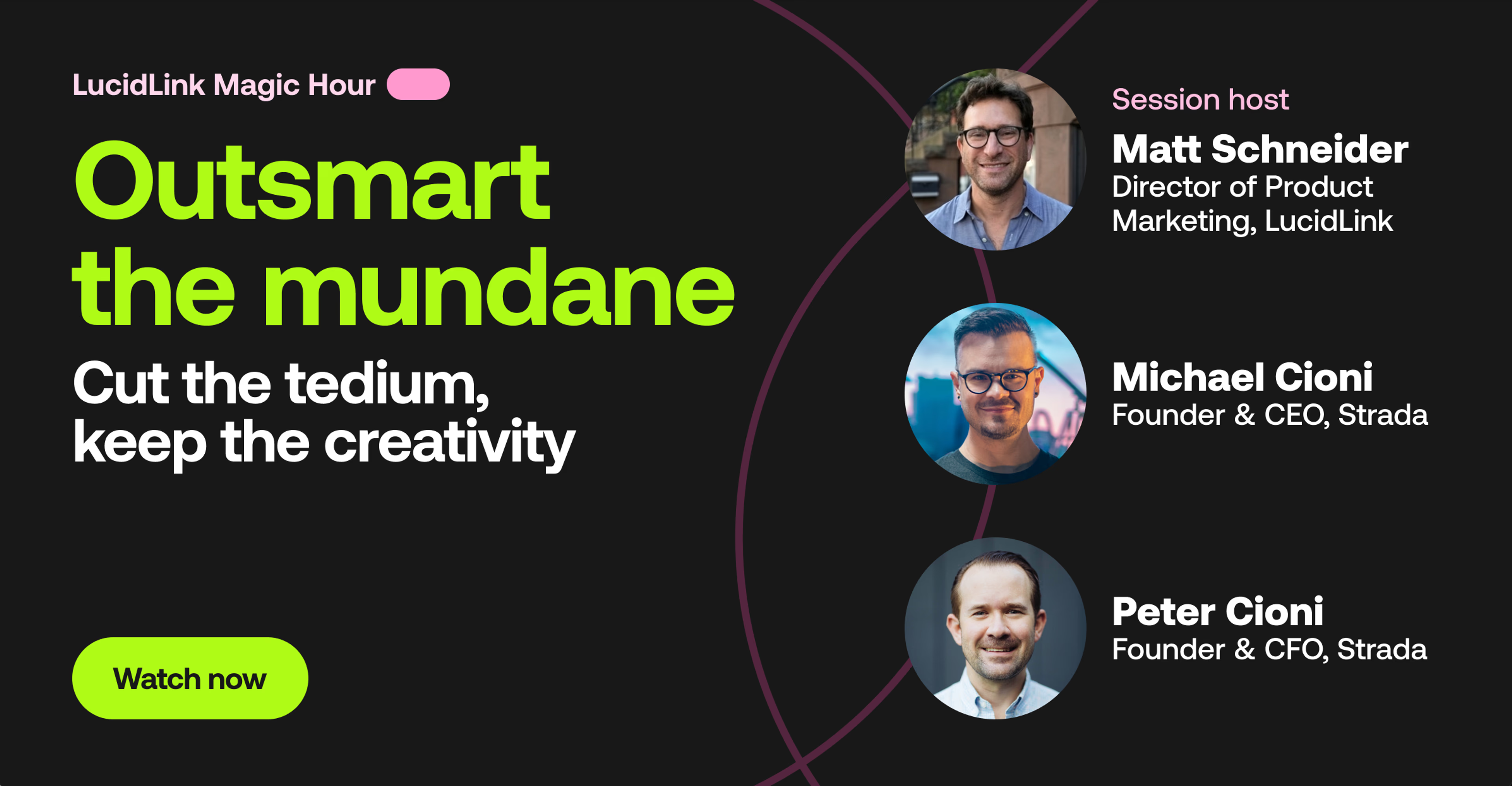
Michael and Peter Cioni are the founders of Strada — a platform to transform the media and entertainment industry using artificial intelligence at the heart of workflow. But what’s the story behind the product and the founders?
Join us for a Magic Hour exploring the Cioni brothers’ journey:
working in Hollywood and how it inspired them to build accessible tools
why they’ve devoted this phase of their lives to ridding the world’s workflows of the mundane
get an inside look at their new platform, Strada
We'll end with live Q&A to give you access to the brilliant minds of the Cioni brothers. You won’t want to miss this one.