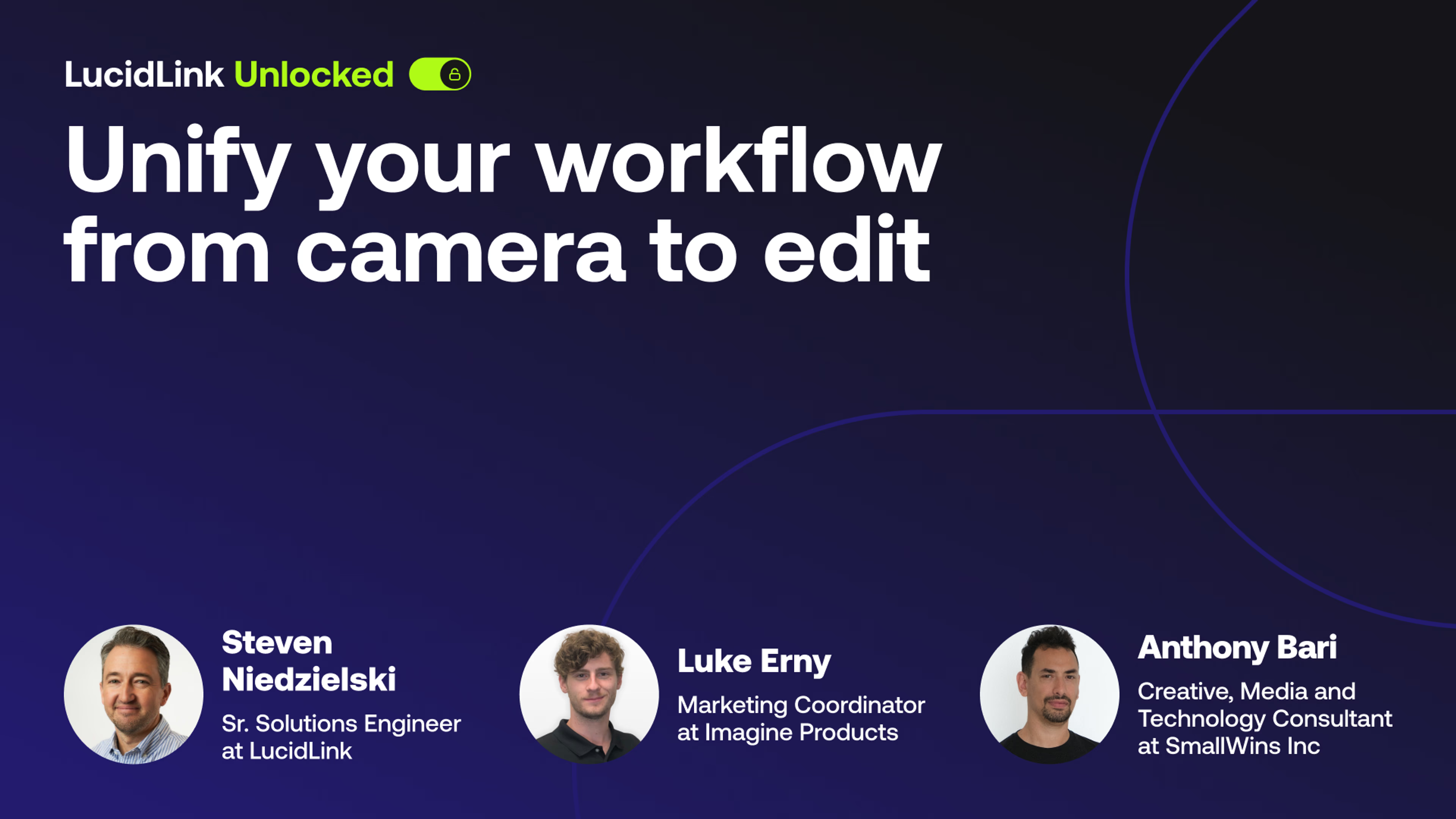
well, welcome to our LucidLink unlocked webinar. Today, we're gonna be taking a look at a really great solution that focuses on the critical first step in any production. Right?
You've gotta get your valuable camera and original files into, you know, something so that your editing team can actually use them. And, you know, Chalkboard Studio has been at the forefront of that that piece of the puzzle, that piece of the workflow for years. And, And, but I and you see this here, they introduced a really elegant, solution and integration between ShotPut and LucidLink. So we're gonna be talking about that today, and it's really it's really cool.
We got to work with, some great people on that here in this, webinar. And, so I'll I'm Steven Nagelski from LucidLink. I'm a solutions engineer, and I'm joined by Luke and Anthony. So you guys, go ahead and introduce yourselves.
Yeah. Thanks, Steven. So I'm Luke Ernie with Imagine Products. I'm our director of marketing and also head up our partnerships.
Awesome. Anthony Barry. Live in Hollywood. You know, live and breathe media. And, basically, I work hand in hand with the folks from Imagine Products. And I've been working with LucidLink now and, just basically giving making sure that people have, the best experience possible when using products and services and doing technical consulting.
Awesome. Thanks, guys.
So
Maybe I'd start with just a high level overview of LucidLink in case, someone watching has not heard of us before. You might maybe came across this link, as a a fan or a user of ShotPut, and you might be new to LucidLink. So we'll we'll do an introduction for each product, and then we'll kinda get into what the integration is all about. So, for those of you who don't know, LucidLink is a cloud collaboration platform that looks, acts, and feels like a local hard drive.
So when it comes to postproduction workflows, think about LucidLink as a a place where you put your media, you ingest directly in, you put your project files in there, you work directly from LucidLink all day. It's your it's your central repository, your single source of truth. And, of course, the reason why we did this integration is the the first critical step of any production is getting those valuable, you know, original camera files and or proxies into LucidLink. And so, let's let's now do we can do a little high level of, ShotPut.
Absolutely. Alright.
I think we'll do a Volley back and forth between Luke and I.
Yeah. Yeah. So I'll just start with, like, anybody who has been a media manager, DIT, as DIT was being defined, even even, production assistants and producers, assistant producers. A lot of people have used ShotPut Pro, whether it was the first time or whether it's, hey.
Take this card and throw it on these four hard drives and don't use the OS. You know? It's basically you're writing a receipt that could save your job, save your credibility, and, so many other things. But, just think of it as a receipt, and a safe way to move media.
Because if if you're filling up drives, just think of, like, when you're all the way to the top, it's kinda like a fish tank full of water, and you're trying to cross the street with that without dumping any water on the floor. That's how valuable our data is, and we wanna make sure that we protect that data in everybody's day rate.
Yeah.
But go ahead, Luke.
Yeah. So as Tony mentioned, ShotPut Pro has been around since two thousand eight, industry standard for a while. ShotPut Studio builds on ShotPut Pro. So ShotPut Pro kind of existed on set and that's where, like, it got used and it didn't really continue anything after that.
You offload your footage, your media to SSDs, HDDs, rates, whatever. And then what you do with it after that is up to you. We don't deal with any of that. Studio is gonna take things a step further.
So, that's where this integration comes in. We are gonna ingest the footage, transcode it, give you reports, and then get it where it needs to go. And LucidLink is a critical part of that.
So I'll add one thing to that just in case, like, people that were former ShotPut users.
And at one point, there was the prime transcoder. There was, there was a few different applications, and then ShotPut Studio basically unifies everything under one roof, making it a lot easier to do all these tasks.
Yeah. Absolutely.
Perfect. So I think maybe a great thing to do next would be, get in and start showing, showing what this integration looks like, and then we can kinda explore it as we go. Alright. So I'll go ahead and put your screen live, Luke.
Cool.
There we go.
Awesome. So just to give a very brief overview of, like, the general layout, and if you're familiar with ShotPut Pro, it this will kinda look familiar. But for those that aren't, you have all your connected media here on the left, kinda like finder. And then these are gonna be our automations. We'll get to those in a little bit. When you are running offload, transcode, report, whatever jobs, they're gonna appear here on the right. And then this is like the main queue, and this is how you switch between tools.
So the actual integration with LucidLink is over here on the left. You can see we have s three integrations.
Favorites is just where you can put any folders or drives you use consistently. And then underneath that, all drives is just gonna be anything we find, in binder. So integrations, you just click on this gear icon and you see LucidLink here at the top. It's gonna tell you how to connect, the version. So you just click connect and it's gonna open LucidLink. So we wanted this to be really simple, really easy to set up.
If you already have LucidLink, really you're just following the same workflow, just how you would mount them in finder. You're going to mount them. Just connect. I'll connect these two and you'll see as they connect, they're gonna appear here.
And give it a second. And now they're under here, under the LucidLink tab, and they'll also appear right here in the integrations page.
Also, just to note, I am on macOS twenty six to show off the new Liquid Glass build. We did just release a build that's compliant. I recognize macOS twenty six just came out. If you're on set, maybe not the best option for you because I'm sure there are bugs that I have not found yet.
But you can see I've got these file spaces connected.
You can connect as many file spaces as you want and they're going to appear here on the left as well as in this integrations menu.
If I click on one, you'll see there's some information here.
Just list the Cloud provider, cache size, cache location, mount point, max upload rate, which is something we'll come back to a little bit later, and then you can forbid special characters. It's a lot of stuff that's available in the LucidLink desktop app already, but we just wanted to include it here in the integration and that way you're not having to switch back and forth between them.
It's just this is more like a pure handshake between the two.
Yes. Absolutely.
We really wanted it to feel not just like a copy and paste solution. We wanted it to feel like actually integrated, as it's an integration. So Yep. Like, close that gap.
Hand in hand. We worked hand in hand.
LucidLink, as the products work hand in hand to make sure that the experience is the best that it could be, and it and it feels like it's running natively inside of ShotPut Studio.
Yeah. Yep. Absolutely. So, just to recap, we've now connected both these file spaces here to the left.
And now kind of the the meat of this, webinar, what we really want to show is after you've connected your LucidLink bucket, how are you going to minimize those onset pain points of getting your media ingested, transcoded, and delivered to LucidLink.
If we go down here to our automations, you can create a new one with this plus icon. I've already got a few and I've got this LucidLink automation right here.
You can see I've already created one and it's going to start with camera ingest. Then from there, it's going to do a backup of the OCM and then edit proxy transcode, and then it's going to upload that solution link. You can see this helpful little warning icon here. I'm just going to click on the name and it's going to bring up the editor.
You can see it gives the warning because there's not a destination yet. I'm going to add this edit proxies.
Just like how you would in finder, everything is drag and drop in this app. You can also right click and browse for items if that's faster, easier for you. But the workflow we can highlight is just dragging and dropping any media for destinations and then what you want to offload.
If I close out of that, we've now got this automation already built.
I'm gonna run a job and then come back to this screen and show you how you actually edit this. It's very simple. It's node based and just like you drag in media, these are your preset tokens and you're just dragging and dropping those. So I'll show that here in a second.
But if I close out of this, make sure I've got it on and just drag in this footage and click start here.
You can see just like that, it's gonna start this job and run all of these at once. It's already finished the ingest.
If you're not familiar with ShotPut Pro, this is what our report looks like.
These are really cool, by the way. This is one of my favorite things about it.
This here in the upper left is just the base logo, but you can change this for some branding. You can also change lighter dark mode reports, and then this background color, you can also change.
We want reports to feel like they're coming. If you have your own company, your own branding, we want it to feel like these reports were tailored for you and not just a run of the mill. Everybody gets the same reports.
You can see every piece of media that was verified, it's going to show a thumbnail and then some metadata about them. We have a couple of different layouts. This is the metadata focused, but we also have thumbnail focused, which looks like this. So it's going to give you a lot more thumbnails.
And then you can see this edit proxies. This is the transcode results. So you can click on any of these and you can view the source and the output and play it right in the app, if you want to do any quality control.
And you can kind of see here in the upper left, I have the time code and the file path, burned in.
Another another thing. Cool thing. Yeah.
I was gonna say that's I love that you can put, you know, like, watermarking and time code burns, and it's it's really, really powerful and flexible.
And I'll I'll show that a little bit more when I actually build out an automation here in a little bit. Some of the actual settings you can edit.
Can you show one one quick thing while you're on that on that topic? And this is probably one of my favorite little, little nuggets is, like, when you're in there, can you showcase the, just making an index of the files, which is basically, you know, one reason to use this and, maybe just show the button. Like, if somebody has got I mean, this happens quite often when you have vendors that are participating in the edit and, you know, all different hands that are not one hundred percent on the main plate. Not everybody is able to tap into, you know, the file space and be in the edit because they have a limited amount of actual users or actual editors. So to be able to provide a list of the files that you're currently using to a vendor, I feel saves time, saves questions.
You know, they'll immediately know, hey. You're using v four. We're on v six. You guys are still working on these files, and we have this other whole set of files. Like, questions like that get answered really quick when you provide, basically, like, the PDF report of what's actively on the drive, and you can ship that out to any kinda, you know Yeah. Any kind of partner, any kind of producer, any anybody outside of the immediate network that needs to know.
Well, just just building off of that now that now if you set those camera reports to go into LucidLink as well, they can go they can be set to any destination. Right?
LucidLink is now available on mobile. So you can have people at producers with an iPad on set, and they can be looking at the file space, and maybe they don't need the full media or don't, you know, wanna take the time to lay back that media. But they've got that PDF right there, and you can just really quickly scan through and just get that visual confirmation of, like, okay. Yep.
Here's everything we shot today. I'm gonna cross reference that with my shot list. Yep. We're good.
We can break down. We can, you know, we can get offset now. Just so many little things like that that are just so native to any production, that are just really helpful.
Yeah.
We had one question in the chat too I wanted to call out before we go too much further. Someone asked if you can choose a specific folder on LucidLink to set the destination, which Yes.
You can.
Sure I know the answer to. Okay. Yeah.
So you can just drop down here. So in partners, you can see I've got quite a few folders. You can set any of those, as destinations.
Something also to mention, if I pull up the settings here, we have these queue automation settings.
If you turn on all of these, I won't go read all of them, but basically, with all of these turned on, you can set up a workflow where you can plug in your card if you're on set. It's going to automatically add it to the queue. It's going to begin the job and it's going to eject the source once it's finished. So basically, you can set this up beforehand, to work where you can just have somebody plug in a drive and it's gonna automatically start whatever automation you have turned on.
And then as soon as it finishes, it's gonna eject that card, or unmount it. You'll have to do the actual injecting. But it'll unmount it and then that camera card is free to, be wiped and put back, into the camera if you if you need to. So it really is, like, truly automated.
You can set it up so that you don't even have to click anything.
That's cool.
Couple more questions while we're in this section here. Stephanie asked, is this, the newest update, which I believe is yes. Right?
This is the first question. This just came out on Monday, and it is the update that includes, the LucidLink integration and macOS twenty six, compliance.
Awesome. And then, Jay asked, where is the proxy transcoding happening? Native to ShotPut, question mark?
Yes. It is happening just on your machine native to ShotPut, and we do have GPU, acceleration, for most file types. There is a pretty big transcoding update coming in the next month or so that's gonna improve performance, and then also include a few more codecs.
Very cool. And this final question Yeah.
Go ahead.
Is just, are you able to choose a preset for export for the proxies, which I know is a yes.
Yeah. Yeah.
Just real quick, if I go to this, when you're in this view, you can click on the name of any of these tokens to edit it. You can also go to the preset page, and these are like all these are all your presets here.
And if I didn't make it clear, when you're building an automation, all of these tokens down here are presets that you've already created.
So when you load up the app, if you haven't used it before, all that's gonna be here are just these new tokens. So you will need to set up, like, the presets beforehand, which is probably the most lengthy process in this. But when you're editing them, transcoding has the most settings. So you can do destination, prefix suffix, full and output folder structure. But the actual video settings, you can choose from, either the h two sixty four sixty five options and then all the progress options. For the avid users, we are working on adding those, but that won't The DMX.
DMX files. Yeah.
Yeah. Exactly. Those will be coming, in the next month or so. We're working on them.
This is a good point. Maybe I'll I'll jump into we've been showing kind of, just putting your edit proxies on on LucidLink here, but You see you've got full support for for MES files, or you could just do a direct copy of your OCS into LucidLink as well. So that just kinda comes down to, like, what kind of bandwidth do you have on set. If you do some camera tests beforehand and if your bandwidth is sufficient, you can do any all of those. You can do proxies, mez, or or and or original camera files, you know, direct to LucidLink. But it's also I think it's always a great idea to have, some sort of second copy going as well, which is, again, one of those powerful things that I've always appreciated about ShotPut is the fact that you can write to two or more destinations simultaneously, which is really killer.
Yeah. And how that would look while we're on the screen, if you wanted to upload this camera, this original camera and just from here straight to LucidLink, have this LucidLink upload token, and you would just drag it right there and it adds it as another step. You could also replace o c m backup with that or you could add it after o c m backup if you want to free up this original drive.
Yeah. There's options.
You see when I added it, it really is just dragging and dropping these.
So you can add it to the right or the left. You can also add it as a subactivity, which I won't really get into because that is getting a little bit in the weeds. But, if you are interested, you can always reach out to our team to discuss that.
There there is a question I wanted to see if, we could tackle. And and, there's a question about remote. Trevor's asking if there's a remote monitoring. So when you're away, you can see what's going on in the queue.
In the past, that existed. I believe that's being reworked.
Lou can It is.
Touch on that.
So Yeah. Like, something on an iPhone or maybe on a on another screen while you're not at the station that's, doing all the file management?
Yeah. Unfortunately, that's not available just yet. We are working on reworking an iOS app that you can monitor, all of those at once. Right now, we do just have SMS and email notifications on, job completion. There's nothing to monitor, like, ongoing job progress, but that will be coming as long, along with some license management. So, yeah, a lot of a lot of updates, coming before the end of the year to really improve upon this, and make it more powerful.
And just so you know, that's been heard, and and that's in the pipeline Yes.
Absolutely. The question.
Awesome. One I wondered if we could show, if you could start another automation so we could show that real time, performance monitoring. I think that's one of the really cool components of this integration.
Yeah. And we'll kind of explain what that does for you.
Yeah. Real quick, I do wanna call it back to what Tony mentioned a little bit ago about the index reports. Okay. Because we he mentioned it, and then we got a little sidetracked.
How you actually create one and what it looks like, you can click on any drive, but specifically for this integration, you can click on any file space.
Up here in the upper right, you see this button, you just click it, It's going to open where you want to send the file or the report in finder. You're just going to open that and it's just going to make this PDF report that is basically just going to expand everything in that file space. So you can see it's pretty long. But basically, completely expand everything and then you can share this. So it gives you a snapshot of everything in that file space at any point in time. And you've got the date and time up here.
So, it takes no it takes next to no time.
Like, you click it, and it's done within within, like, seconds or less than a minute depending on, you know Yeah. Bandwidth. But, yeah, for the most part, it's, like, seconds.
Yeah. And then also on this page, I don't know if you wanna, touch on. You can see live speeds. So you've got the right input, and I don't know if you wanna kind of explain what those mean, Steven.
Yeah. Yeah. So there's two components when you're doing an upload, you know, into a LucidLink Filespace. There's there's this thing called the Lucid cache.
So Lucid cache is gonna be some space allocated on your, on your device, either internal boot drive or an external NVMe disk. And the the purpose of the cache is twofold. It one is when you're when you're reading data down from the cloud, it helps kinda smooth things out and and give you some local buffer to make playback better. But more accurately to this presentation, when you're uploading it, the data writes into the Lucid cache first, which really helps speed things up on the ingest.
But then there's a second piece that it still has to make it into the cloud because it's gotta make it there for to for that single source of truth for everyone to be able to collaborate on. So that's why you see actually two steps. There's we and it this is reflected twice within this integration. One is within this performance dashboard.
The other place is there are two steps in those little green bars to the right. You'll see, like, there's two sets of progress bars. So this is one of the things I think is really great about this integration is it gives you some really clear visibility into the the two critical phases. It's gotta make it into your cache and then into the cloud.
So Step by step, more or less.
Yep.
Right. Yeah. So now that we we'll kick one off, and we'll kinda see it going, in action. So you see all these different bars that are going, and then there's this there's, yeah, it's going nice and fast there. There's the edit proxies, you know, transcode, and that's writing into the Lucid cache. Can we show that dashboard or the performance dashboard again really quick?
So what we should see Oh, yeah.
Is we should see the yeah. It's it's going pretty fast. Oh, yeah. It's this one.
It's it's moving quite slow, but but you will see, it will show live speeds.
Yeah. There we go. So, yeah, the cache is is, I think, just about done already. And now it's, yeah, now it's into the upload part. Notes. So if we go back to the you'll see basically the speed there, what kind of performance you're getting.
Yeah. So there it goes.
So put bytes if you're kinda of what it would be like in the field because, it's quite slow.
But if you were on set, this is gonna show, live speeds and be a little bit more visible as opposed to just this tiny little spike.
Yeah. But just so you kinda so people who are following along, you'll notice the cache portion goes down to zero when that completes, you know, because it's already fully cached. And then now it's getting you can see now it's gonna be bouncing around in two to eleven megabytes per second, and that's showing your throughput. What's really important about this, this isn't like a synthetic, like, speed test dot net kind of thing.
This is the actual throughput you're getting from this machine directly into the LucidLink file space. So it's measuring the actual performance. And so I think it just finished, and now it's back down to zero. So it's just sort of it's a really cool way to kinda visualize, you know, like, what kind of actual throughput you're getting, you know, in the in that live, you know, real environment.
Yeah. So just to go back to this kind of main automation view, you can see these are all of the steps.
And just because I didn't really mention this. How we structure it here on the right is, you have your main automation job, which is really just comprised of other jobs. Like, there's not actually, like, an automation job per se, but that but we structure it so that you have kind of this automation.
And then you have camera ingest feeding edit proxies, so those are kind of indented. And then, you have the LucidLink upload from edit proxies and then o c.
You're on the automation view. This is kind of just a way to see, like, the full overview.
So you can view the breakdown for each step in here in the progress. The loose link one so you can see, as Steven was mentioning, we have this local copy here, which is gonna be the copy to the cache. And then this lucid link step here, is going to be, like, the actual upload.
Cool. I was just seeing in the chat there. We had some people having a hard time reading, so I tried minimizing a few of us.
But, it's hard to see I think Luke Luke would have to, Luke would have to change his screen resolution if you if you could do that quick enough.
If not, like, maybe can you zoom?
Do you have the, can you zoom in maybe when you're Oh, yeah.
That's that's the last A little bigger, I think. I don't It all depends on what people are watching.
Improve it. Yeah. Yeah. Yeah. Absolutely.
So But, yeah, also a little bit.
This is this is recorded. Right? So we'll post it later, and you can always come back to things.
Absolutely.
Yeah. So like I was mentioning, there's a couple different ways to view, like, full automation progress. So as this was running, each of these is kind of like a progress bar in itself that's gonna fill up. So you can monitor it that way.
You can do time based. So it has each step and, like, when it started and finished.
And then you can also, view it as, like, a TXT log, and you can export this, and share that if you want.
So, yeah, I think that about covers, like, the actual job. So I can go back to the automation and show you kind of how you build that.
And Maybe we can answer some some q and a in the meantime.
If if we could just slip one or two in there so we don't grow, big queue. And I'll just put so, Jack is asking, you know, if if, you know, if there there's some issues that he's experienced with with the Adobe Media Encoder, as far as, like, when you generate proxies. Sometimes proxies come before the actual full res footage. And if there's anything any issues similar in ShotPut Pro or ShotPut Studio, I should say.
ShotPut Pro doesn't do the transcoding. ShotPut Studio does the transcoding. But my my quick answer and then, Luke, feel free to chime in Yeah. With the company answer.
My my quick answer is that it's a dedicated transcoder that's independent of of it's on a different engine. It doesn't, operate the same way as the AME does. But and and, you know, when we are doing any transcoding, like, the reason why the Avid codecs are not in there is because we're gonna get them directly from Avid and work with Avid directly.
And there's there's ways to get kind of a generic transcode in, your system, and then there's, like, working with the actual manufacturer that that writes the the program. So, you know, when everything that we're doing, as far as transcoding is it's a different engine. So that would be my short answer to that, loop. Yeah.
I mean, we haven't seen yeah. We haven't seen any issues with that. Not to say that it's gonna work a hundred percent. Like, you may run into something similar, but nothing that we have had reported to us or experienced ourselves.
So Would would anybody be able to, like, download a trial?
Is Yeah.
How long does the trial last for?
Just, you know, if you wanna maybe add that to the chat so people have it, if they wanna kick the tires on this. And then if you do encounter these things, like, one one thing to tip a hat to your, to the support, in Imagine products, like, you're gonna get you're gonna get a real answer from a real person and most likely somebody on that team. So Yeah. Like, you know, feel free to try out what you were trying out, with the AME and try it try it inside of ShotPut Studio. And, you know, if you encounter something similar, you know, feel feel free to reach out. The only way that the products are getting better and these updates are happening is by hearing from all the users as they encounter these issues.
Yeah. For anybody wondering, imagine products dot com or shop the studio dot com, you can download a, application, and then you can, activate it with a free seven day demo. There's no restrictions on that. So, as many jobs as you want, in seven days. And then we also have rental options, and then we do perpetual licensing. So there's no, subscription for the actual license.
Okay. This is probably a good time for me to mention that, LucidLink also has a trial.
You can do sign up for a free thirty day trial anytime.
Just go to lucid link dot com. There are limits. It's a one terabyte limit and ten users, during the the trial period, but it it's the full product capabilities at least. You know? So when you get in, you could actually try this whole workflow that we're showing you here for free, and and, really kinda test it out for yourself.
And, so a question another question here, is, basically, is there a watch folder option, Luke? I just wanna put that out to you. And, I'm I'm just tipping ahead to that because we we hear all these kinds of things, and he can kinda tell you along along, where we are in timelines as far as some of these requests.
Yeah. We are working on that as well, adding watch folders so that, basically, anytime new media hits it, it's gonna go through the whole process. Just making things as simple and automated for users as possible.
Yeah. Coming soon.
Yep. So not an exact date. I hope that answers your question, but that has definitely been heard, Jack.
Yeah.
Then let's see here.
So are you able to set a temporary directory for our transcodes, while they're in progress? So if you need to switch drives, maybe a drive is filling up, and you're at eighty percent on that drive, and you just wanna make sure these are heavy files and they and they all land if if that's what if that's what I'm getting if I'm receiving that question right. Or but but the real the short answer I mean, the short version of that question is can you switch destinations in the middle of your progress or transcoding, Luke?
Yeah. And right now, that's not available. But these are great great requests. Some of them we already have on the timeline.
Some of them I'd love to get more info on. So feel free to reach out to our support team. We also have a user Discord, where I am directly involved. So you can talk with me directly on there, and we can kinda flush out some of these feature requests because, really, I mean, like, this is this app is built on user feedback.
Like, we want to make it like we want to add things that users actually want. So we really do find that feedback valuable and do take it to heart. It's not just a, okay. We heard you, and then we're we're not gonna, like, address it.
Like, we do really appreciate feedback like that.
So And, also, you don't wanna stray too far away of from the core of what this actually does and what people know.
Meaning, this goes into a menu, five menus over. Everything kinda stays in a similar place.
Try to keep the core intact and then build on to that if that helps. So, with all this feedback, believe me that taking notes is a laundry list of of things that people want, but making sure that it stays intact with what the core, you know, what the core actual application is and what it's done for years is really important to the team.
Yeah. To answer these two last questions oh, sorry, Steven.
Yes. ShopBase Studio can apply a lot.
So what that looks like is you just go into this transcode, and you'll see in video, you can apply a lot and then just drop your LUT file in there.
And then, yes, we are working with StoreJ.
We are actually working with them. Right now, you if you go to s three, you can add them just with your credentials. And we are working on, like, object mount with them as well.
Great. Yeah. I wanted to, yeah. Thanks thanks for catching up on on the questions. Yeah.
And, yeah, keep keep them coming. Yeah. These are the great great audience questions.
There were a couple of settings we kinda teased early on that I wanna circle back to. And I'll I'll I'll kind of explain the the the reason that they're so important. So we have this the ability here, to change both cache size and also, max upload rate. So the reason these two components are gonna be really important as you're doing ingest, and I mentioned it very briefly at the beginning is because as as you're writing data, it writes into the Lucid cache first and then it goes into the cloud.
So let's imagine you've got your default Lucid cache size of twenty five gigs. It's very easy to change it, but that's just the default. We need to pick a number. And that you're trying to say ingest a hundred gigs worth of stuff.
What happens? Okay. It's not a problem. You can do that, but means the first twenty five gigs are gonna write into your Lucid cache really quickly, and then the other seventy five are gonna slow down at the rate at which your bandwidth allows it to, you know, clear the cache.
So that if you've got time and you've got good bandwidth, that's not a problem at all. It'll just go through. It'll go into the cache, and then the cache will fill. It'll just keep going as as blocks of data are pushed into the cloud.
More more room is created for the rest of the blocks, and it'll all make it into LucidLink eventually. Now if you wanna kinda speed that up as far as, like, getting the the cache portion faster, You could just click on that pencil icon there like Luke did showing you, change that cache size up to a hundred, hundred and fifty, two hundred, whatever you wanna do. Hit the check mark, and now you've got a a larger amount of space allocated for that first phase, which is like getting the data off the memory card into your Lucien cache quicker. And now it will just continue to push into the cloud at whatever speed your Internet, allows.
You can also change the cache location, which I think is just a jump into the LucidLink UI. Yeah. That's not something you wanna that's not something you can do mid flight. You can what's cool, you can actually change your cache size mid transcode or mid ingest.
Right? So if you start a job, it's going here. Like, oh, you realize I wish I had, more cash allocated. You can actually do that on the fly.
Doesn't hurt anything. But the cash location, don't change that on the fly. Yeah. You're gonna need to, do that at kinda once the beginning of the day and then, you know, work with it the rest of the day, I would recommend.
The other thing I'll mention here is the the max upload rate. So the reason now generally speaking, we default to unlimited. Right? LucidLink is really good at using all of the bandwidth available to it.
We use parallel connections, small block sizes, and it really can saturate your bandwidth. However, there are times, like, maybe you're on a Zoom call or you're, you know, doing a a webinar in the middle of a, you know, upload batch. So you might wanna actually set a maximum threshold for what LucidLink uses, and that's what this setting is all about. So if you're trying to maybe or or maybe you're, like, also uploading a review link to Frame.
Io and you're and you're while simultaneously, you know, doing this ingest using shop put up studio into LucidLink, You could temporarily kinda restrict or throttle your your LucidLink upload speed by just clicking in here, changing that value, and then that lets the other upload process happen quicker. And then you come back to this, unthrottle it. Again, you could do this on the fly mid job. So that's a, really cool, you know, way to just sort of, like, gives you some control, like a little bit of a dial.
Like, let's dial LucidLink down. Let's and then we'll go back to unlimited and let it just use everything available.
Yeah.
So I thought that was Cool.
Great stuff to have built built right into the app. So between the performance monitoring here and those dials where you can kind of adjust your cache size and your maps upload speed, that's kinda how you can use those two in tandem to kinda get the most out of, your your upload batch.
Yeah. Awesome.
Okay. So just to kind of, like, do, like, a full recap now, so I'm gonna make a new automation here, and you can add a color if you want.
That's just for organization.
So this is what it looks like from a blank slate. So you've just got this kind of blank area here at the top, and then you've got your preset tokens down here. So for this one, you start, and when you drag it, it is node based. We don't do it in the same way that, like, you may see kind of doing, like, coloring in DaVinci Resolve where you where this is, like, completely free flow. You can add them anywhere and then, you, like, draw lines. It's a little bit more rigid than that, just in the sense that I have camera ingest here and then I wanna add this transcode token. So I'm gonna add it up here and it's just gonna add it to the right automatically.
So then same with this OCM backup, add it here. So if you wanna add it as kind of like a dual step, you add it to the original token. If you wanna add it, after a token, like, if I wanted to add this listed link upload to add proxies, just drag it to the right there.
Something to note is, when you're adding these tokens here, you can see this warning icon is here again, because we when you add a token from here, it is taking the preset settings. And when you change it so if I add edit proxies here again, it's not changing the original preset. And that way, you're not, like, getting into a situation where you have, like, one of these presets used in multiple, automations, but maybe you've changed, like, the destination for one, it's not gonna change it everywhere. So if I were to go to preset and change, one of these, like, ACAM ingest. If I were to change the destination here and then go back to automation, that change would be reflected when I add this token. But if I already had ACAM ingest added, it's not gonna change it automatically. So think of it, like, once it's in here, it's kind of locked, and only the changes you make, like, in here are gonna apply to it.
And that way, we just kind of avoid any situation where you're accidentally changing across all your automations as opposed to just one.
So, yeah, after you have all this added, one thing I'll note is you have these reports, tokens here at the bottom. Right now, for all these copy jobs, it's just gonna be using your global options. But if you wanna override that so say I have editor reports here, you can add it to the bottom of this token here. And then when it runs this job, instead of using your global report settings, it's gonna use these editor reports.
And just to give you an idea about reports, you can do CSV and TXT. PDF are by far the most, like, dynamic, because you can generate more than one layout at once. We have thumbnail focus, metadata, table, index, which I showed earlier, you can do directly from a drive where you can generate it with a copy if you want, which will show kind of, like, the state of the destination drive once, the footage, like, you've ingested is on it. And then legacy, if you're familiar with, like, ShopUp Pro, from a few years ago, we had a, like, single report type. So that's how you would get that if you wanna, like if you have some continuity that you wanna continue.
And then just kind of going into the settings, custom logo, summary page. You can change the thumbnail quality. You can apply a lot to thumbnails. So if you're shooting log, and you want like, if you're handing it off to someone that may question why everything's grayed out and doesn't look like it should, you can apply a LUT to give them kind of a finished look.
Yeah. Yeah. And then, like, it's just look. Report appearance. Yeah.
Go ahead, Tony.
A quick little sidebar. If you have DaVinci Resolve installed on your system, you can use the LUTs that are included with Resolve.
So if you download the free version of it, you can go target the LUTs folder and then grab those and use something that you're gonna use in post anyway or, well, close to what you're gonna use, just so you know. And and that's free to download as well, the DaVinci Resolve.
Cool.
The the free version, not the not the paid version.
Yeah.
The other thing I just wanna, I think we probably we touched on very briefly, but, this might also answer questions about, like, changing destination and, you know, maybe people are worried about, oh, with all this transcoding and all this uploading, I'm not paying attention to what my cache size is. And, you know, I'm worried about this drive filling up because we got a bunch of four terabyte drives, and we're working with massive files. You can pause your jobs. You can pause a job, and then you can replicate a job, and you can change a destination of a job, when you're when you're in when you're using a file space inside a LucidLink, it's a little bit different.
But what I would say to that is if you're, like, trying I wouldn't try to change, the you know, as a safety feature, like changing your destination in the middle of transcoding and stuff like that is not necessarily that's why it's not a thing right now. But, as an intermediate, I would say pause the job. You can duplicate the job, and, and you can change your destination before you kick it off again, and you can even grab the the latter half of what you already, started working on if that made sense.
So if you did, like, I don't know, five camera cards and you've already done three of those camera cards and you and you wanna grab the next two, reels, then you can kick off that next job to a different destination by pausing in the queue. Could you show maybe how to pause in the queue and how to how to just go and, talk to that job?
Sorry.
I I didn't mean to derail you from what you're talking about, but I I saw one or two questions that I feel like this might be a good job.
You guys?
Sure. Sure.
You guys can see it. So if I just do a local job, you can you can see.
And then I'm just gonna pause it.
And you can see it's paused. It'll finish writing, like, the last chunk so you're not getting corrupted.
And then you can resume it at any point, and you can unplug your drive in between that.
So this is also you know, with you saying that, let's say, for instance, you know, being the DIT, media manager, producer, whoever is handling the media, you know, a member of the camera department, like, whoever's handling this media, and there now you need to switch locations and you need to continue at the next location and you need to strike right now, you can pause, you know, unplug everything, you know, keep the computer running, move to the next location, get set up, move your cart, everything you need to do, and then kick it back off again.
Yeah.
Alright. In terms of anything that with the integration or automations, anything you wanna add, Steven or Tony?
Yeah. I was just thinking about the fact that, you know, we're focused. We've talked a lot about, you know, naturally, the the process of getting the the media into LucidLink. Maybe I just kinda flip it for a second and say, well, what's what's the benefit of that?
And now I can be an editor, you know, somewhere else. And if I'm looking at the same folder, that those files are going into, those files are appearing in real time for me, like, like that. So you can have and we've seen, you know, productions whether it's, like, the next day or we've even seen, like, while while something is currently happening, you could have a remote editor or an AE starting to go through and look at and verify and even start to edit with those files as they're, you know, up appearing in LucidLink, you know, practically in real time. So this is how you can sort of connect your set.
You know, we talk about this term like the connected set. Right? This is this is that in action. You you're bringing your media in.
You know, you're either transcoding or doing your OCS directly into LucidLink, and you've got your editorial team able to start working, like, while this shoot is still happening. And that's a really powerful way to save time, but also kind of increase the creative, you know, feedback. We've even seen instances where people are doing things like continuity checks. You know, like, they're looking for, like you know, people brand managers maybe are looking at the footage as it's coming in, and they're saying, oh, there's this, you know, the classic coffee cup in the background of their mind, you know, medieval drama thing.
You know, you can catch some of that stuff and maybe without having to always fly as many people to the location where the shoot is because you're able to connect, you know, postproduction and producing with your on on set, you know, or in studio kind of environment. So this is that way where you're you know, this is what I kinda look as one of the best ways to get media in in such an elegant and, like, sophisticated way, but then you're connecting it with that full, like, LucidLink, you know, postproduction world where everybody's, you know, working from the single source of truth. So that's why we were really excited about this because it brings such two cool pieces of the puzzle together.
So, yeah, I just wanted to mention that here at the end.
Yeah.
And I'll just add more of the story Go ahead, Tony.
No. I was gonna say more of the story, just check your coffee cup.
Make sure the logo is facing the other way.
Yep. Yeah. To add on to that, though, you can you can see I have this folder here at the bottom, and you can add, presets to there by dragging and dropping or, like, right clicking.
But on this folder, or for each of these presets, you can click it, and you can export it. So you can export entire folders or individual presets and share those. If you have multiple instances of studio on set. You can share those between them so everybody's working from the same automation. So you as Steven was mentioning, you keep that kind of continuity.
And make a folder on your LucidLink file space for all these that you can share across. So anybody connected to this, open up your file space, go in there, download it, bring it in. There it is.
LUTs too. You can do the same thing with LUTs.
Yep. Keep a little admin space in there so you can have all these fun fun things to share across your file space.
Yeah.
Awesome.
Alright. Looking at time, we've got about twelve minutes. So if there's any questions, that you want answered, we would be happy to do so.
If you think of any later, feel free to reach out to either of our teams.
If our team doesn't know something about LucidLink or their team doesn't know something about Studio, we'll get you connected.
So Yep.
Yep. Absolutely. Yeah. Yeah. And I'll I'll give a shout out to our support team as well.
We've got a amazing, you know, twenty four seven support for our enterprise customers. We've got people in the US and Europe and Australia. So we really cover that full, you know, twenty four seven, you know, global workday. If it's midnight for you, it's gonna be the middle of the afternoon for, you know, for our support team in Australia.
So, yeah, really easy to get And they're fresh.
Yeah. Exactly. They're not they're not tired like you are.
They're not exhausted.
Fatigue free.
I'll also I'll add Luke's Luke's, personal email and phone number in the chat, so feel free to reach out directly. He's available twenty four seven. He's kinda he's kinda wild like that. Drinks a lot of coffee, and he answers every question.
So feel free to to buzz Luke.
I see we have one more question in the in the chat there. Jack is asking, when transcoding, do you have the option to copy audio channels, or are they naturally moved into two channel stereo?
Great question.
Yeah.
So let's go into here.
And you can see with the audio settings, you can change, the layout if you want. And so you can do a custom layout. Tony, you may wanna chime in here because, the audio It's a little outside. It will happen.
If you want you know, like, you see the option there for discrete mono or if you do multichannel or you do channel remapping.
And, you know, if you have a particular, like, channel layout, that's where you can go to those drop downs, and you can kinda do the channel remapping.
And I think it also depends on the type of file. Right? I wanna, like, just you know, this is something to put a pin in, but, I would say it also depends on the the media.
Sometimes, like, certain files structures don't allow for you to really remap the audio. So my my answer, I would say, is not a hundred percent, but I would say it's at least eighty percent. You can map any of these, in in the channel layout that you want to, but I would say there's one or two. I don't know if it's the the Sony codecs or the, I don't think it's I don't know if it's the MXF.
That's, one of them is is not too easy to work with. I know you can do this in a ProRes, MOV wrapper, but I'm not a hundred percent sure you could do this with every type of MXF because there are quite a few different versions of the same style of codec and wrapper. So but I hope that I hope that answers the question, and feel free to drop another, something in the chat if if you do want a part two to that. But, yeah, you it these drop downs are purely for you to remap and change the layout the way that you want to or just basically flatten it out and turn it all discrete, mono.
Yeah. And then, Josh, to answer the question, about the queue pause, So you can you can quit the program, like, from the apps. You can't, like, quit it from the dock completely, but you can, like, close it, and it will save your pause. And you can, like, close your machine, but you can't shut it down completely.
So I hope that answers your question. I mean, you can kind of, like, you can kind of, like, close things down, but just not, like, shut things down, if that makes sense.
Like, close your laptop, keep it keep it powered up, keep the application up, and and then move on, open it back up, log right back in, and continue I mean, like, if I like, I can click the red x there and then reopen it, and it'll save everything that way.
But, like, if I were gonna go down The command queue?
Yeah. Quit.
Yeah. Quit from there, it would close out everything in my queue.
Alright.
Yeah. Any last question?
I'll I'll I'll throw out just a a quick quick aside. If anyone who's watching today is going planning to go to the Adobe MAX show in about a month, I'll be there. I'll make sure I've got this running and can show you, an in person demo if you wanna check it out. That's, it's the last week of October, if anyone's if anyone's already planning to go.
Yeah. And I will say There you go. For NAB New York, if anybody's New York based or traveling for that show, we won't have a booth, but I am based in New York. So I will be attending.
So, yeah, reach out to our support team, or I'll make a link. It'll be under the events page on our website to schedule a meeting with me. So I'd be happy to get to, meet with anybody or give an in person demo, at that show. We can meet at coffee shop or just kind of in the lower level of Javits.
Now could you go from automation and just take it back to the go, click the drop down for automation just to kinda just go through the interface real quick, show people that there's some elements of the the rudimentary portions of this. Like, go back go down to copy and just show, like, if you're not doing everything in in this stack, you can literally go here where it says source and destination, throw your camera cards there, go to destination, and look. LucidLink is the destination. If you wanna just anything that's on the left hand side is an attached drive, and and you can grab anything on that from the left hand side, throw it in sources, or throw it in, destinations, pick your flavor, and hit go.
Yeah. That's a good point. We were talking the automation. But, yeah, there like, LucidLink is not just for automation. The integration works anywhere in the app that you would use a destination.
We were showing it as automation because that's where it gets really pow powerful. But if you wanted, we have your basic copy. We also have sync, which has compared That's awesome.
Yeah.
So you can compare two directories, or entire drives. Right now, we only do head to head, so you can't compare, like, multiple drives to multiple drives because that gets a little that that starts to get a little crazy. So we only do one to one, but say but sync is really cool. If you have two, like, folders and you think there may be some different files between them, you add one to the top, one to the bottom, and start the job. We have this plus here at the bottom to let you know which one is going to have items added to it, and it will only copy what's what's different between the two.
And when you get a report, I think you get it'll tell you what's been added or something something along the lines of that?
Yeah. The output will show will have, like, two drop down file trees. Yeah. Let's see if if I have anything.
Wow.
It's alright. You don't have to go through it right now, but, like, yeah.
If you're interested, though, it is cool. It's got, like, drop downs for both file trees, and shows, like, a plus or minus, if things are similar or the same or similar.
Go to the go to the transcode, portion real quick.
Yeah.
So those of you that we're talking about, the Adobe media and code, you know Stuck right there.
You had it a second ago. Well, control t.
Understood. Three.
Yeah. There it is. Okay.
Preset, and then you can edit transcodes from here as well. We do have, like, a simple version of transcode, which just is like a standalone tool.
Yes.
But we do recommend just doing it from the preset because, unlike unlike copy where you can kind of just add something and go, there's so much involved with transcode that we have a, like, a simple mode, but it's pretty similar to preset because you still have to, like, add all these settings.
So Well, I just I would like I just wanna tip ahead to the people who are who are thinking Adobe Media Encoder.
And, like, they're used to working like that. Like, your presets would be in that bottom left hand corner, stuff that you can already generate. And if you if you go back, Luke, from that June production, just go out of that folder. So you're making folders where you can house all kinds of presets. These can be shared as well. Right? Correct me if I'm wrong.
Yeah. Any presets or automations can be shared just by right clicking and then clicking export.
Yep. And keep those inside of your, you know, your toolkit that you share across your team. But this right here would be the equivalent to what an AME is, And this is where you can do just the transcodes if you want, and, you know, you can transcode from a drive and and, beam that right up to LucidLink as well.
Yep.
Awesome, guys. Well, we're just about at time. You can see there's a lot of power built into ShotPut Studio. A lot of options, a lot of things.
What one of the things I love is, like, you once you kinda figure out your flow, it really simplifies. You know? You see, there's a lot under the hood, but it's like, once you've defined your your transcode formats, your mezz formats, and stuff like that, it becomes very, very clean and easy to, you know, consistently and repeatedly, you know, get the media in where it needs to go safely with reports. And then it's now in the LucidLink ecosystem, so your whole team can now collaborate together, uniformly anywhere in the world.
So it's pretty it's pretty cool workflow together. That's so I wanted to share it with you today. And, like we said, you've got our ways to contact both of our companies and, reach out anytime you have any questions. So thanks, Luke and Tony.
Thanks for joining. Thank you. Thanks for being here.
Thanks everyone that joined. Yeah. Alright.
Alright. See you everyone.
See you. Have a good one.
Welcome to LucidLink unlocked — your inside look at how LucidLink can transform the way you work, without changing your favorite tools and workflows. Just add LucidLink.
Speed up your entire production pipeline (from the moment footage leaves the camera to when it’s ready for your editors) without adding extra steps. In this session, you’ll see how ShotPut Studio’s automation pipelines handle ingest, verification, reporting, and transcoding automatically, while LucidLink makes that verified media instantly available to your post team anywhere in the world.
Experience a demo of the new ShotPut and LucidLink integration
Discover how this connected workflow eliminates delays, reduces manual tasks, and keeps your whole team aligned on one secure source of truth
Get your specific questions answered in a live Q&A
Grab your post team, some popcorn, and learn about the new workflow that’s about to make your lives a lot easier.