I'm gonna give a quick intro and then turn it over to these guys for the rest of the session. I'm Marcy. I'm on our community marketing team at LucidLink. I'm so excited you're here for what we call magic hour.
This is a very long running series that we dedicate to spotlighting people and stories from our LucidLink community that we think and know are amazing.
And this is an extra extra special one because we have three people from reputable, and different post houses, to talk about what's next in post production.
So, Joe, Melissa, and Jack, thank you so much for being here again. We really appreciate you, and I can't wait to hear, this discussion.
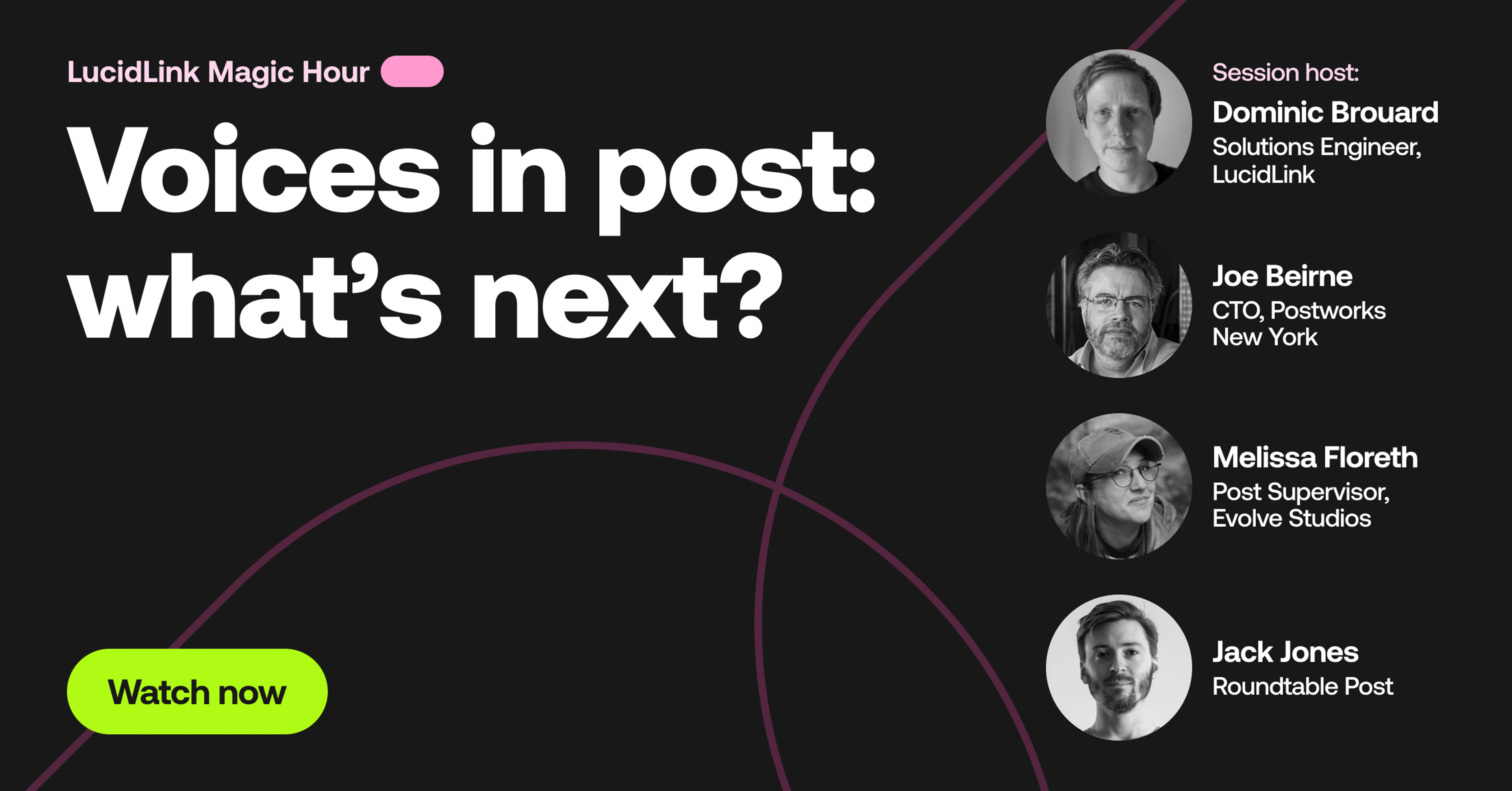
We also have our very own Dominic Brouillard, who is here to guide the conversation. As I mentioned, he is about three months into LucidLink. We're so lucky to have him. He has an extensive background in postproduction, so he is a great person to lead this conversation.
can I hand it over to you to take it away?
Absolutely. Delighted.
Thank you so much for joining us today. I'm really honored to be part of this discussion and to, to meet you all.
I wanna start by just a little bit of introduction. We're gonna talk a little bit on the topics, especially around AI, workflow innovation and the industry and how it is right now. But I'd love to hear from all three of you about your current roles and what area of kind of post production that you're working on right now. I'm just gonna start by introducing myself and then I'm gonna hand over to you.
So I have a background in media engineering. I started out actually as a documentary filmmaker, and then after a number of years working for National Theatre in London, I I moved over to a technology role at Vice Media about, nine years ago. And, I basically, started working in local infrastructure in London and Europe, and then I took on, media engineering and cloud first initiatives, right around the time of the pandemic, which was apt. But, yeah, my expertise is really around post production technology and workflows, I would say, and engineering workflows.
So I'm I'm here and really excited to hear what you guys are gonna tell me a little bit about your industry and your companies and what you do. So I'm gonna start with Jo if that's okay. Jo could you tell me a little bit about your current role, what you do, and what kind of area of post production that you focus on?
Sure. I'm I'm I'm the CTO of a company called Postworks in New York. We're a privately held but pretty big, well established post facility, that focuses pretty much exclusively on long form content. So we do feature films and, scripted TV, some unscripted.
My personal background of, like, Dominic's is in documentary feature documentary, and I've done a lot of work, in that field. I was original and I'm older than a lot of you guys, so I I was originally, like, an MTV baby.
I I started off doing technical stuff and production for and post production for music videos, and I worked for the band Talk Me Heads, and I did a lot of music videos in the eighties. And then I went on to, do more, like, straight post production in, in the digitization of the, the industry. That's why I got my hooks and things.
Great. And do you wanna tell me a little bit about your area of postproduction right now and and what PostWorks do?
We we do, pretty much everything that's thirty minutes or longer.
We do sound and picture.
We do, you know, we have mixed stages and digital intermediate finishing workflows and and, you know, we work to projection and to fix displays.
We also collaborate with other companies on components of things, so we're often doing part of the production collaborating with somebody else. We just delivered a show called Weapons that we did in collaboration with a company called Color Collective. And that's kind of become increasingly common for us to pair with other other entities all over the world to do stuff.
And, you know, we, we also have a a big, avid based editorial company with a lot of cutting rooms, you know, spread all over New York.
Great. Same question for you, Melissa, if if you can go next.
Tell us a little bit about, what you do, how you got there, and your area of post production.
Yeah.
So I'm a post supervisor here at Evolve Studios.
I actually used to work at PostWorks quite a while ago, probably, like, fifteen years ago at this point.
But, yeah, I kind of started my career at Postworks. I mean, I was an AE before that.
But as far as, you know, learning how to be a post producer, Postworks set me up well.
And then I moved on to being like a DI finishing producer, working in, like, feature film and scripted television, and then ended up moving to Nashville, and landed at Evolve Studios.
So overseeing the the post depart the post department here, and we do kind of everything. We do feature films, scripted, non scripted.
We do commercial promos, trailers, non, sorry, branded content and nonprofit, like, kind of the the whole gamut.
So all the different types of services or things that we do, goes from color, visual effects, graphic design.
We do visual effects for virtual productions, and we do, you know, all the audio postproduction needs, Foley, all those different things.
Trying to think. Kind of kind of all of it. And, the the interesting part about Evolve is, we have a production branches, branch as well.
So working alongside the production, part of the company is really fun. We get to do it from, like, you know, creative idea all the way through to to the finished delivered piece.
Great. Jack, I'm gonna ask you the same question if that's okay. Go ahead.
So, what am I? I I'm a bit of everything. So traditionally, my skill set is a colorist. I've been a colorist for fifteen years.
Mainly great meaning doing DI work across, all different grade systems. So, I started out on Baselight and Apple Color, Luster, Resolve, you name it. I've used it. Mystica, Scratch.
And, during the last ten years, I've been running a post house in London, so co owning one, and being the CTO. So it's been a lot of putting in technology, doing some of the engineering as a as boutique facility being quite hands on with things, and then also kinda looking to what's next and making sure we're, we're all set up, for being able to achieve whatever a client might need. So there's a lot of bespoke type workflows and services.
But yeah. So it's it's always been sort of full DI post, bit involved with visual effects. So I've been looking after sound, offline edits.
Yeah. A little bit of everything. And and then I'm also doing a bit of, bit of software development as well as part of the kind of AI revolution.
So we'll probably get to that in a bit.
Interesting. I mean what what I'm hearing is that there's a real spread for all of you really and I guess that's probably a necessity in in the post production industry in some respects.
I want to talk a little bit about the topics on our our raster and I'm going to start with the technology and innovation piece.
I've just got a little quote I'm going to interject which is, any sufficiently advanced technology is indistinguishable from magic, which is Arthur c Clark. And I'd like to say that the, the art of post production is essentially you're in the business of magic in that the technology should be sufficiently advanced that you're able to make anything happen really for the the purpose of storytelling.
And, I want to use that as a framework to start talking about AI because it's a very kind of catch all term right? It can mean many things, it's probably best not to think about a sci fi esque kind of robot overlord but probably more like a multitude of different programmed intelligences that we can use for assisting or automating our kind of human processes, right?
And I really want to hear about how these different aspects of AI are being used in the current postproduction workflows today, whether that's, you know, vision models being used for image and video analysis and tagging or natural language processing, interpreting and creating textual data, or Gen AI, creating images and videos, or or some other use case that maybe is a bit of a mix of some of those technologies that, I haven't mentioned.
About the question, I'd love to find out, I guess, from all of you, how you're integrating AI into your workflows today.
So I'd love examples, whether it's tools or just a specific workflow.
I'm gonna hand over to Melissa first, and then we'll go through.
Yeah. So, we're like a lot of companies trying to figure out sort of what our AI stance is as a as a company.
And I feel like, you know, like I said, there's a lot of people currently kind of figuring that out.
Right now, we're kind of using it to kind of help figure out what the, like, sort of the ideation of different projects might be, like, when we're creating, like, pitch decks, trying to understand what a client is really wanting to see or for us to create in terms of, like, references and getting those from them or or putting them forward as ideas.
We're we're using it more as a an assistant and not necessarily a replacement of roles, which I feel like, you know, so many people I've heard are are and I'm curious to see what all the answers are, but I from what I've heard are are nervous about, you know, it taking the place of something that you might do.
But so far, we've been using it more as an assistant type thing, you know, whether it's, you know, creating the ideas, like like I said, for reference for visual effects or imagery, or using it to, you know, I don't know, make something format a document, you know, something as simple as that that, like, helps speed up your day and make you more efficient in your role.
Those are kind of the ways that we're currently using it.
And how about you, Jack? Do you wanna talk a little bit? You mentioned software development. That sounds quite advanced for post production workflows.
Is is there Yes.
I mean, I'm using a few different ways. So, first is exploratory. So I'm looking at the the generative AI stuff using things like comfy UI, which is a sort of relatively new piece of software, to just test, see what can be done, see what's possible, and and kind of try to find where it might be appropriate for projects that are able to use it. And I think Melissa makes a very good point on terms of companies still trying to figure out where what is acceptable, what isn't acceptable, how how we can integrate this. But from a testing point of view, you can go crazy, and I encourage people to go crazy and learn and play with these things.
But generally value's eye is just one part of it. I think the bit that I'm finding more interesting is the software development side. It is the you know, one of the one of the questions in the chat here was, Ty is saying, you know, they're not seeing good and cheap tools that do the tedium tasks. Well, I think that's you probably just haven't found those tools yet, but the the example is software like Cursor or Windsurf, which are software development tools, and you can chat with them, you know, like you might with a chat GPT type of or Claude type of software.
The benefit with these bits of software is they can interact with your desktop. So you can actually ask it to rename files. So you could get to look at a folder of photos and say, can you rename all the files and, to match what's in the photos?
Just as an example. But what what I'm really using it for is taking APIs from different pieces of software and making them all talk to each other. So, for example, I built an an LLM chat tool within Baselite so where you can talk naturally to Baselite and ask it to do things for you. So you could say, I have got a project that we've had a turnover for.
Could you go ahead and locate the media and do the conform? And it has a go. It's not it's definitely not there to be doing the whole process, but it's taking the API. It's taking some of the shell scripts. It's gluing it all together. And I think that's where the AI stuff can be really cool and interesting.
Is it for me, around Christmas time, I realized I could probably build anything I can think of now, which is really fun because I'm not a developer. I'm not a coder.
But to be able to now sort of say, I've got an idea for just little microfix. Look. I'm not talking about building some sort of version frame IO or something crazy like that, but just for, like, little micro fixes of you know, maybe you you want to ingest software in a just video in a certain way, and you just want it to be know, spread across ten drives, just have it automatically do it without you do it. So if you could just write some Mac software now or some Windows software, without doing any coding, and it can get you the results. But, yeah, I think particularly in answer to Ty's question in the chat, I think, is looking at things like Gemini CLI from, Google, codecs from ChatGPT, and looking at, cord, code as well. Those sorts of bits of software that you can have on your computer for twenty quid a month, and you can let it interact with your desktop. But cursor is the cursor is the main one I've been using.
And, Joe, I'd love to hear your take on AI. Is it is it made its way into PostWorks in every element? Are you using it day to day?
Yeah. Yeah. We are.
You know, a couple of key things that we've been doing for a while. We're in we're beta testing an application, that I called batch that does, mats.
And there's this kind of, like, akin to the mythical man months in development. There's this, mythical mat minute. So it's I'll I'll just take a minute to draw the mat around this object and track it, and it goes on for, you know, much longer than it should. So what Dash does is that it, has developed with, another one of our creative collaboration partners.
And what it what it does is it makes mats for everything in the in the whole shop, preemptively.
So you just go in and you pick the mats that are already drawn for the for the project. Obviously, we use the matte tools and the matte AI tools in in the color correction and and, effects stuff that we do as well, and flame and, basically, then resolve and everything else too. We also we're multi we're ecumenical about tools.
We use AI in development, and that that group is, you know, it it's a great aid to our small group.
Honestly, we've had mixed results with it, as many people have. It's kind of like you you employ ten people to work on something, and one of them is insane.
And you don't know which one of them it is.
So you have to be very careful when you like, what they've done and say that they haven't decided to kill somebody or something like that. So that's a that's a interesting thing. But we've you know, in our in house development, it's helped it's helped a lot with that stuff in many of the same ways that Jack talked about.
I like that, analogy of there being one person that's insane. You're not sure which one.
I definitely have used AI in various workflows and found that it makes regularly for various things. Yeah keeps you on your toes for sure.
I would love to move on and talk a little bit about, whether AI is sort of the only game in town when it comes to kind of production technology and postproduction technology innovation. Do you think there are other areas that we should be talking about and shedding some light on? I mean, obviously, you're you're mentioning some existing tools, all of you, in your workflows and AI sort of complementing, but not necessarily being the be all and end all.
Is there anything that anyone wants to mention? Joe, maybe I'll come back to you straight away.
Well, one reason why I think that AI may not feature us directly in our plans is it it does for other people involved in general in the media business is that we don't have a, we don't have, but in other context, it's called an insurable interest in the content.
So, you know, we are we we essentially are the last stage in the process, and I you know, these guys are too you know, that's where you know, it is post production.
So, there are a lot of very interesting stuff that's happening, obviously, on the creation side. And we it's not that we don't do that, but that's secondary to our main business. The other thing is that is the obvious thing that Marcy also brought up at the beginning in her intro is that is is how the work how workflows have changed with remote production and wide, you know, wide area collaboration, which has changed out due you know, with catalyzed by the pandemic, but but also, you know, that was it was brewing anyway. And that is that's been a big that's been a big thing for us, and it's changed everything. So, it's made us easier for us to be an international, company, which has helped with a lot of things.
Like, our head of workflow is based in London, and and that actually suits a lot of our you know, it it you know, he's very he's awake during our daily's, hours in New York, which is very handy. This is where the bulk of our work is. But, also, you know, we have daily's happening in, countries all over the world. And that is that that reach has been helpful and also the flexibility in being able to stay on a project and and service a project regardless of what their plans are. It's been enormously helpful. But it's also changed the quotidian, you know, the day to day, way that everybody works and and, you know, particularly in a very expensive city like like London or New York or, it it's it's really good, not necessarily, to, have to, you know, live two blocks from where you where you show up to work.
It's that's helped a lot, for a lot of people, but it's been challenging in a lot of ways as well. So, and we were doing that well before the pandemic for other reasons, you know, among things. You know, production's chasing tax incentives all over the world.
And, that's that's one, in the so it's we've been in part partly in response to that, but also just the change in expectations about technology processes in general and what people expect to be able to do and where they expect to do it is different.
Melissa, I would love to hear is is that your kind of experience in terms of other technologies and are you finding yourself kind of choosing technologies based on just you know how much is it going to cost me, what's it going to do for me, or is it maybe more of a an investigation into kind of holistic effect on your business and and your ability to do things like collaborate remotely into a global environment?
I feel like, generally, we're looking for things to solve a problem that we have. So, like, if we're trying to figure out whatever it is, we'll start researching, well, what's out there and and what are the techno technologies that can help us, and then we kind of go into these little rabbit holes of whatever those are.
I mean, that's kinda how we found LucidLink.
It's like, what what are people doing? And and, you know, because what we were doing originally just was not working for us, during COVID. I mean, it was. It it got us by, but, like, it wasn't the best solution. So, like, just trying to figure out what is the technology that works.
And there and there's always things that pop up where you get an email of, like, a new technology and you're like, Oh, that's really interesting.
And there's some out there that like we've kind of researched a little bit but haven't had the time because there's like, you know, so much going on that like you have to figure out like how much time you can allocate to like learning or figuring out how that might help you, with everything you have going on. Like, one of the ones, that I still would love to maybe reach out, I'm curious, you know, who else has been doing it, but, like, camera to cloud was, like, a big thing, like, in the news, you know, like post news, when that came out. And, like, we looked into doing it and and and then never were able to kind of test it or see how that could help us get to, you know, editorial happening faster or what that might look like.
And then there's also, like, new technologies.
I can't even think of the one I saw recently, but, like, kind of how you can, like, use your a hard drive to then, like, remote and have multiple editors, like, you know, working from the same drive.
That was, like, a new thing I saw recently that was seemed interesting. They're not there yet, but it was, like, an idea.
But generally, just what what's what are we needing and then figuring out what the solve is and then kind of figuring out if it's a solution for us. And the cost definitely varies. Like, if it's, you know, super expensive, there's that, you know, is this helpful for us in the scheme of the cost? And, that definitely plays a, you know, a part in the decision making.
But yeah.
Do you calculate the time saved, as part of that kinda cost of ownership?
Yeah. I yeah. Definitely.
And but, also, it it kinda depends on, you know, where a company is at a certain moment and whether they can invest in that at that time. So, you know, there's there's definitely, like, the cost savings of the time for sure. Like, would that be a person? That could be a person doing something, like, not to scare people, but, like, this new software can do this, this, this, and this.
And then that would be, like, you know, a digital media type role of creating those assets or something like that. I'm just throwing out an example.
But yeah.
I'm conscious of time. I'd love to hear your approach, Jack. I mean, it sounds that as though you're, kind of experimental and building your own solutions when you're not seeing those out there on the market, and they're quite, specific problems to specific workflows which is really great.
I want to jump ahead a little bit because I'm I'm conscious we want to talk a little bit about how AI is impacting our creative work and I guess I'm wondering if, maybe, Jack, you'd like to start by just talking about where you see AI making the biggest impact for you.
Yeah. Go for it.
Kinda everywhere.
I think it's hard to say biggest impact in one place, but, I can easily see shows that, you know, TV style shows that pre would previously do, source of lower budget reconstruction stuff. So, you know, maybe maybe it's like a history program, and they're trying to, pretend they're in the jungle, and they're shooting through some palm tree in their flat to try and keep the costs down. You know, I see that stuff changing quite dramatically. I see, productions shooting possibly with phones, just the environment that they roughly want to be in, and then being able to have reasonably low cost access to sort of partial VFX.
You know, these AI generated types of VFX, but they're not it's not VFX in the traditional sense. I still think I mean, I think VFX is gonna have a huge role to play still. I mean, you look at some of this some of the generative stuff and, okay, you can prompt it differently, but there's a big battle over trying to control, like, the behavior because it is not hugely repeatable at the moment. You run the same thing twice, you get slightly different results.
And I can easily see, you know, if if any you've worked with brands, you'll know straight away that if you send off a Coca Cola can looking slightly the wrong shade of red, you're gonna you're gonna be getting some some feedback. And that's great, but then how do you implement that feedback without, without an artist? So I actually see VFX. I mean, a lot of you worry about VFX maybe being taken over by this.
I actually think it'll VFX might become more important, as a result. I really think the editor is going to become an even more important role than it already is. I think some of these tools are just gonna enable new ways of storytelling and creative new you can you can come up with shots that aren't necessarily feasible with a camera.
Well, they are. I mean, you can you can achieve anything with with some clever old school filmmaking.
But, you know, that magic you spoke about, I think I think being able to do new un unthought of things, and I think the editor and their storytelling ability is gonna have to drive that. Obviously, directors and whole production team general will, but I think an an editor's role might become even more important.
It's dangerous for me to say that, but I think so.
No. I think that's that's great.
Joe, I'd love to ask you about, you you already mentioned that you're doing things like preemptively creating mats in advance and saving yourselves and your team's time.
But do you think that AI and those sorts of use cases are actually replacing certain types of content creation steps, or are they just kind of making it easier to iterate faster or make better content?
What what's your view?
You know, I I I'm a little little you know, I'm a I'm a technology, you know, advocate and and, you know, come from a engineering family and and I'd like to think of myself as as welcoming these, angels.
But I'm a little skeptical about the contribution of AI creatively.
I I do think it has an absolute role in in all these things, and I've seen interesting stuff come from from all kinds of content creation, from writing to, you know, image making, animation, etcetera.
I think it looking to it as a way of streamlining or creating efficiencies in the process may be a little, premature.
I think that it it can do amazing things and, like, in the kind of, you know, sort of vibe coding, scenario kind of that, like, that Jack was referring to is it it does can do really incredibly handy and time saving things.
And not to say that those things are completely trivial. They're they're very helpful. But I think in terms of, like, real creation, it has real limits, and I think that they are very readily visible a lot of the time.
And there's a kind of uncanny valley kind of quality to a lot of the the generative stuff that is that is makes it not quite satisfying, to use this content. You know, and one of the things that has been interesting to watch over the last especially over the last ten or fifteen years is that, you know, we we ran a a a, sorry. It's a little bit of a story, but we ran a photochemical, film lab in our collaboration with Technicolor and and with Deluxe here in New York. It's the last of the Technicolor labs, and we closed it a number of years ago, if you're you're you know, and it was and we're quite sad about that. And a lot of lot of really great people lost their, living doing that. It there was no work. No one was shooting film.
And then a couple of years later, we started to get the more demand for film, and film sort of came back. And we're now doing a lot of film. You know? Not as much as we'd like, and things have been slow in general, and we can talk about that too.
But the we people came back to film, and it's interesting to see why. And it's not all about you know, it's not all hipster, sort of nonsense. It's there are real things about film that are really great and really different, and there's a bunch of things about it. I know if you're going forever about what that is.
But some of the things that happen when you open the aperture and and the shutter and expose something to the real world on a a medium that is that is changeable is that you create things with randomness that are have a kind of a a a there's a determinism in it that comes it's almost like there's a it's almost like it has a soul.
And I don't mean that in a sentimental way. I mean, there actually is something detectable that you that you sort of sense the creator, the artist, the the work you know, nature, whatever that is, coming through in the media. And it's not like it's not there when you take a digital photograph.
But there's something about that that is very magically important in creating the media that we make and that people love.
And I can you know, people are clinging to it, and I think if for a good reason, it's it's been a hard battle to keep it alive. But I think that's that's similar to the some of the things that we've seen with the particularly generative AI, that it doesn't quite fit the need from a storytelling point of view because in a way, it's slightly wrong.
And it and I've I've, you know, I've seen amazing stuff that's done that contradicts this in some ways, but it the most of what we've seen has been pretty has this kind of layer of of fakeness to it that is that is pretty readily visible. And I don't know what that is. I don't know the science behind it. I have some ideas, but I don't I don't I'm not I don't have a theory as to what that is. But I've I'm finding myself generally a little skeptical.
Okay.
Melissa, I'm gonna come to you.
Do you think the the kind of roles that you're looking at now and, the skill sets when using AI and your workflows are changing post production at all? Are you you seeing people actually having to have AI skills as part of their kind of roster of qualifications?
I don't know that it's one hundred percent necessary when we're looking to hire people.
But there are certain projects where, like, if I go, you know, maybe on the nonprofit side. Like, the budgets aren't as high. They wanna get a, you know, an idea across where we might have you know, it it be a conversation of using AI to generate, you know, images and what that how the how we create a workflow that might kind of support them and and what they're trying to do.
They're I mean, being able to search for generative AI imagery is definitely a skill. I will say that.
And we do have folks that, you know, know how to do that. We've talked about, you know, the team learning a little bit more about it, but it goes into the world of, like, us trying to learn along with everyone else. Like, what are all the tools that we have? How you know, it's always good to know what they are, how to use them, and then see kind of how they build into the world of, you know, what we do as it kind of develops.
Okay. That's exciting.
I guess closing remarks on AI.
Do you think in a a short sentence whether AI is gonna continue to complement our artists?
Is it gonna replace some roles, or is it not there yet? Maybe might take quite a while.
Jack, do you wanna Yeah.
I think roles will change.
I don't think I I think it's sort of becoming evident that although there's a lot of hype around new models and, big advancements, and we are sort of on an exponential curve at the moment.
It does appear that some of these companies sort of hit starting to hit a bit of a a wall as to how do we keep improving these various models. But they're gonna this is the worst it will be, and it's gonna keep improving.
But I do wonder if we're starting to tail off a little bit from where we were. Bigger models aren't giving better results.
The thinking side of it is helping.
Whether, you know, they're running through the same sorts of questions, it's becoming a bit more, organic. But, yeah, roles will change, I think. I mean, it's I look at roles, like, in theory, you'd want the conform role to change probably.
But that doesn't have to already I mean, we could we could already do that without the need for AI potentially. Just, for facilities stops and does some scripting, they could actually make it more efficient, for a facility that wasn't doing it. So AMI isn't necessarily needed for some of those bits. But I think the fact that more people are gonna have a bit more access to be able to do some of these things where maybe they couldn't or they're gonna be able to do them potentially quicker, potentially.
I mean, I know there's a some a research paper that shows that developers who are using AI to you know, normal software developers use AI, feel like they're doing it going quicker, but, actually, the the research showed they're actually going about half the speed. They just feel it has a feeling that they're working faster, which is maybe a good thing because it might be that they they have to enjoy the work they're doing in a more relaxed way. And therefore, it's it's less efficient currently.
I think that will still improve.
Yeah.
I think it's only ever gonna complement. It's always gonna be I don't think it's gonna come and take people's jobs. I think there was a brief moment where I worried about color grading, and I was like, oh, this could this could if people if a client can request what they want the images to look like and and have them adapted, well, that would be a thing. But I sort of more see it you know, you're always gonna need that interpreter in that world as well.
You're always gonna need someone who, you know, can take the information a client gives you. I mean, in theory, you could get a client to directly say, here's my edit. Make it conformed and graded mixed, and then the machines will take over. In theory, you could, but I don't think a client's ever going to have that full knowledge base to be able to set off that chain of events because it's not so not what they wanna do.
It's also not that interesting.
I I I guess I think I think we're gonna end up with this world. We're gonna have these artisan filmmakers who will make things, shoot on film, do things, in a more traditional way and not have its own big market. I think we're gonna have a bit more of this sort of semi automated content, which will cover some of the social start side of things, you know, mass production of things.
But I think, yeah, it's I don't think it's gonna replace. It's just gonna complement, I think. I hope.
Let's talk a little bit about the, the market, the, industry as it stands at the moment.
I guess, something that came up in our early discussions was how Hollywood has the flu. I think that was originally coined based on what was going on with the Screen Actors Guild and the WGA and the strikes going on in the States. But I would love to hear if that's still what's happening now from in your perspective and and I'm gonna ask this question to Joe whether you think the, the market and the industry of post production is is being squeezed still and whether there are challenges ahead.
Objectively, I think it it it is being squeezed.
And the you know, I think that it some of it is regional.
You know, there's been a flight of production from certain areas that that the studios or whatever the studios are, where they perceive to be high cost. They they go to other other places.
And, you know, that's a that's a bit of a of a sort of cyclical thing. It's because you're, you know, you become the inexpensive place again after a while.
But, it so there's there's some of that. And some of it is just the the dissemination of production all over the world as as, I think it's as as, regionalization has become more and localization has become more, has been more become more automated and and and a more conscious part of the product, making by many of the studio.
I think that that's that's facilitated that too. So you have things appearing from all parts of all over the world and serving all sorts of markets.
But I think it's, you know, there's there's definitely huge issues and the failure of very large companies, you know, well funded, well managed companies that failed, is is proof of that. You know, we're hanging on, but we've contracted. And, you know, the and the other thing that's interesting and I'm I'm sorry. I'll I'll use all the space you possibly can. You can just cut me off if you want. But the one thing that we've noticed, which is that, you know, we do quite a lot of things.
So we, you know, we do some reality and some science factual and some, you know, features, indie features, studio features, TVs, curved TV.
Usually, when one part of the field is weak, another part is strong. So one big thing that saved us back, you know, many years ago was reality sort of took up a lot of the space that was being, you know, abandoned by in the dramatic, content world. That's not happening anymore.
And although I think you can say to some degree, the small screen has taken up that that Slack. There's that's not a business in many ways for people who are content, you know, for what we do.
So, so it's it's that that's that's and that's a new song.
So the TikTok ness of the world and the attention economy in general, I think, have have changed that.
Interesting. I'm there's so many more topics I would love to chat to you guys about. I'm conscious of time.
And Marcy do feel free to jump in if you want to go into Q and A. I am I'm hearing that we're kind of collaborating across borders more and and that's kind of a good thing for flexibility but also necessary because of how we're being expected to produce content at a certain price point with varying requirements for regional outputs and different types of, stream norms and expectations for all different types of consumers.
Do you think that's the experience that you're seeing Melissa?
Is there anything you'd like to add to that to close?
Yeah. I mean, kind of piggybacking off of what Joe said is, like, we also have multiple things that we can kind of go to when one thing kind of pivots or isn't as abundant at a particular time.
So, yeah, like, I I kinda just agree. Like, having the the ability to do the different things is only helpful. Like, if you if you're very niche and only have, like, one thing, like, that could be difficult, for some. So, yeah, that's all I have to add for that.
Great. Thank you all so much.
It was amazing to kind of hear all the different perspectives from, your different post houses, but also just from your own experience.
That was that was really great. Thank you.
We do have some questions from the audience that I would love to ask. So I'm gonna put these on stage just so you can see them as well as hear me say them.
So this one from Nora. Do you have advice for editors about what AI tools or software they should be learning to use for creative purposes as a as opposed, to organizational?
And anyone can jump in, if you'd like to or you don't have to answer if you'd rather know.
So going first, I'm gonna recommend, people start looking at Comfy UI just because it's I mean, it's a bit, it falls over quite a lot. You almost need to have a custom thing every time you start again.
And it it it's a pain, but it's a good thing to just be able to experiment with at not a high cost.
And there's some different things that that can happen in there. And and another one well, I I think just just playing. Just constantly playing with anything you can.
I mean, if it's in Resolve or Baselite or in in in Avid or whatever it is, not that I mean, Avid doesn't have a lot internally in the software, but but even if it's just, you know, generating some images and dropping them on a timeline and then using that to practice storyboarding or just knowledge knowledge is always is power in our industry, and you never stop learning it.
We never there's constantly more. And I think it just, yeah, keep filling your brain with with healthy knowledge.
Yeah. I'm gonna please feel free to answer this question directly, but I will also add on there's so much information out there about AI, so I'm also curious. Have you all found any resources that you trust particularly to kind of steer you in the right direction in addition to particular tools?
No.
It's Okay.
Yeah.
It's totally fine.
It's I mean, it's called West.
Yeah. Yeah. It's the it's the particular place where the unreliable narrator is the only source of the information.
So I think there's a there's something like Google fu that, you know, that is applies to AI. And you you learn it by by by interrogating the various models, and you see what they're good at and what they lied you about. And and and and I I I it is a little it it's it's a little intimidating because you're it's kind of hit or miss, and you're as Jack says, you're paying that twenty quid a month for each one of them, and you're, you know, deciding which one you like. But I I think just using it. It's and you see you see what's credible and is incredible pretty quickly.
Yeah. Just to add, I guess, one I'm just picking a person to sort of a curator to sort of follow a a little bit if those if people are interested.
I quite like reading the post from Matt Matthew Lorraine, who's part of the Google, DeepMind team.
Not all of it's useful, but there's he definitely shares some quite good content that is made using the Google models, and that leads to other there's other things you can then follow off the back of that. But it's I find that some quite interesting.
So, alrighty. I'm gonna move on to the next one, which is kind of the inverse of this question. So Brian is asking, opposite of Nora, what are the most significant organizational efficiency improvements you've achieved with AI tools?
Shall I go again?
Yeah. Whoever. Go for it.
I mean, I'm working on a piece of software at the moment that will reduce, the workload on productions for generating some of their paperwork that they have to do, around things like change logs.
I'm working for software for that, which will in theory, will be used on production towards the end of the year, and that should reduce their paperwork time from six weeks down to about a week on a project. And that is being made bespoke for them, beta testing very soon with them, and then we'll start to see how well it actually responds. But the that is the end outcome that is desired that we're working towards. So that to me is the most significant use I've found, I think. I mean, there's lots of so many micro things where just, you know, I got so I mean, so many little things I've put in that you can't even think about just stopping people naming files with capital letters and things like that.
But but that, for me, feels like the biggest AI related improvement that might happen, providing it works.
Sure. The feeling you'll get some some calls and texts about that one if you do get it to work.
Great. Anyone else wanna add to that one?
Okay. Cool.
Let's see what we got here.
Oh, this is interesting. Okay. Charles is asking, what security factors are you considering when using AI, and how does that fit in with the certifications in cyber essentials?
Lots of AI questions.
I'm on on this one.
Let's Yeah.
Dominic, go for it.
I think this is really interesting because a lot of people type in anything and give away all sorts of information, when they're putting in these prompts, and they're not necessarily thinking about that as letting out something sensitive, but, it it is a slightly scary prospect that somebody might at some stage find a way to find that data, whether it's train the model again and then it turns up as a response or, you know, I think some areas, things like software development, that's it's not new. People know not to put your secret access keys in your GitHub repos in case it might show up somewhere. And the same is true when they're using AI prompting. They don't wanna train it based on secrets.
But I think this is quite a new area, and some of the providers are getting better. They're offering you sort of closed gardens where your data isn't used to train other people's data, and other people's models.
But I it's still a bit new, and I think people should be a bit wary.
Just just to add on the back of that though quickly, there are a lot of these new Vibe code of people, I'm effectively one of them, who are writing applications and putting them out online, and they are not aware of this. And they are immediately you know, they are exposing their security, you know, their vulnerability straight away. I mean, authentication for login systems is is trivial to some, but if it's not something you're used to doing, it certainly is not trivial. And, I did see someone posting about this recently, and they they basically had lots of people replying saying, oh, no mind.
Super safe. You know, try it. And, they were just replying with pictures of the the login dashboard where they've got into the admin side. And, you know, they they people are just not the security is hard.
And for for a testing point of view, keep everything local, keep everything offline, only use online systems that are, you know, isolated from the rest of the network.
Do not risk anything, because it it could easily go wrong. And I think Dominic's point about giving away information is even more dangerous if you're doing it on a network as well because you potentially, yeah, give away file names, which may or may not be important or but it all add into something else. Yeah.
I I do think we'll see more on prem models to that's coming.
Yeah.
Yeah. Okay. That actually leads into our final question. I only we only have one minute left, but I like this question. Sebastian is asking, are post houses still doing much offline post? Will traditional editing servers eventually be eradicated and be cloud based instead?
I feel like we might have a mix of opinions. So curious what y'all think about this one.
K. Well, so shall I go first?
Jack, go for it.
I mean, post I mean, London is my example.
The capacity in offline for offline facilities has reduced by around fifty percent since, the start of last year. So there's been a it's all it's half the amount of rooms.
There's a lot more remote systems. People are using things like Teradici and or HP anywhere, whatever it's called now, and solutions like that.
And I think there there are cloud solutions people are using.
Being able to spin up Avid in clouds is great in terms of needing machines very quickly or, premiers as well. But, I do think I think we'll probably end up with a model where people do a lot more editing outside of a facility, and are just coming into do collaborative review sessions.
But that yeah. That's my opinion. I don't know what Melissa and Joe has seen.
I don't know if I see a world where there's not the traditional servers. But, I mean, people are using cloud more.
I feel like, you know, it still needs to come back and be somewhere.
And, at least that's how we're kind of, you know, utilizing it now. And then also just the cost of having everything in the cloud is expensive when you can just pay to have things on the server and it be there, you know, after the fact. So, like, cloud for the moment and then come back.
Well, you know, I don't know how that'll I see that changing, but yeah. I don't know.
We we built our own cloud so we could have the benefits of being, both cost and efficiency, of having containing it within the organization and having the ability for people to come back and hit the same media with the same cost structure when they're in the in our buildings and and when they're working remotely. That was how it worked for us.
I guess to add to Joe, though, I guess the that's probably where I see it all going, a lot more private cloud. Because even things like, I mean, chat GPT is a really good example because it's just happened.
You know, they bought out their new version five well, GPT five model, and lots of people are unhappy because it behaved differently.
And the previous models they liked, but this new one, they it was responding in a different way and people didn't like it. But I think that's that is in particularly in in the business world, we're all in in the industry, that you kind of need to be able to control that behavior. I don't think you can have it where you're working one day and the next day they've done an update and suddenly now you've lost it now works differently. And what months of work or research has now gone out the window because you're relying on an external provider.
I think that on prem or private cloud type of, way of working is gonna be important. I think, Riff, you're gonna rely if you can set your business up to rely on someone like OpenAI to to be running the whole thing, you have to expect that you're gonna get an unexpected change at some point. They'll do a product announcement. Suddenly, now you've lost control of what you were doing.
So it all comes back. I think AI is, I think, a good word for is control. I think it is everyone's trying to control how how it works, how it's used, if it's used, and then the consistency of it as well.
Yeah. I guess the only thing I would add is that not everyone has got the capability, the scale that they can build their own private cloud.
There are lots of amazing features becoming available that are really exciting that you can leverage and more SaaS platforms that are finding creative ways to provide services and potentially very flexibly.
So I think a bit of a hybrid approach is probably the right way to think about the future.
I don't think that going all in on cloud is necessarily right for everyone and going all in on private is necessarily always the economically correct model. And so I think being a little bit agnostic but also playing to the strengths you know. I think if you're used to buying something, owning it, filling it up, and not having to think about it maybe you didn't have to think about the long term cost of some of that content that you used to make when you were using that server, and it ages out. You didn't have to think about migrating it because it's not relevant anymore. But with cloud, you kind of are forced when you put everything there to keep paying for it, so you have to think about it because it's it's a monthly cost and it keeps coming. And I think people are starting to wake up to those ideas, and differentiating between what is now, what am I using at the moment, and what is maybe a value ownership discussion, if that makes sense.
Yeah. Yeah. Absolutely.
Okay. I will let everyone go because we're already five minutes over, and I'm so sorry about that. But this was an amazing discussion. Thank you, Joe, Jack, and Melissa, and Dominic for being part of it.
And last question for the audience. Who will we see at IBC? Because we will be there next month, and we're all very excited about it.
Jack, you're in the UK.
Will you be there?
Yeah. I'm I'm going to IVC. I'll be there this Friday Friday and Saturday.
Amazing. And Melissa and Joe, will we see either of you?
I won't be going. Okay.
I'm not either ticket.
To hang up.
Okay. Okay.
Great. Well, thank you all again so much. I appreciate it. You'll get a follow-up email from me later today, with a few of the resources that we talked about in here today as well as some next steps.
And, again, thank you. I appreciate it, and we hope to see you again at another Blue Splitting community event.
The post-production world is shifting fast, and the way teams collaborate, hire and deliver is evolving in real time.
In this panel, sit down with industry pros who’ve seen it all: the changing roles in post, the rise of AI in production pipelines, and the reality of remote and hybrid work. This session will dig into the new normal (and what’s next) for post.
What we’ll cover:
How post houses are using AI, and why it’s not replacing artists
Collaboration for remote and distributed teams
How “Hollywood’s flu” is shaping post budgets, priorities and mindsets
What clients are asking for right now and what that says about the industry
Expect real talk from post pros who are testing tools, adapting workflows and still delivering beautiful work, faster than ever.