Forget the future. Remote and hybrid workflows are the new normal.
But let’s be real.
Moving mountains of media files back and forth, syncing across time zones, wrestling with version control and dealing with complex cloud setups can be a headache.
During our recent LucidLink Unlocked virtual event, we showcased how this powerful combo transforms hybrid workflows into a smooth, scalable, real-time experience. Our pro panel included:
Lee Danskin, Escape Technology CTO & Sherpa Co-founder
Alex Ferris, LucidLink VP of Solutions Engineering
Dominic Brouard, LucidLink Solutions Engineer
Watch the full session here, or read on for the highlights.
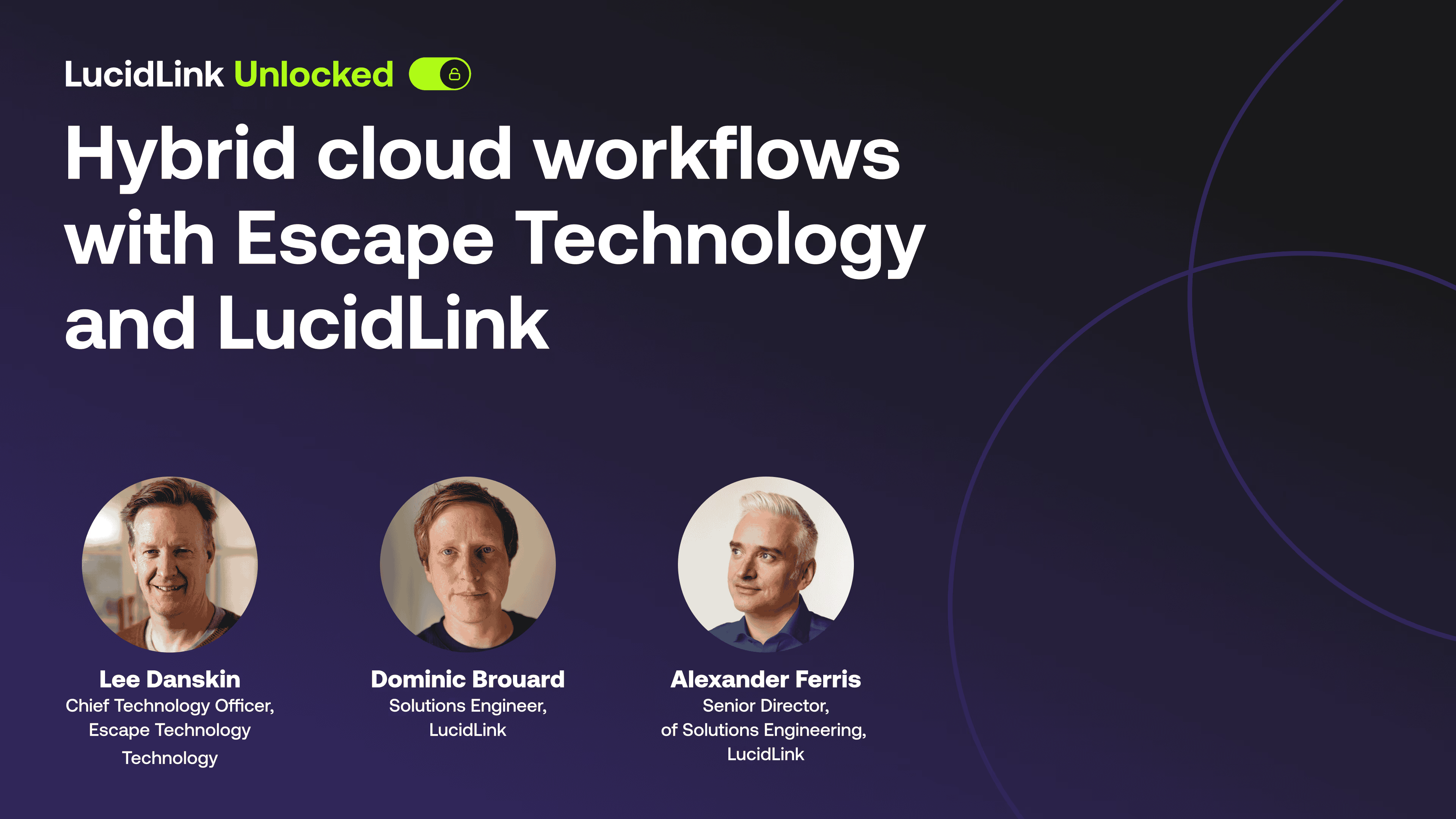
Okay. Just a reminder of why we're here. So you are at LucidLink unlocked right now. Welcome.
This is your inside look into how LucidLink can transform the way you work, without changing the tools and workflows that you already use. So the series is dedicated to going deep into LucidLink and our partners to get inside the pro tips and the insider info. So we're really happy to have you all here to join us. Fifty five fifty five and counting, which is amazing.
So today we have our VP of solutions engineering, Alex Veras, one of our fantastic newer, solutions engineers, Dominic Breuard, and the CTO of Escape Technology, Lee Danskin.
So we're gonna go through two different slightly different, demos of how LucidLink and Escape Technology slash Sherpa, which is the platform of theirs that we'll be demoing today, work together to make your workflows even more powerful. I'll let these guys tell you a little bit more because they they know all the technical know how.
But before we get started, Lee, I wanted to ask you. For peep people who are just now joining, they have a whole hour ahead of them. Why should they stick around for the next sixty minutes?
They should stick around for the next sixty minutes because I'm gonna be super exciting. No.
Primarily, if if if cloud has always seemed daunting, and has always seemed awkward, then hopefully we're gonna make light work of cloud today where everybody goes, wow. Data's easy. Spinning up stuff's easy. This is a different world. So, yeah, stay around.
I believe that. I believe that. Dominic and Alex, anything you wanna add to that?
Just that you're gonna see a real world demonstration of a challenging workflow, and it will come together before your very eyes. And it really does demonstrate the the versatility, the the, you know, the scale that you've got working with Lucid Linker Sherpa. So I'm genuinely excited, you know, that we're actually gonna have three people collaborating on a on a project in front of you, you know, today. So and we're gonna kind of split up the demos.
So, you know, we're gonna talk a bit, do a demo, talk a bit, and do a demo. And you you'll get to see something from all of us and how it fits together. So, yeah, looking forward to it. Dominic, anything more you wanna add?
No. I'm just gonna say that I'm excited that we're gonna show that you can collaborate regardless of where you are, whether that's an exotic location somewhere in the world or or whether it just happens to be at home. We like working remotely, and I think we're not the only ones out there. So, hopefully, we'll get to see that in action.
Are you saying Norfolk's not exotic?
Let let lesser known Norfolk.
Yeah. I assure you it is.
It's great.
Well, Alex, I will hand it over to you to screen share whenever you are ready.
And I'll see you guys when it's time for q and a.
That's great. Thank you very much. So I'm gonna hit screen share.
You might see our own faces staring back at you for a minute. Now I'm gonna switch to my presentation.
And we got a couple of slides just to kind of lead in. I'm gonna wait for it to update for me on my other screen here.
Let let's let's make sure that that we're actually sharing the right screen. So if anybody wants to chime in and say you're sharing something stupid, please feel free to tell us so.
I can see it on my other laptop. It's about twenty seconds behind real time but it's the right thing. Hi. Workflows with Escape and Lucid Link. So, we, you know, Marcy kindly introduced us very briefly but let's just go through, get a little bit of background from you, Lee on, you know, your experience, kind of what brought you here today, and then. Yeah. We'll get into the actual discussion and demo.
So, I'm Lee Danskin. I originated long, long time ago, thirty five years plus.
Used to work for a small company called AES Research who developed Maya and Paranameter running on silicon graphics. I was on the Maya development team. Did that for about six years. Run off and went into post production because my wife said it'd be really good if you were in the country and see me every now and again.
So, obviously, I made the cruel decision to go into post production for ten years and ended up working at the film factory, Smoke and Mirrors and I ended up at the Moving Picture Company. Then we set up Escape and for the last eighteen years, we've been doing escape technology where we escaped the industry and did a really bad job of escaping the industry because we're still in the industry thirty five years later. So, Escape developed Sherpa about five years ago or started developing it. So, essentially, it's a tool set that we'll show off in a bit.
That's great. Well, it's it's brilliant to have you here. Dominic, a little bit of background from you.
Sure. So I'm a solutions engineer, which means that my role at Lucid Link is to understand customers' requirements, their workflow. I've got a background and expertise in media and entertainment infrastructure, cloud technologies, and SaaS platforms. And so I'm really meant to be sort of a trusted advisor who will walk through and find and identify pain points and bring Lucid Link and show how it could be a solution to help with those sort of pain points that our customers experience.
That's brilliant. Well, great to have you on the panel today as well. You know, similar background to you guys from me. It's IT if you go back far enough, you know, but for the last fifteen years or more, very heavy focus on things like collaborative post production, media asset management, cloud adoption, workflow automation, that kind of stuff. But definitely based around helping our customers and partners solve challenges, both, you know, their current one and their emerging challenges for things like collaboration over distance. So it's good to know we've got a mix of creative and technical attendees today on the panel because that's kind of the experience we're bringing as well. And let's get into what we're actually gonna talk about then.
So I've done the introductions, and it it's great to be here. We've got a big group watching, so I'm really pleased with the turnout. We're gonna be discussing, you know, the challenges with remote collaboration over distance. And based on, you know, the personas of of the poll there, I think you're all gonna be really familiar with those.
What we're also gonna do is give you a demonstration of how to solve those challenges with two very complementary platforms, LucidLink. And some of you may be customers of LucidLink. You may be current users of LucidLink, or you may be kind of new to it. We're gonna start with a very high level overview and then explain the challenge we're gonna solve today.
And that will as well bring in Escape's platform Sherpa to provide a virtual compute automation. And Lee will speak much more eloquently than I about about that Sherpa platform and give us a live demonstration as as well, spinning up workstations to work on and also integrating them into our LucidLink file space, which we'll go into in a moment. We're also gonna talk about some kinda more exciting, scalable, future proof architectural options that these two platforms bring and finish up with a summary, take any questions like Marcy said and get kind of final thoughts on it.
So good to be here. Hopefully, you're looking forward to the the conversation.
This is what we're gonna be showing you, a very challenging collaborative environment. There's me in London. I'm actually in the rural fields of Norfolk as we know, which to some might be even more challenging place to collaborate from, but I can even collaborate from there with Lucid Ling. Let's imagine this scenario. Right? I'm a creative user. I wanna start collaborating with people around the world.
And here's Dominic. He mentioned he'd be in Miami. Again, he could be anywhere, as could Lee.
You can see a problem emerging immediately. Right? We're completely disconnected, and we're separated by a giant ocean. If we wanted to collaborate on the same content, on the same media files, there's an there's an immediate breakdown in that potential.
Right? We're not connected. We're not using the same platforms. We're not able to see what each other are doing.
The way people solve this challenge today, and you've all probably experienced it, is generally based around giving me access to the content that we wanna work on. Let's say I'm an editor. Right? And I wanna work in Premiere, Adobe Premiere to create some content.
Dominic over there is gonna record some content. Maybe he's got a camera crew. Maybe it's a live event. Maybe he's got an existing on premise server full of content.
I can't connect to it. He has to get a copy of that content and send it to me. And that might mean old school, shipping a hard drive. Right?
Copying it on, putting it on a plane, flying it overnight. It might mean sending the files to me through an upload, download service, you know, a more traditional wait for the files to upload. And, you know, these are gonna be big files. Right?
Like, I'm sure you all experience working with very, very large video files, long time to upload that content.
And then I have to download that content. Again, there's a wait there. You end up with three copies of that data. One with Dominic, one in the the cloud, and one on my local storage in London.
And we've completely remain completely disconnected. I'm working on one set of files and Dominic's working on another, and we can't see what each other are doing. The other option is to send it through some type of file acceleration or data replication service that may be quicker than upload, download, but still results in a completely isolated set of data for me. And that still breaks down the collaborative opportunities.
It still introduces versioning issues. It still means we're both managing a separate set of data and linking to different projects. So this is the way people have solved that problem of a person not being connected to the data in the past.
Today, we're gonna look at the first stage of this multi vendor solution, which is connecting through a LucidLink file space. Now for those of you that use LucidLink, you'll know we install a client application on the desktop, whether it's Windows, Mac, or Linux, and we've got iOS and Android clients as well.
And it connects the user and their computer, their operating system to some cloud services. So behind that LucidLink logo, you can imagine the scale, the availability, the resilience of AWS object storage. You know, Amazon Web Services and their global network of data centers, that's what's sitting behind this LucidLink file space. The differentiator is the LucidLink client makes the data that's in the cloud instantly accessible, which means we don't have to do that download that I mentioned or that data replication or that data transfer that that you would have previously had to have done.
It can be any size dataset, hundreds of terabytes, petabytes of data for some of our larger enterprise customers. And any part of it is instantly accessible on any operating system in any application. So it solves a lot of those challenges around wasted time, the security aspects of sending unencrypted data around the world, and also managing different versions of files, relinking media offline messages, and so on. We're going to bring in another collaborator later on, represented here by Lee. But first, let's take a look at the LucidLink demo, and we'll talk about how Dom and I are gonna collaborate.
So I'm gonna come out of there, and I'm gonna minimize my presentation, and I'm gonna minimize our faces.
And you should now see my macOS desktop.
My other screen is about twenty seconds behind real time, so it's kinda confusing what you can actually see. I'm assuming it's it's up to date for everyone else.
So this is the LucidLink client. It's my MacBook. I'm sat here in a shared office on a Wi Fi connection, basically. And remember, I'm that orange user on that map. I'm Alex in the UK, and I wanna start collaborating with somebody somewhere else.
This is the LucidLink client, and I simply log in as a user. You can see I'm logged in here as a particular user, and that is presenting to me what we call workspaces. And I'm logged into in fact, this is one of Lee's workspaces called Acme Data. And inside that workspace is a drive.
This is a file space. This is, you know, this is what presents itself like a drive. It's worth noting that I'm just a collaborator on here. The only option I have is to leave this workspace.
I don't have any administrative capabilities like adding users or modifying permissions. In fact, Dominic's gonna play that role in today's demonstration, and he's gonna decide what I can see remotely and make things appear and disappear on my mounted drive immediately in real time. But before he does that, let's just take a look at what's behind this. It's really straightforward.
Once you're logged in to the client, you can kind of forget that it's there.
Even though we look at the details of this particular file space, the data for this is in an AWS data center. It could be anywhere in the world. There could be hundreds of terabytes of data in there.
The data that you're gonna see me work with today, it's important to remember, is not on my local machine. Okay? It's stored in that AWS data center. But I can access it anywhere in the world where I can install LucidLink client. I'd log in and simply open that file space, and it presents itself just like any other local disk to my macOS operating system. Again, I could be on Windows or I could be on Linux, and you'll see some of the mobile devices later on in the demonstration.
So despite the fact this data is sitting in an AWS data center, I can see it just like a drive. Now I've only got access to one folder there. There's actually lots of other data in there that will start to appear as Dominic gives me access to it.
Just remember, when I'm browsing this directory, I'm not looking at local media.
Finder, in this example, kind of thinks that it's live, and I can click on it. I can start playing back that file.
And I want you to imagine the data streaming from the cloud in real time here. The file is still in AWS. And no matter where I go in the world, no matter which machine I connect from, that data will only remain in AWS.
When I hit play in an application, I'm starting off with a simple example in Finder here, that data starts coming down from the cloud. Likewise, if I wanted to open it in a bigger app you know, another application, I could load QuickTime. I could jump to any part of a video timeline and hit play, and that data is just gonna be delivered on demand. We haven't had to do that download workflow that you'll be familiar with from other solutions, like right click, download, right click, make available offline.
But you have to wait for the full file to download onto your local machine. There's no need to do that. You can simply select an asset and start streaming that data out from the cloud in real time. Now Lucid Link's doing some really interesting kind of clever caching in the background there.
That means if you ever need to play back data more than once, the second time you play it back, it comes from your local disk. So you can minimize things like the challenges of low bandwidth or high latency or egress charges if if you're paying those as well. So really, really straightforward way to work. What we can actually look at is a bit of collaboration between Dominic and I here.
I mean, if that's clear that kind of what I'm showing, this is streaming that data on demand. Let's let's Dominic, if you don't mind, and we'll share your screen in a moment after this so people can see. But I'm really keen for people to see it from my perspective, first of all. Why don't you upload a new file or maybe create a new folder in that live uploads directory and upload a file, and we'll see what that looks like for me over here in the UK.
So I've just created a Reels folder, which you should see, and I'm gonna copy in a file from my local machine. That's copied in now.
Yep. You probably can't see my screen, but that's already appeared for me.
And I can see it. If you can I don't know if you can all see that? I can see a little icon there that says another user is still uploading these file changes to the cloud. Right?
So how big is this file? We can see it growing. Right? If you can see that, this file is growing, but it's not being sent to London.
It's being uploaded into AWS. It hasn't even finished uploading yet, and that's what that icon means. But despite that I'm gonna mute this because it's there. I can actually start playing back that file in QuickTime before it's even finished uploading.
This is a really great way to visualize that streaming technology LucidLink brings into any application.
Just looks like a local disk, but you've got the scale of the cloud and the availability of the cloud.
I see it's uploading now.
Yeah. I can see the little icon that says someone's uploading it. It's disappeared, which means all that data is fully in the cloud now.
But I still haven't had to download it. If I pause my playback, we've only brought down twenty seven seconds of this file. The rest of the file, it's in AWS. It's available.
You know, I can jump along that timeline into any part of this file and start playing it, and we've missed out the bit in the middle. It's really good way to visualize that real time data access. Think about that map streaming up from Miami, streaming down to London. And if I press pause, it stops coming.
Now Lee could open up the LucidLink client, connect to that file space. And if he has permission to that folder, he could be playing it back as well. And it would be streaming to him, but only the blocks that he requests. So it really is looks and performs like a local disk, has the accessibility in the shared collaborative space of a NAS, but it has the scale, the global accessibility of the cloud.
So it's really simple from the creative user's perspective and really clever and interesting from the technical user's perspective, and we'll get into that. So this is a really cool way to think about accessing data that's already there and looking at data as people actively add it. And that's a real example there. I'm literally on this Wi Fi network.
That file has never been there before.
Dominic uploaded that into his into the file space, and I was able to play it. Let's look at one more thing here, Dominic. And then I'm gonna before I do some work on the project, I'm gonna ask you to share your screen and actually show the the view you had just quickly so everyone gets an idea. Why don't you change the level of access that I have in this file space?
Remember, I'm logged in here as a user. I've mounted the file space, and Dominic is in control of what I can see. He's the administrator as you'll see. So if you if you choose, like, a project or something like that, Dominic, then talk us through and let us know when you've done it.
So I've just added you to a user group called Donut, and that's gonna grant you access to two root folders within the production demo file space. It's a media donuts folder and a projects premiere donut folder. And you'll get edit access to both of those.
Brilliant. Yeah. That popped up.
So remember, Dominic could be anywhere in the world. I could be anywhere in the world, and he's just said, Alex can access this data from where it already is. He hasn't sent this data to London. I haven't downloaded it onto my laptop.
This data is in that same AWS data center as the content I've already seen. I can see here there's some project files. I can also see some source content. We're gonna get into the the actual Blender workflow and and and so on in a minute.
If I stop sharing just for a moment, let's very quickly
show your screen, if you don't mind, and then we can just show people what it looks like from as an as an administrator.
So as an administrator, I've gone to the workspace groups tab, and I have added you as a member to this workspace group, And that has granted a predefined set of permissions to specific folders within the file space with edit access.
So it's as easy as clicking add member, finding your email address and hitting tick. It's very easy to administer.
Excellent. And if you click the go back to your dashboard and actually look at the the workspace, you'll see you have more options than just to leave. Right? Because you're an administrator, you've got all these other settings. You can configure permissions.
In fact, if you look at members, we'll probably see Lee in there as well. Right?
Yeah. So Lee's in there as the What? Space owner.
I'm the other. It's all it's all about me.
It's it's all Lee. Alright. Let's very quickly now jump back to me. I'm gonna make a couple of edits on the project. We wanna make sure we we hand over to Lee for his section. So I'm gonna share again the whole screen.
And now that we're back to the file space. Right? Here is the stuff that you just granted me access to. I'm gonna load the doughnut project. And my role as creative editor is to finish the edit and then publish something out for you to review as my producer. Now I can see that project instantly loaded up despite me just being given access to it.
All of the assets here in the project bin have automatically linked up. Right? I didn't have to download any of these. And if I look at the properties for that, you'll see they're already in a location that Premier thinks is local, which is great because I didn't have to wait, and I don't have to download it.
They're all delivered on demand. So let's fill in this you know, I can see a timeline here, and I can I can look through it? This is an image sequence actually that was produced out of out of Blender by Lee. I'm gonna fill in the the gap there on on the timeline.
Let's just quickly do that. So now I've got a complete edit.
I can play back my edit in Premiere. I'm streaming into Premiere just like I was streaming into QuickTime, just like I was streaming into Finder. And now I've got my donut timeline here, and anyone that's ever worked with Blender will get the reference here.
So there's our donut. We've got our little outro animation collaborate everywhere instantly. So what do I wanna do? Right. I wanna export this back into the file space so that Dominic's able to review it. I'm simply gonna jump to the export tab.
And because Lucid Link looks like a local disk, I can use it as a export location for my render. So I'm gonna export it to projects, premiere donut exports. Okay?
Dominic, and I'm gonna call this donuts live export because it's super fun and real. I'm gonna hit save, and I'm gonna export that. Simple as that. Premiere is rendering my timeline, and it's actually uploading this data. It's it's already finished it, actually, because it's such a small small edit. It's that quick.
I would actually see that go into my exports folder. There it is. It's in the drive. I'm gonna stop sharing.
And then, hopefully, you'll be able to share your view, Dominic, and you'll tell me whether or not that export is right.
Yeah, so I'm gonna share my screen now.
So you should see my iPhone screen. I've joined from a mobile phone now, and I've got the LucidLink application, and I'm gonna go ahead and browse into that exports folder, and sure enough, there's my donuts live export.
I'm gonna hit and play back that video now. You can see I've scrubbed through, but essentially I'm still streaming this file as and when I want to. None of this is pre downloaded.
I'm just gonna scrub a little bit further along because I wanna see Lee's bit.
Ah, we have a problem.
The problem is is that Lee has done the donut in the wrong color. So we want green donut Lee and you've given us a brown chocolate donut.
Yeah.
You know, it's I'm not I'm not very good at this three d stuff.
I've only been doing it a little while.
So I must try harder. I'll I'll get you a green doughnut, and it it you mentioned something about a lucid logo on the cup as well, I believe.
That's that's right. So let me now show a couple of views of sharing. Let's bring Lee in. I wanna show you one other one other thing before we do that, just to really highlight what's what you're about to see.
So you've seen that first demo. Right? You saw Dominic and I collaborate. He made something instantly accessible.
I opened Premiere. I completed the edit. I rendered it back into the cloud. He watched it on his phone.
That was us.
No no downloading. No drive shipping. Now Lee, right, is normally in London.
He is our blender artist. He's our three d collaborator. But at the moment, notice the addition of the sunglasses. He's on holiday.
He's not near his workstation. He doesn't have access to the dataset. What are we gonna do? This would be a very challenging issue.
Like, how can we get Lee to output this new content quickly without sending drives, without doing upload downloads. And that's fine because he's gonna now demonstrate spinning up virtual complete compute bursting into the cloud for a workstation that integrates directly with LucidLink, which means we don't have to send him the data. We don't have to wait for him to get home. We don't have to let him find, you know, a Blender workstation on the ground wherever he is.
So, Lee, I'm gonna hand over to you. You share your screen and talk through that process of spinning up a workstation and then adopt the persona of the render artist and please update our donut. Let me stop sharing.
Hopefully, I'm sharing now.
There we go. Look at that. It's like we planned it. Okay. So this is Sherpa. For those who don't know, hopefully it's all visible and everybody can see what what I'm looking at.
Here we have the Sherpa GUI. It's very straightforward. We have some projects. I have some cost reports and a little dashboard.
Projects inside of Sherpa. So Sherpa is an API that we wrote about five years ago that allows us to talk to all of the major cloud providers. So we've got Sandbox, Ubuntu, and I have this project here. Each project is in its own VPC in AWS parlance, which means obviously, if we're in AWS and Lucid is in AWS, we get no egress charges from EC2 in and out to Lucid Link as well. So that's a massive benefit.
So let's imagine that essentially, we wanted to make a project, we could make a new project just to go through the process.
We could make a process called loose, a project called Lucid.
I can pick a provider. I could say it's AWS.
I can give it a location. So pretty much anywhere in the world. I'm gonna pick Ireland just as a quick one.
I hit next, I get my pizza menu is what we aimed to make this as simple as. So what we're trying to do is hide all the complexity of AWS, all the complexity of Azure GCP, just make it really easy to use. So at the top, you've got a workstation. I can give it a name, WSO1.
Wow, complicated name. We can come in and we have the ability to give any environment we want. So we could spin up a flame, we could spin up a rocky machine, we can spin up a windows machine, we can give it a size. Well, let's give it a profile first.
Let's make it a rocky machine. And wherever I've picked, I can then pick a GPU or a machine that I wanna spin up. Okay? So this is how we generate a project inside of Sherpa.
I'm not gonna go through the crazy aspects of that. If you wanna go through it, give us a shout. It's not a problem.
And I will do the here's one we did earlier. So this is Acme Inc, which is the, project that we're talking about. So again, in Sherpa, we have the ability to have a Linux workstation, a Windows workstation, a collection of things all in its own VPC, super, super secure again.
The Windows workstation, you can see currently I've turned on and I have a Lucid Cache. This is my, Teradici or HP Anywhere connector. So let me just disconnect and make this fairly obvious.
So if I pull in here, obviously, my Windows workstation, if I click on it, it will tell me where it is in the world. So this is in London. I need a new one, so I'm gonna add a workstation. So very quickly and easy, I can come in, add a workstation, give it a name.
Let's add one. We'll call it new underscore machine, and we'll give it a build profile. So I could, give it a three d workstation open source. So this is the golden image, as we would call it.
Golden image, basically, this is a three d workstation that has Blender. It has GIMP. It has all the open source programs on it that I like to play with, but it also has Lucid on it as well. So Lucid is already installed, ready to rock and roll when I need it. I can give the workstation a size.
It's then going to say to me, hey, Lee, you realize that this is going to be about fifty two pounds a week for fifty hours. You leave it on all twenty four seven. It's a hundred and fifty pounds. So Sherpa's telling me how much this is gonna cost me at the same time.
And I can say, right, okay, let's go and create that. And I just say yes. So Sherpa's now gonna go and make me a brand new workstation, then one here that's called new machine. So you can see currently, I have a saved state. My little project in the meantime is gonna go into a build state, and this will start building, as you can see. Look at that. It's almost like we planned it.
Here though, I'm going to connect to this Windows Workstation o one. Okay? Just because, again, time in about sixty seconds, ninety seconds, that will have built. But just to show you what's going on, let's shortcut the process a little bit.
So this is me connecting to a workstation in the same way as a lot of people have with Teradici worldwide. So this is connecting to this workstation right here.
So I've spun up a workstation.
Up comes my workstation, and there we have it. So let's imagine we now have our workstation. So in the same way, I have Blender, Natron, all the open source applications that I was talking about, and this is a Sherpa machine. I have access to Lucid in the same way. I have projects.
I have the donut, and I can see that I am a donut, and I've made it the wrong color, which is crazy. Bad, bad form on my part. Dom's got the right ache because he already sold me the logo, sent me the logo. So let's just launch blender.
And obviously, we can come in and I've sort of already started this process. So I've got Blender open, I need to just change obviously the brown to a nice subtle green or not so subtle green for Lucid Link. Obviously, I could ask all the nice things. But let's just render a quick test render just to make sure that that's doing what I'm expecting it to do.
So there we go. We have a machine rendering in Blender through to Teradici on a workstation that I've just accessed in the cloud. Super straightforward.
So at this point, I could send this to Dom, but in in no. I know Alex is after it in a big rush. So what I'm gonna do is just stop that. I'm just gonna start a render on an animation.
So he'll know that as I'm writing to LucidLink, instantaneously, that's pulling straight into Lucid up in AWS. So all of this data is there on demand for me to get to anywhere I've got a workstation. So all of my paths work, everything works as I expect. To Alex's point, I am streaming in all the text ures straight from AWS into this workstation that could be anywhere in the world. Absolutely not a problem. So I'm now rendering this as an animation. So if I stop sharing for a second.
And where where is this going, Lee, in into the file space? Which folder are you uploading that to?
So this should be going into your media folder now. So this should be going into media donuts blender. Donut dot zero zero zero one dot ping. And it's already on the next frame. Look at that. Rocket ship.
Yep. I can see that stuff coming in.
Let me share my screen.
these they're they're renaming additional file. I don't know if can see that, Lee.
But we are see that.
Yeah. It's it's basically the files are appearing as fast as as fast as Lee can export them. You can see them coming in here. We get that same kind of another user is uploading them, but we're not we're not downloading. We're not automatically synchronizing them. Now if these were replacing the original frames, the original image sequence, we would even see it in Premiere start to update one by one.
And you'd see that first frame because this is an image sequence, basically. If I were to jump to where that is in Finder, you're gonna see that basically brought in that image sequence as it came out from the original render.
This is taking a long time, though, Lee, to be honest. You know, I've gotta sit here and wait for each one of these frames to come out of your render workstation there, your Blender workstation. Is there any way we can speed it up?
Yeah. Yeah. Look. Let let's let let me let me reshare. Let me get my path in right.
That might be useful, mightn't it? And get my name in logic right. That would be a useful thing to do. So, let's go back and let me share my screen again.
Obviously, at this minute in time, what I have currently, let's just get rid of Lucid client for a minute. So, you can see there that my little workstation is building. So, that's.
Let's do there we go. Sorry, it's just popped in for me.
Did it pop in eventually?
Yeah, I can see your screen now, yeah.
Cool. Cool. So let's go back to deadline over here. So currently we have Blender. Let me just see if I can fix the pathing. That should fix the pathing now.
I'll save my scene.
Automatically in Sherpa, we have our lovely workstations and everything here. You'll see at the bottom here I have a deadline server and I have a Linux render node as well. So at this point in time, I can come in and make sure that I could start this render node.
And what are what what are these? Just for anyone on the webinar, Lee, that doesn't know what a rendered because we have some creative, some technical people here. At the moment, you've got one workstation out doing all the rendering. So what what would this give you?
Exactly. So at this minute in time, obviously, a workstation, as you can see here, the Windows workstation that I've got here is essentially running blender on a single machine.
Let's let's imagine that I've got one hundred frames which we have. We've got one hundred frames of donut. We want to render those one hundred frames of donut a lot lot faster. Obviously, one machine is gonna take a minute a frame. That's one hundred minutes. If I spin up ten machines, I'm gonna do this in a lot lot quicker time especially if I wanna change the size of the machine as well. So, at this minute in time, this little machine has, quite a small aspect on it.
So it's quite a tiny, tiny machine that I'm using here for my Linux render node. So I could spin up some more render nodes. So my new machine has just finished. So you can see there on my new machine, if I wanted to, I could now invite myself as a user to this workstation and connect to my new workstation that's just finished building, which is wonderful.
But I need to add a load more. So if I just jump back to the workstation quickly, obviously, if we put deadline, we can put blender away, we can pop deadline up. Here's deadline.
And at this minute in time, you'll see that I have just started a single render node. I have my render node here. I have my project there. So at this point, I've been trying to render locally on this machine.
And like I said, minute of frame, a hundred minutes later, I would have it all on my workstation. But I wanna go a lot, lot quicker than that because Alex is applying the pressure and Dom wants it to go out. So if we come back to Sherpa, you can see here I have one Linux render node. So let's add a few more.
So very quickly, can just say add some render nodes. And if I come in and add a node, I can give it a name, n, let's call it render render node. I can come in. I've got my render node already assigned, my golden image again with blender four point four.
I can come in and give it, a nice CPU. So I could say, well, actually, we'll go with a standard CPU. What does that give me? So hover over at sixteen cores, thirty two gigs of RAM to render a donut.
Anybody that's ever done three d knows that donuts are wonderful.
I wanna add a few more of these. So, I wanna create how many? I wanna create ten of them.
I'm gonna pad the sequence and I'm just gonna get rid of that space because I put one in there. So, at this point, I can say, create, say yes, and this is now gonna go and make, as you can see, ten new render nodes. So all of these machines now, let's just try and see if we can see this working side by side. So if I put my Anywhere client, that's going to resize and adjust. So you can see that on the left, we've got building now. So my render nodes have gone into a building state.
The project is building. And when we look at deadline in a second, once those nodes have been added, they will now be in my render farm, and I'll be able to submit a job, and we'll be able to render this whole sequence in in very quick time. So there we go. They're building.
I now have to do jazz hands and hope that it goes a little bit quicker.
So once these have all built Even if that job was still running, you could add more into that render farm, and it would then just automatically start farming out some of the frame jobs to those additional render nodes.
Right?
Exactly that. I mean, in what we'll do in Blender now, let's just change back to the workstation.
And while that's building those, we will load up Lucid again.
So we have our chocolate. We can now come in and actually submit this to deadline. So now we're submitting it from the workstation to the render farm so that it will get picked up automatically and start rendering across the farm. So at this minute, I need to make sure that we're putting the output files in the right locate which is media donuts, blender, donut. I don't think we want all of those in there. We just need four.
Yeah.
Media donuts blender is where where the image putting it.
Yep. That's where I thought we were putting it. That's fine. So we'd do that.
We've got one to a hundred. Have the machines appeared. So you can see now all of those machines have now appeared in my render farm. So if I just jump back to Sherpa quickly, you'll see that they've all gone green. They've all built. All my render nodes are added, and they've automatically popped into the worker list within within the deadline. So I can sit, hit okay, hit submit.
Oh, that does not exist. It says let's just double check my output.
So it was media, donuts, blender. I'm overwriting these guys here, yeah? Yeah. So we'll say yes.
So frames per task file. So we'll try again. We'll just hit submit.
And then Those render nodes that you spun up are going to they include Lucid Link line already.
Right?
Which is why All of these have got the Lucid Link client pulling directly again.
So I don't have to worry about my parts. I don't have to worry about anything. Everything's just gonna pull straight in. So, you can see that the ten machines have all come in.
Lucid is now each one of those render nodes is pulling from Lucid and rendering all that data. Now I've used Sherpa to generate a render farm of ten render nodes. It's automatically populated inside of deadline. And hopefully now, as you can see, we're now rendering a lot, lot quicker, Alex.
So hopefully, all of your frames will be jumping into the right folder with the right name this time.
So as you can see there, we've we've done ten already. We're on the next ten. So within a couple of minutes, we will have a hundred frames of green donut.
Yeah. So that that really shows, you know, how three people around the world or more leveraging their own devices in front of them, you know, like me on my MacBook here in the the fields of Norfolk.
Or Lee accessing, you know, a powerful GPU based virtual compute workstation in a cloud provider through Sherpa's automation platform can benefit from that single source of truth without the need to, you know, fully upload and download those datasets. What's interesting as well, Lee, is what LucidLink gives you here. You mentioned that, you know, you could kind of spin up workstations in different cloud providers. Today, it might be AWS.
Tomorrow, it might be GCP. The day after that, it might be somewhere else. Normally, if you're working on a compute provider, the data that the applications you install on those compute instances have to be stored within persistent or blocked disk within that infrastructure provider, which means if you wanna move to where there's more GPU or a better price point or a different reason or incentive to adopt a different cloud provider, you would normally have to move all of the dataset with you in order to access it on the application levels. But with Lucid Link, you can just spin up in different providers, and the data kind of is already there because it's in that Lucid Link file space.
I used that comment, didn't I, the other day that it's already there. It's sort of not like the wrong terminology in some respects but you you're spot on. It's it's already in the cloud. I don't have to do the usual Friday afternoon.
Get all the data to the cloud because I gotta do a render you know. That sort of middle moment on a Friday afternoon where you know, awkward Dom and Alex have gone, I need different colors, I need different this and essentially, it's already there. I I can spin up workstations anywhere around the globe and not have to worry about my pathing, not having to worry about anything. Right piece of software and we show up with, you know, it could be flame, it could be resolve, it could be whatever you need it to be and as long as you've got the right caching set and the right things tool set up, you can pull this really, really quickly and easy around the globe and just start, stop, get your end of farm up and running, you know, and and you know, I can stop all of these just by, you know, hitting the stop button, super, super straightforward.
I can come in, I can see that, you know, that job is now three quarters of the way through already.
Well, let me, let me, let me show you.
Sharing and you you see if I got my let's see if I got the path right, you know. Yeah.
I mean I can I can tell you I can tell you you haven't already?
Alex, I want you to share this, and then I'm gonna cut y'all off because we have so many good questions, and I wanna make sure we get you a few of them.
Oh, you're just spoil sport. Look.
I'm I'm being I'm being pedantic. But, look, the point is they're all coming in.
I saw d.
The these these are the rend this is the render nodes outputting this content, and I'm only bringing this data down to my machine when I request it. And, of course, I could come in here.
I could choose to import you know, I can scroll down to my My dodgy numb my my dodgy named version.
In indeed. And then choose it to be an image sequence and import that. And that was straight away. I'm able to import that into my Premier project. I'm gonna overlay my green donut.
And there we go. It's as simple as that. That's already there. Look. And you've got the logo on the Lucid Link mug, which is brilliant.
I'm gonna just do it for the sake of it. Right? I'm gonna call it green doughnut, and I'll export that. I'm gonna export that back out to the file space.
Simple as that.
And Dominic can then watch that on the iPhone app, on the Android app, on his Mac, Windows, Linux machine, wherever he is in the world. And there we go. Super, super simple. And all from one set of data in the cloud, which is awesome. Right. I'm gonna stop sharing, Marcy. If you wanna talk through some of the questions we've got, let's get into that.
But that was love to.
Yeah. That was awesome. Thank you all so much.
And Alex, I see you've been answering some of these q and As in written format. Thank you for doing that. That'll save us some time too.
So this first one is from Spencer, and this is directed to Lee. Can you speak a little bit more to Sherpa's new note how excuse me. How Sherpa's new nodes are automatically adding the file space connections on build? Is that part of the golden image that you created?
Yeah. Yeah. In in Sherpa, you can request an image to be created.
And essentially, so, once you've built your workstation, you put all the software on it, you've done everything that you expect to do. So, you might put Blender, Maya, Houdini, whatever software you want, absolutely is not a problem.
You can request an image. It makes a snapshot copy of that workstation at that point in time. And I just have the Lucid Link client installed ready to go. So when you make any new workstations, the Lucid Links clients there, whether it's for a render node or for a workstation. There are other ways of doing it, there's things that me and Alex would like to get into another point with, you know, the whole, sharing or what's up? I've got a fart moment. Sorry.
Oh no.
But essentially the new storage that.
Right. You're talking about what we can share.
So, it's like cash. I mean, we, you, with a lucid cash, the way we're doing it at the minute, obviously, that's super straightforward but slight cash would enable us to do hundreds, if not, thousands of end nodes, you know, so it's one of those ones where it's a qualifier for having that discussion. But yes, essentially, every render node, every workstation can have Lucid on it. Or you could do it slightly differently, but we we we won't talk about that that way. But there are numerous ways to do this.
Right. I'm gonna make a or I'm gonna ask our social media team to stitch together all of the fun noises and hand motions that Lee has made during this session.
That has been a great part of this. Okay. Lee is asking, can LucidLink handle cross OS paths if some users were on Macs and some Windows?
We we can. Yeah.
Sitting deadline as well. So there are other ways to do it as well. So you can actually use, you know, the Mac OSX and Linux all at the same time. So I can't share my screen, but I had a Linux workstation.
I've run out of time because I talk too much. But we had a Linux workstation that had Natron on there. We could have used Linux to do the workflow. We could have used OSX, and obviously Alex and Dom are both on Macs.
So doing the, cross OS paths, absolutely, you can do that. It's not a problem.
Yep. And also, you can choose to lock down if you wanted to, the LucidLink file space to support, you know, the the Windows supported characters if you wanted to make sure all datasets were accessible to all operating system. For example, Mac OS can put a forward slash in a folder name, whereas Windows wouldn't like that. You can choose to allow that or or prevent that as well. And the application layers, because Lucid Link is essentially a local disk for them, things like Premiere will allow you to support different path URLs to different assets in the project bid. So, yeah, really good for for cross operating system collaboration.
Just just to point out, all of those all of those render nodes were Linux render nodes. So the ones that I spun up were actually Linux render nodes with a Windows front end, and we managed the path in in deadline in that instance.
But the the trick is is that you can do it both ways.
Great.
I'm gonna ask this one next because this alludes to something that may or may not be coming out relatively soon.
Can we leverage the API to push raw data from live events onto Loosevelink to share in order to make the shoot footage available to all users?
Yeah. Out out of the box, you know, anything that reads and write to a local disk or to a network attached storage or a SAN will read and write to LucidLink as long as you've installed the client somewhere that will present it to the service that's writing data. Now that will work for a lot of live ingest workflows, but we also, today, have customers putting other gateway services in front of LucidLink to present it as an s three endpoint where they can upload without the Lucid Link client, and they also can even do things like put HTTP or FTP or secure FTP in front of it.
Longer term, we have APIs and SDKs in development that will allow for programmatic putting and getting, basically uploading and streaming for services that can't have the LucidLink client installed on it. And that API and SDK will also support administrative functions. So things like inviting users, modifying permissions, setting configurations, that kind of thing could be done through the API as well.
So actually combine Sherpa's API into that as well. So you could actually spin up storage workstations and do the ingest if everything was prebuilt for that. So absolutely, you know, both APIs would work together in that instance.
Yep.
Great.
Alright. We probably got time for one more.
Let's do this one from Ed. As an editor who uses LucidLink to receive footage from crews across time zones, are there any plans to add notifications within LucidLink to notify when someone is currently uploading media as well as notify that the media has finished uploading in full?
Yeah. You know, that will be kind of an eventing alert from from the SDK or API. I mean, there are ways to do it today if you're comfortable kind of using the command line tools or the APIs we have available already, publicly documented. We have an audit trail feature that will trigger when someone starts writing a file, for example, or even when someone starts reading a file or deleting a file, any kind of file access activity.
And you can kind of listen to that and send emails, do alerts based on a file beginning to upload. We also have a publicly documented API called the remote upload indicator that you can hit to say, has the file finished uploading? And it doesn't just say, is it all in the cloud? It takes into account the the cache of the machine that's doing the upload.
But they're not kind of available within the end user experience, like in our GUI, in our UX. You have to kind of build that integration yourself using the command line tools and the APIs, but that is possible. We will be productizing something like that with the SDK and API in future. But if you want information about how to kind of do that yourself using some of the back end tools, reach out to us at Lucid, and we can help you.
So, yeah, sounds good.
Great. And I see one question from SciFi here in the chat too. Does Sherpa work with Creative Cloud?
Yes. It works with any application. So think of Sherpa as infrastructure as a service. So essentially, we're spinning up base Linux, base Windows machines.
You put whatever software you wanna put on top of it. So if you wanna run Unreal with Perforce, we can do that. If you wanna run any application at all, we'll run with Sherpa. It's all, like I said, right at the top.
It's HP Anywhere based. So, essentially, it's like having an on prem machine, but it's just not on prem anymore. It's in the cloud wherever you want it to be, but it's your machine. You can do what you want with it.
It's absolutely, you know, open to any piece of software. If you tie a lucid into that as well, things like big SIM data, big Houdini SIM data, pulling that straight in.
You're not waiting on, you know, most people, it gets to Friday afternoon.
Oh my god, we're never gonna render this on our machines over the weekend. What do we do? Lucid eliminates that in a heartbeat. You've got off-site Doctor. You've got an instantaneous, you know, all your changes are being written all week And then at right the last minute, I spin up a workstation, call up a render farm, hit the render button. It's too easy. It really is too easy.
Such a beautiful love story to watch unfold, the Sherpa and Lucid Link.
But I'm not kidding anyone.
Alright? I'm just putting that.
Well, to be respectful of all of your time, I will let you get on with your Tuesday.
But Lee, Dominic, and Alex, thank you so much for doing this today. This is super informative and dare I say a little fun.
I will be walking to my neighborhood bakery immediately and getting a donut after this.
Don't know if anybody Anybody who use blender needs donuts, you gotta have it. Yeah.
Thank you all so much. I appreciate it. And thank you all for being here and asking such amazing questions. This will be recorded and sent out later for all of you asking it in the chat. So if you wanna share it with teammates, please do. And we will look forward to seeing you at the next LucidLink virtual event. Alright.
Thanks, everyone.
Bye bye.
The challenge: collaborating across continents without losing your mind
Picture this: you’re a creative in rural Norfolk, your teammate’s in Miami and your 3D artist is halfway across the globe. Yet you all need to work on the same files, in real time.
Simple in theory. A logistical nightmare in practice.
Old-school methods don’t cut it anymore:
Shipping hard drives still takes days
Traditional cloud storage means long uploads — and even longer downloads
File acceleration tools still leave teams working on separate copies
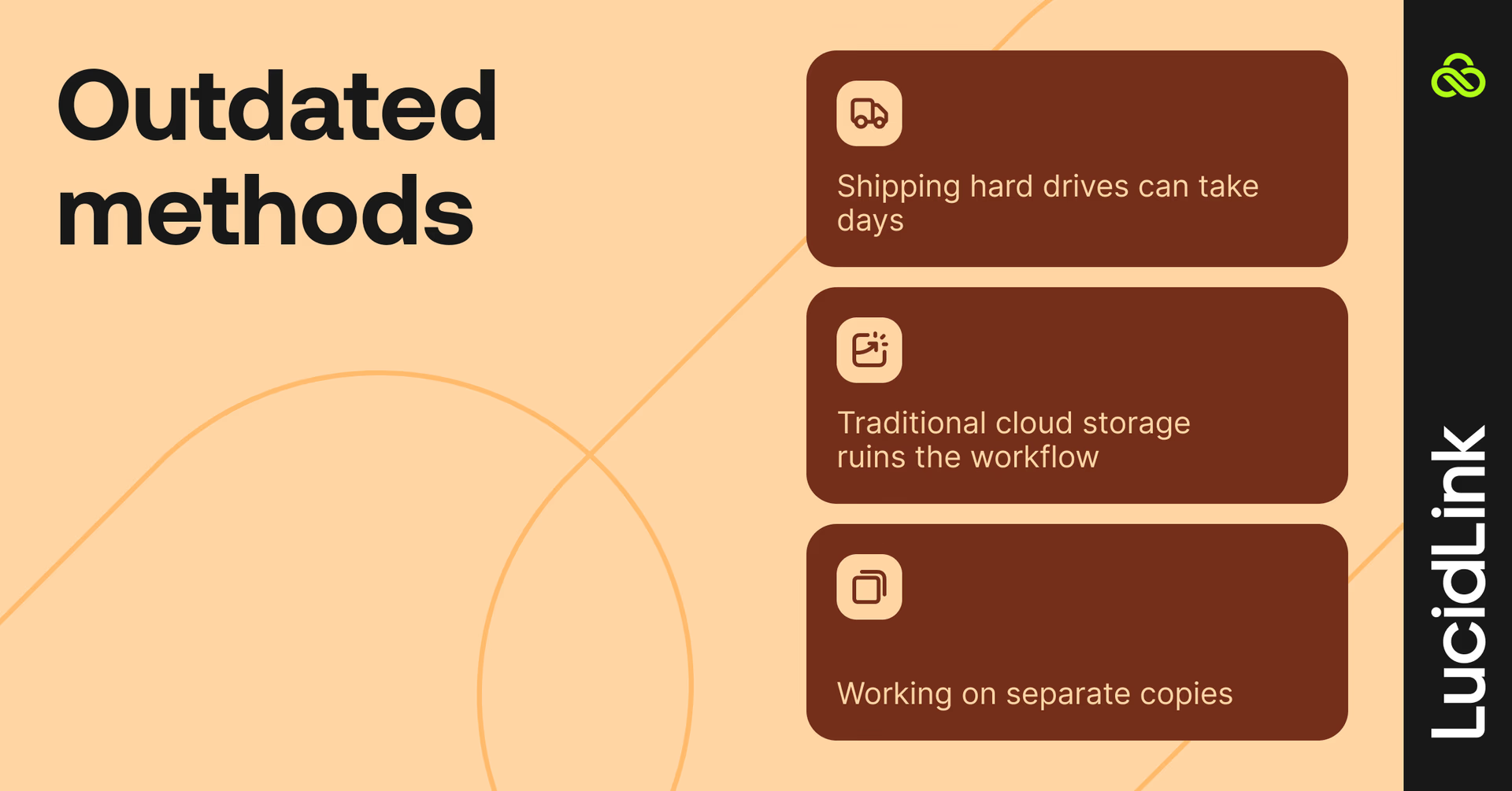
This is the reality for many creative teams. You’re either stuck playing an expensive, slow game of “pass the hard drive,” or you’re spending hours uploading massive files, waiting for them to sync and download again on the other side.
And while file acceleration tools promise speed, they don’t solve the bigger problem: teams still working on isolated file copies, disconnected from each other. Real-time collaboration? It’s not happening.
The solution: two tools, one seamless remote workflow
LucidLink and Sherpa tackle different sides of the same problem, but when they work together, everything clicks. Creative teams get instant access to media, the computer power they need and a workflow that just flows.
LucidLink: instant access, real-time teamwork
LucidLink transforms cloud storage into a real-time collaboration workspace. Files are streamed directly from the cloud as if they’re local — no downloads, no sync delays, no silos.
In the demo:
Alex in the UK previewed video files in real-time while Dominic was still uploading them from Miami
New collaborators were onboarded instantly, with folders and files appearing live on their desktops without IT tickets or waiting
LucidLink eliminates the file transfer bottleneck, giving creative teams immediate access to shared assets from anywhere.
When it’s time for heavy-duty processing (think rendering, 3D workflows or complex effects), Sherpa provides the compute power, exactly when and where it’s needed.
Key highlights:
Spin up high-performance virtual workstations in minutes, pre-loaded with creative applications and natively connected to LucidLink file spaces
Sherpa abstracts cloud complexity (AWS, Azure, GCP) behind a simple API and intuitive interface
Teams can choose a region, select a pre-configured workstation and get real-time cost estimates, no cloud expertise required
Sherpa ensures creative teams don’t lose momentum waiting on hardware or wrestling with multi-cloud quirks.
Why this combo matters
LucidLink and Sherpa together solve the two biggest blockers in remote media production. With LucidLink, your data stays in one place. With Sherpa, compute comes to you, on-demand and scalable.
Together, they eliminate:
File transfers: stream, don’t sync
Manual path mapping: files appear exactly where you need them
Deadline panic: scale up workstations and render nodes in minutes
Let’s see how this works in practice.
Fixes that don’t break the workflow: the “brown donut” story
The problem
Lee spotted a mistake in a 3D animation, a donut was the wrong color. A small fix, but in a traditional workflow, it could cause huge delays. Files would need to be re-uploaded, re-downloaded and passed between time zones, risking version mix-ups and late-night scrambles.
The new way with LucidLink + Sherpa:
Lee demonstrated how Sherpa streamlines compute-intensive tasks by spinning up a fully pre-configured cloud workstation in under two minutes.
Instant workstation spin-up
Lee launched a cloud workstation with Sherpa in less than two minutes
The machine came pre-loaded with Blender and natively connected to LucidLink’s file space
No setup, no IT and ready to go immediately
Direct file access & real-time editing
Lee opened the project file directly from LucidLink without any downloads
Textures streamed on-demand from AWS into the cloud workstation
He made the necessary color corrections on the spot
Real-time rendering & review
As Lee rendered updated frames, they saved directly back into LucidLink’s file space
Each frame appeared instantly on Dominic’s screen, ready for review, no exporting, no transfers
Lee sums it up: “I’m streaming textures straight from AWS into this cloud workstation, wherever it is in the world. Absolutely not a problem.”
Cloud rendering that scales with a click
Now picture this: it’s Friday afternoon, a deadline’s looming and a massive render isn’t done. Local workstations just won’t cut it. In a traditional setup, you’re facing a long night and a stressed-out weekend.
But with Sherpa and LucidLink, Lee scaled up a render farm in minutes.
Immediate render farm spin-up
Lee spun up 10 Linux render nodes via Sherpa in just minutes
No IT tickets, no manual configuration
Each node had immediate access to the shared project data via LucidLink, no syncing or file copying
Pre-built environments, zero hassle
Using Sherpa’s intuitive “pizza menu” UI, Lee selected pre-configured workstation profiles, ensuring consistency across all nodes
Every node was ready-to-go with the right software and permissions, no manual setup
Automated render orchestration with deadline
The team used Deadline, the industry-standard render manager, to automate render job distribution across Sherpa’s cloud nodes
This turned a complex, manual process into a streamlined, push-button workflow
Why this workflow matters:
No file copying or re-mapping paths
Render nodes stream assets as needed from the cloud
Distributed rendering slashes production time from hours to minutes
Completed frames are accessible instantly for editors to begin working
Building workflows that scale
Sherpa and LucidLink aren’t just about rendering, they’re built to make every part of your hybrid workflows smoother and faster.
Golden images: Sherpa lets teams create snapshots of fully-configured workstations (Blender, Maya, Houdini, Adobe CC, etc.) for quick and easy setup.
Cross-OS compatibility: whether it’s Windows, Mac or Linux, Sherpa and LucidLink smoothly tackle those pesky path issues and OS quirks without you having to lift a finger.
Scalable automation: APIs for LucidLink and Sherpa allow automation of end-to-end workflows. Spinning up storage, deploying workstations, managing ingest pipelines and more.
Live data workflows: LucidLink acts as a local disk for live write/read operations, making it ideal for live events or on-the-fly content creation.
As Lee puts it, “it’s like having an on-prem machine, but it’s just not on-prem anymore. It’s in the cloud, wherever you want it to be.”
Hybrid workflows that actually work
The days of upload, download and hope for the best are over.
LucidLink and Sherpa give creatives real tools to cut the hassle out of hybrid workflows, without making you say goodbye to your favorite apps or wrestle with complicated cloud setups.
Need to fix a last-minute animation from the beach? Spin up a 10-node render farm on a Friday? Or collaborate live across continents? This combo proves seamless remote teamwork isn’t some far-off dream, it’s just a smarter setup away.