Product & news
Every AI factory assumes the data’s already there. LucidLink has made that true.
by Peter Thompson,
Co-founder & CEO, LucidLink
Last updated 25 June, 2026
6 mins

How a decade of solving distributed data access for humans proved to be exactly the right foundation for agents.
Most enterprises have years of data that can't simply be moved.
It lives on-premises, in regulated environments, across clouds, in systems with compliance constraints that make migration a legal question before it's a technical one.
The assumption baked into every AI stack — that your data is preloaded, accessible and ready to feed the pipeline — doesn't match how enterprise data actually exists.
In reality, before any agent can run, you need a project to copy, stage and migrate data into the new system. That project wastes months and dollars, introduces downtime risk during migration, creates a compliance surface and produces a copy that immediately starts drifting from the source.
Most teams accept this as the cost of entry. But you shouldn’t. It's an artifact of infrastructure that was designed to move data rather than connect to it.
LucidLink was built to access that remote data in place. Today, we’re opening that infrastructure to every agent pipeline, starting with the public beta of our MCP server.
The problem when agents go to production
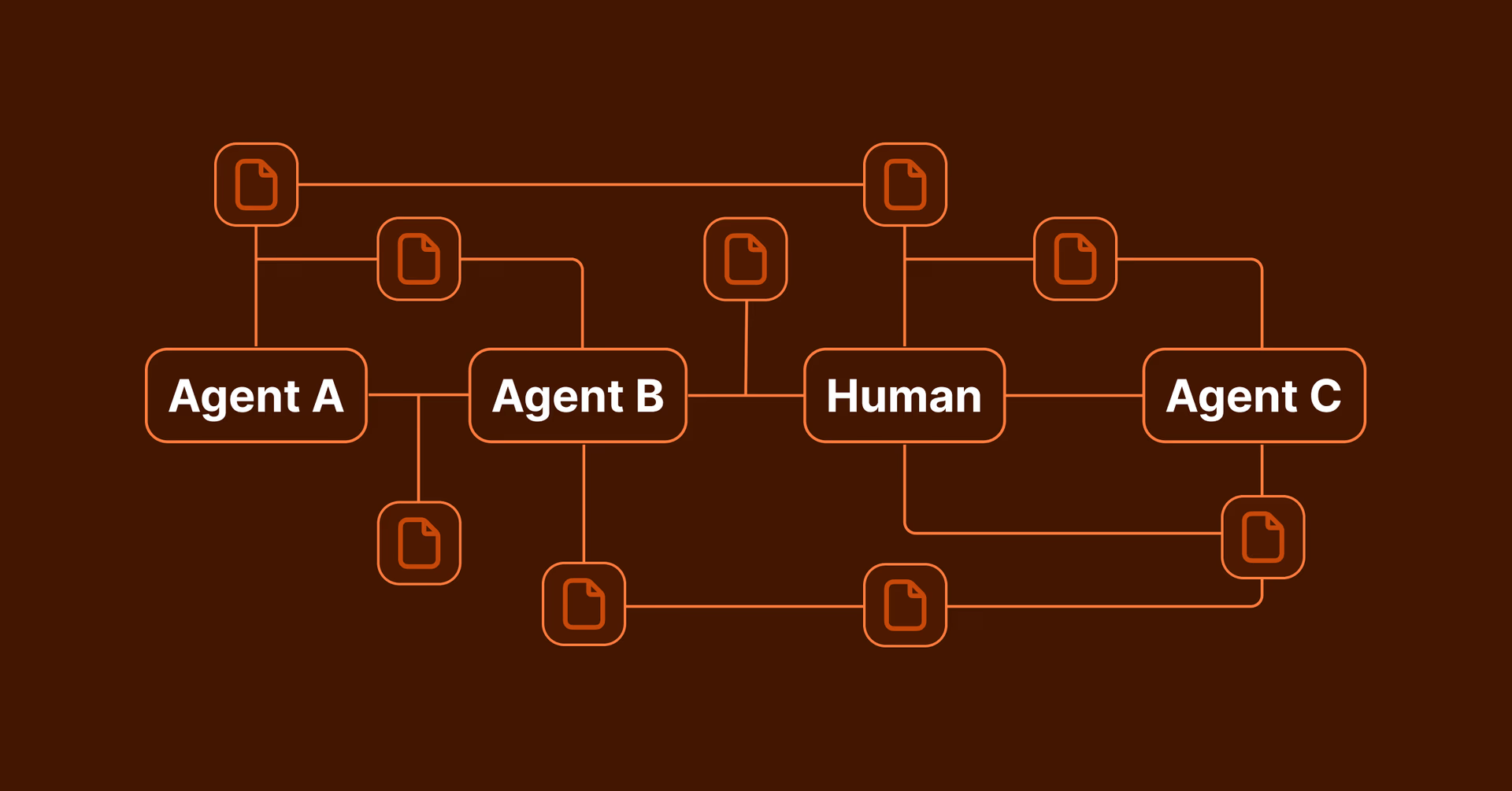
Single-agent workflows work. But the moment you add a second agent, a human handoff or a second node, something breaks: shared state.
An agent finishes a session and the next one starts cold. Three agents into a pipeline, context doesn't survive the transfer. The output looks wrong, and nobody can trace why.
Teams put this down to model or framework issues, but it's an infrastructure problem. And most teams don't hit it until they've already committed to an architecture.
How MCP helps (and how it doesn't)
The Model Context Protocol is a genuine step forward. It standardizes how agents connect to tools and data sources. Interoperability across frameworks is now tractable, and the ecosystem is moving fast.
But MCP is the protocol layer, not the persistence layer. It tells agents how to reach resources. It doesn't provide the durable, shared, writable state that persists across sessions, survives handoffs and stays consistent when multiple agents write concurrently from different nodes.
Files are the lowest-common-denominator interface across every agent framework, language and OS. That means there’s nothing new to install or abstraction to learn. The problem isn't the primitive. It's that local filesystems break the moment you distribute.
What's been missing is the layer underneath: the persistent shared substrate the whole pipeline reads from and writes to.
The same problem, a decade earlier
A decade ago, distributed human teams hit the same wall.
How do you give everyone instant access to shared working state, across locations, clouds and infrastructure, without copying files or losing consistency the moment two people touch the same asset simultaneously?
The teams that needed this were video editors finishing films across three continents. Engineers collaborating on CAD assemblies across manufacturing sites. And enterprise teams sharing large assets across hybrid infrastructure with no option to centralize.
They weren't AI developers. But the problem was the same.
A decade’s experience has proven the answer was never to move the data. It was to make it accessible wherever it already was.
What LucidLink built and why it matters now

Over ten years, more than 5,000 customers and 95+ petabytes under management. These numbers represent production deployments at organizations where data scale, cross-site reliability and security are non-negotiable.
We built the capabilities these workflows demanded. Today they map directly to what agentic AI requires.
Block-level streaming: LucidLink only streams the bytes an application requests. Whether that file is going to a post-production video editor in a home office or a GPU in a datacenter, it happens without downloads, staging or waiting.
Global file locking: multiple agents writing to shared state concurrently from different nodes produces consistent results. Silent corruption, plausible-but-wrong outputs with no visible error, is the failure mode agent pipelines can't afford.
Zero-knowledge AES-256 encryption: every file is encrypted before it leaves the client. LucidLink doesn't hold the keys. The cloud provider doesn't hold the keys. Enterprises control what agents and models can access, and where the runtime sits.
For organizations with genuine data sovereignty requirements, that's a meaningful distinction: zero-knowledge multi-cloud contradicts how hyperscalers operate. That gap doesn't close on its own.
Cross-cloud, any-infrastructure: the namespace works identically whether agents run on AWS, GCP, Azure or on-premises hardware. The agent doesn't know where the infrastructure lives. The data is just there.
File-based working model: agents and frameworks already think in files, folders, inputs and outputs. The MCP Server exposes this same model through standard tool calls so agents work with what they already know.
From human teams to agent pipelines
LucidLink was built to solve distributed data access for human teams. But we’ve extended that foundation with SDKs, APIs, access tokens, LucidLink Connect and now the MCP Server so developers and agents can use LucidLink without depending on a mounted client.
Our customers got there first, connecting agents to their existing filespaces, and what we discovered together was that the infrastructure was already right. The data doesn't move, everything connects to it where it lives.
What we're announcing
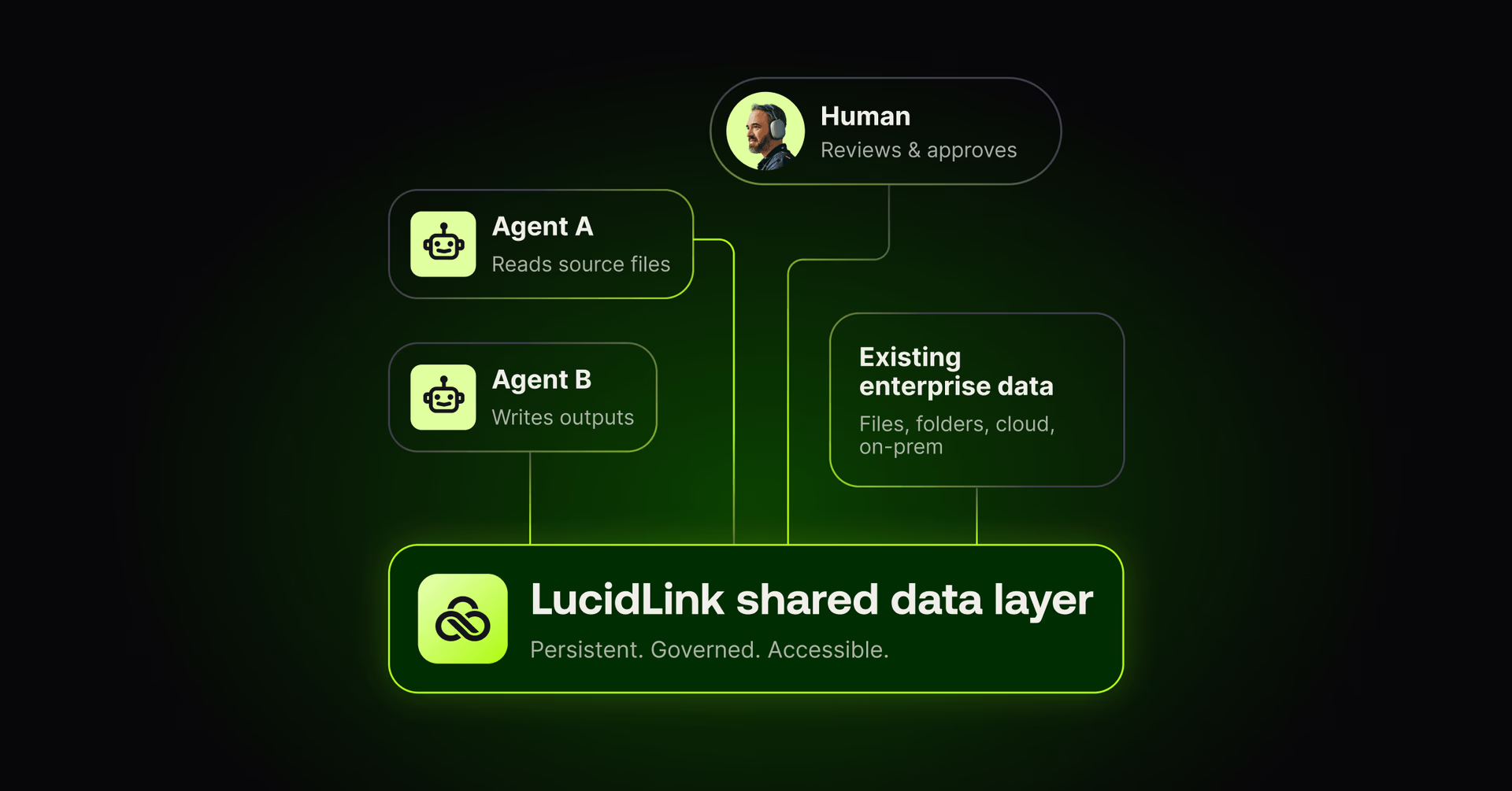
Today we're releasing the LucidLink MCP Server in public beta.
Connect any MCP-compatible agent or orchestrator to a LucidLink filespace and you get the persistence layer that multi-agent pipelines have been missing.
Persistent working state: an agent's working state is a folder in the filespace. The next session, a different compute node, a different framework version — the state is there.
Shared state across the full pipeline: one agent's output folder is the next agent's input. Handoffs are instantaneous. State lives in the filespace, where every participant sees exactly what they're authorized to see.
Humans back in the loop: because LucidLink mounts as a local drive, a human can connect to the same filespace an agent is working from, supplying data, monitoring, dropping instructions and reviewing outputs, directly inside the agentic workflow.
Enterprise security and audit trails by default: every write is traceable, every version recoverable, zero-knowledge encryption and global file locking on by default.
The LucidLink MCP Server supports the same standard that connects most of the AI ecosystem. Claude Code, LangChain and CrewAI are among the frameworks that already work with LucidLink as the shared data layer underneath, giving agents persistent access to the same filespace teams already use.
When agents move beyond demos
Teams are moving past single-agent demos into multi-agent, multi-node production architectures. That's when the infrastructure requirements surface. The workarounds that held during experimentation stop holding.
The more AI evolves, the more context matters. The best model in the world is only as useful as what it can remember.
The teams that establish durable, consistent, secure shared state infrastructure now are building on ground that compounds: institutional knowledge that persists across agent generations, compliance-ready workflows that regulated industries can actually deploy, the data layer enterprises will require before they trust agents with consequential work.
The invitation
To customers already on LucidLink: your filespace is already the right substrate. The MCP server is the connection. You can start today.
To developers building agentic pipelines: this is the persistence layer your users will need at production scale. We'd like to build with you.
To enterprises evaluating agentic AI: the infrastructure question has an answer. The data doesn't have to move first.
To organizations in financial services, healthcare, defense or any regulated industry where data sovereignty isn't optional: the question of whether you can use agentic AI at scale starts at the infrastructure layer.
We've been solving that problem for a decade. The answer is yes, and the data stays where it is.
The public beta is open, get started here.
Keep reading

Product & news
LucidLink wins 2026 Inc. Power Partner Award in AI, Technology & Development
LucidLink has been named a 2026 Inc. Power Partner in AI, Technology & Development, recognizing the results we deliver with customers and partners.
23 October 2026, 3 mins read

For developers
Product & news
A dashboard for your filespace, built where your keys are
Build a dashboard for your LucidLink Filespace from its audit trail with an agent skill for Claude Code and Codex, without touching zero-knowledge encryption.
19 October 2026, 4 mins read
Product & news
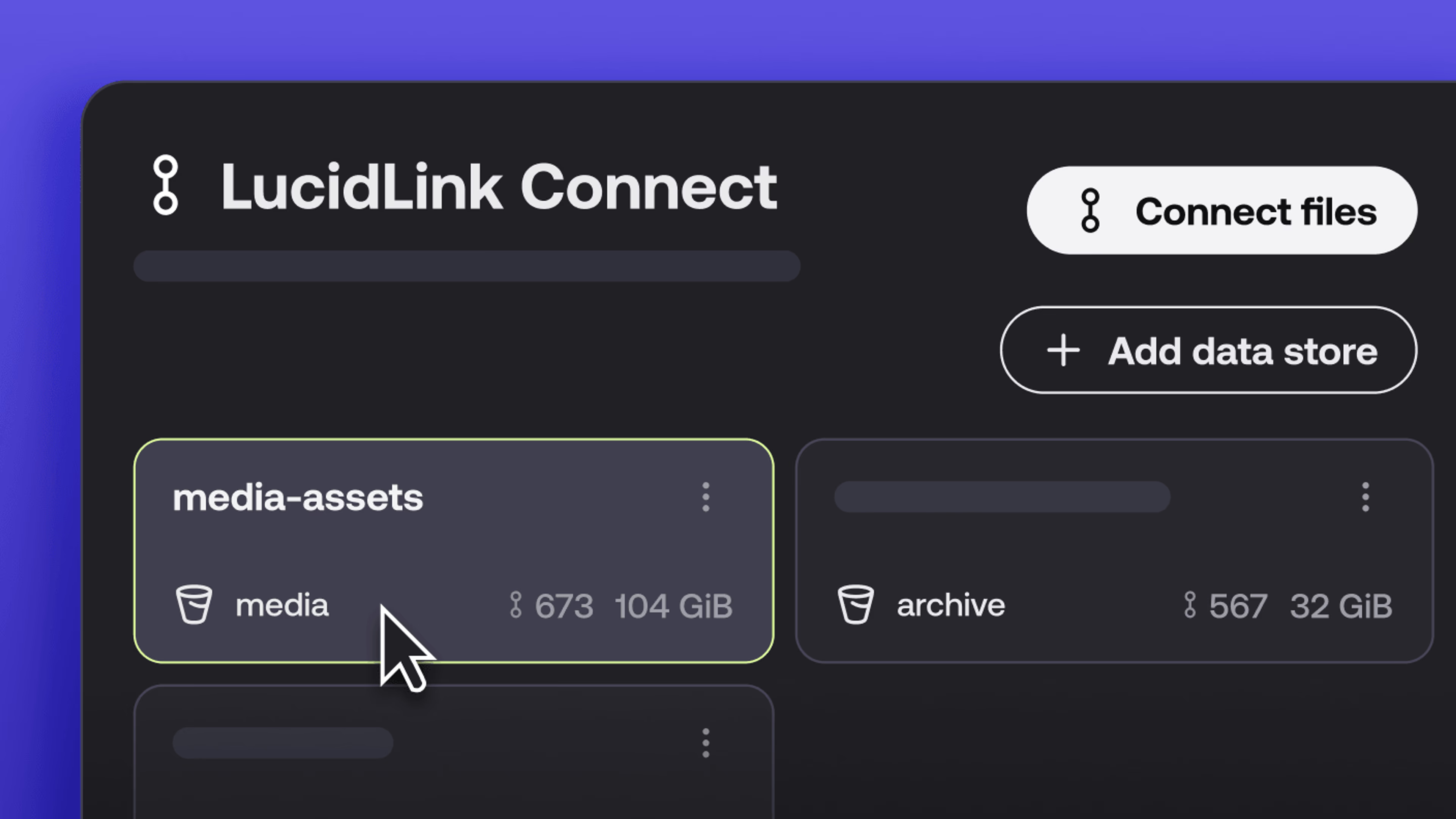
New in LucidLink Connect: simpler storage management
LucidLink Connect makes distributed storage easier to manage, with a new UI for connecting and managing data available through LucidLink.
06 October 2026, 2 mins read
Join our newsletter
Get all our latest news and creative tips
Want the details? Read our privacy policy. Not loving our emails?
Unsubscribe anytime or drop us a note at support@lucidlink.com.