Product & news
Cloud storage
Why cloud storage speed claims don't reflect reality
Last updated 30 July, 2026
5 mins

Part one of our series on demystifying cloud performance
In the cloud storage market, performance claims have become a marketing battleground.
Vendors compete on headline speeds, trying to win on paper rather than in practice.
But there’s often a significant gap between what’s promised on a vendor’s homepage and what your team actually experiences when it matters.
Our new series, demystifying cloud performance, is designed to help you separate fiction from architectural reality.
In this first post, we’ll explore why huge headline speed numbers rarely equal real-world performance, plus the infrastructure realities those numbers ignore.
The 20Gbps+ promise
Every technology leader has seen the headline numbers promising flat, universal speeds like "20Gbps performance."
But in the real world, when your team sits down to pull massive video files or complex datasets, they rarely see anything close to that.
The gap between vendor promises and actual day-to-day experience comes from universal speed claims ignoring a fundamental reality: you’re always at the mercy of your first and last mile.
The law of the last mile
Imagine buying a Ferrari purely for its 220 mph max speed, but your daily commute’s on a 35 mph road.
You can only go as fast as the road allows.
In cloud storage, a vendor’s software can promise 20Gbps, but your local internet infrastructure dictates your real speed ceiling.
LucidLink is engineered to make the most of whatever bandwidth you give it. But no software can magically pull 20Gbps out of a team’s 1Gbps shared broadband or a remote editor's home Wi-Fi. Promising a flat, blanket speed to every user regardless of their local pipe is marketing fiction.
We see the reality of these infrastructure limits everywhere. On one end, growing creative teams get frustrated by marketing hype because their local office connection physically can’t support a vendor's ‘required’ speeds.
On the other end, even massive pipes have limits. A major enterprise production studio on a state-of-the-art 100Gbps network pipeline can find their real-world throughput topping out at roughly 1.8Gbps (even with a 500GB local cache allocated) due to hardware routing bottlenecks on their end.
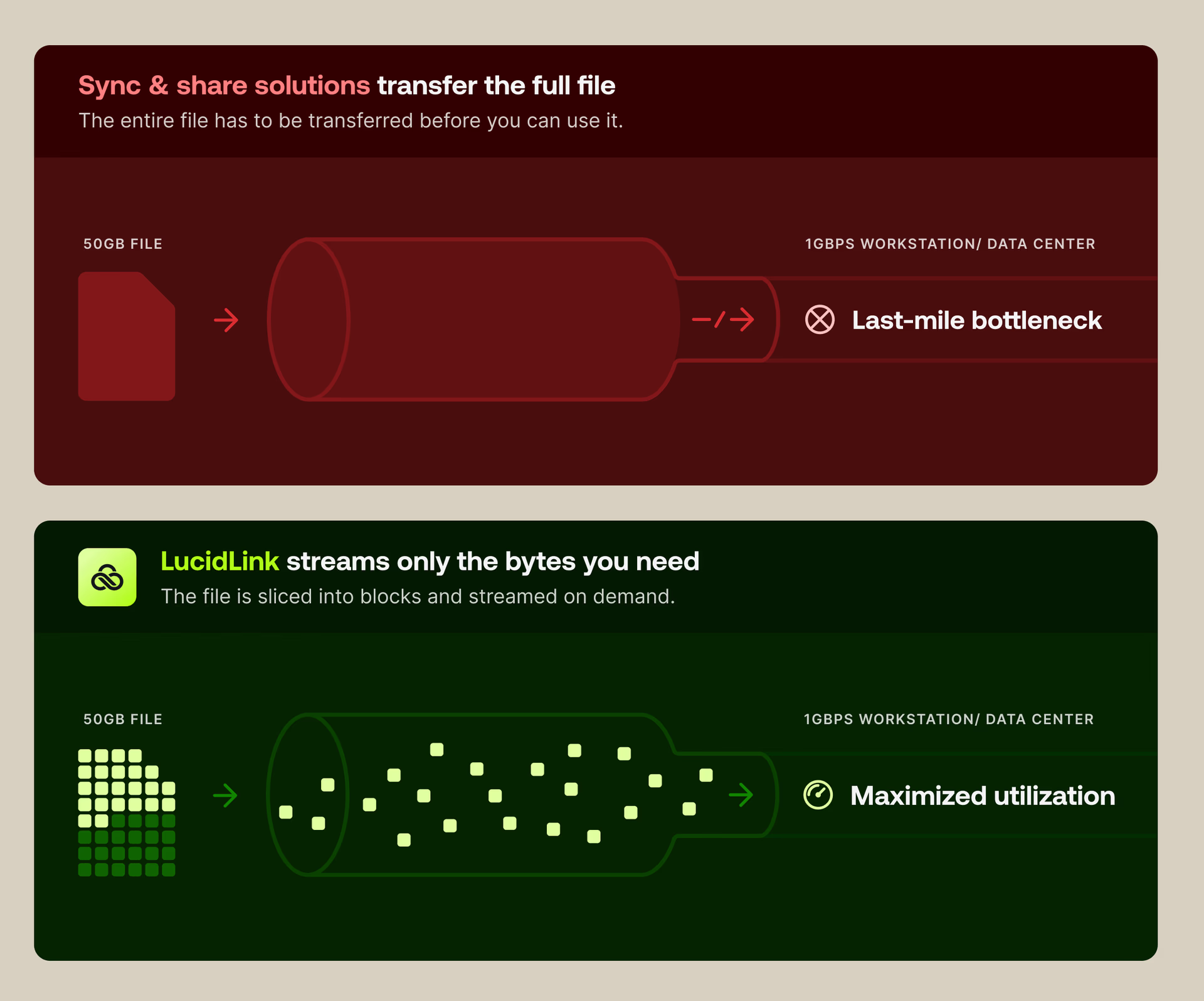
Don't let theoretical benchmarks sell you a top speed your local infrastructure physically can’t reach. The right architecture will make the most of the pipe you actually have.
A performance experiment: what happens when you remove the last mile?
Recently, our solutions engineering team decided to run an experiment.
We wanted to see what would happen if we completely removed the last-mile bottleneck.
In other words, what’s the performance ceiling of the LucidLink architecture when money and local hardware limits are no object?
To find out, we dropped a single LucidLink client directly into an ultra-high-end cloud data center, hooking it up to a high-performance virtual environment with a local NVMe cache.
The results of this experiment:

When given a clear runway, LucidLink went well beyond the arbitrary 20Gbps marketing benchmark, topping out at over 36Gbps on warm reads.
Whether we chopped the files into 1 MiB or 4 MiB block sizes, the architecture held perfectly stable.
Why we won’t put ‘36Gbps!’ on our homepage
Our marketing team could easily take that 36Gbps figure and put it front and center on our homepage.
But it wouldn’t reflect how teams really work.
The vast majority of end-users don’t deploy their daily workflows using an expensive cloud data center setup. Most teams operate on standard internet connections, use more economical cloud instances and connect from decentralized offices or home setups.
While we proved that our engine can clock 36Gbps+, we’d rather be honest: your real-world performance will always be a reflection of your entire pipeline, from our architecture to your local desk.
Finding the reality behind the benchmark
When analyzing a vendor's metrics, focus on how the system is designed to handle the constraints of the real world.
You want an architecture engineered to intelligently manage data chunking, local caching and stream optimization. That’s what determines whether you get consistent performance from your daily internet connection, not from a benchmark data center connection you don't have.
Three questions to ask any cloud storage vendor
When a cloud storage vendor throws out a flat, high-speed metric like 20Gbps performance, don't take it at face value
Look at their technical documentation and put their architecture to the test with these three questions:
1. How does the system move files across the network?
Why it matters: traditional tools force full-file downloads or slow background sync loops, causing performance to tank over normal internet connections. In practice, this is what sync-and-share architecture looks like: before an editor can touch a frame, the whole file — or a full local mirror of the folder — has to land on disk first. A 40GB camera file behaves the same whether you need 2 seconds of footage or the whole clip.
The LucidLink solution: we completely bypass file transfers by breaking assets into tiny blocks, streaming only the exact milliseconds of data your software actively requests.
2. How does the system handle high latency and distance without stalling?
Why it matters: high bandwidth is useless if distance or patchy home Wi-Fi causes lags and dropped frames while you wait for linear file queries. Systems built around simple sequential reads have no way to anticipate what you'll need next. Every jump in the timeline is a fresh round-trip to storage, and latency compounds with every one.
The LucidLink solution: our engine uses predictive intelligence to pre-fetch data blocks ahead of your editing playhead while caching active frames locally for instant replay.
3. What happens when multiple users edit out of the exact same workspace?
Why it matters: most systems choke under team workloads because ten editors opening the same project translates to ten massive, concurrent network-killing downloads. Architectures that rely on full local copies or file-level locking hit this immediately. Either everyone is re-downloading the same multi-gigabyte project file, or the system locks the whole asset the moment one person opens it.
The LucidLink solution: we coordinate multi-user changes strictly through tiny metadata updates, letting massive production teams collaborate seamlessly out of a single cloud workspace without performance drops.
Before you sign anything
A vendor that can't answer these clearly in their own documentation, regardless of who they are, is asking you to take their speed claims on faith. Documentation only gets you so far. Before you sign anything based on a slide:
Ask whether the performance numbers you're being shown are synthetic benchmarks or real workflow tests
Push for a proof-of-value with your own files, not sample assets
Test with your actual team size, not a single-user demo
Run it over your actual network, not the vendor's ideal-case connection
Look beyond the numbers
Don’t judge cloud collaboration vendors on marketed speeds.
Evaluate them based on the reality of how they perform on the workflows your team actually runs every day.
In part two of our performance series, we take a closer look at LucidLink’s file streaming architecture. Discover how we combine block-level streaming, smart prefetching and metadata coordination to deliver local-drive performance over everyday internet connections.
Keep reading

Cloud storage
New research: what your storage bill doesn’t tell you
New research from Situation Publishing explores the hidden costs around file infrastructure, from egress and duplication to lost time and manual work.
14 October 2026, 4 mins read
Product & news
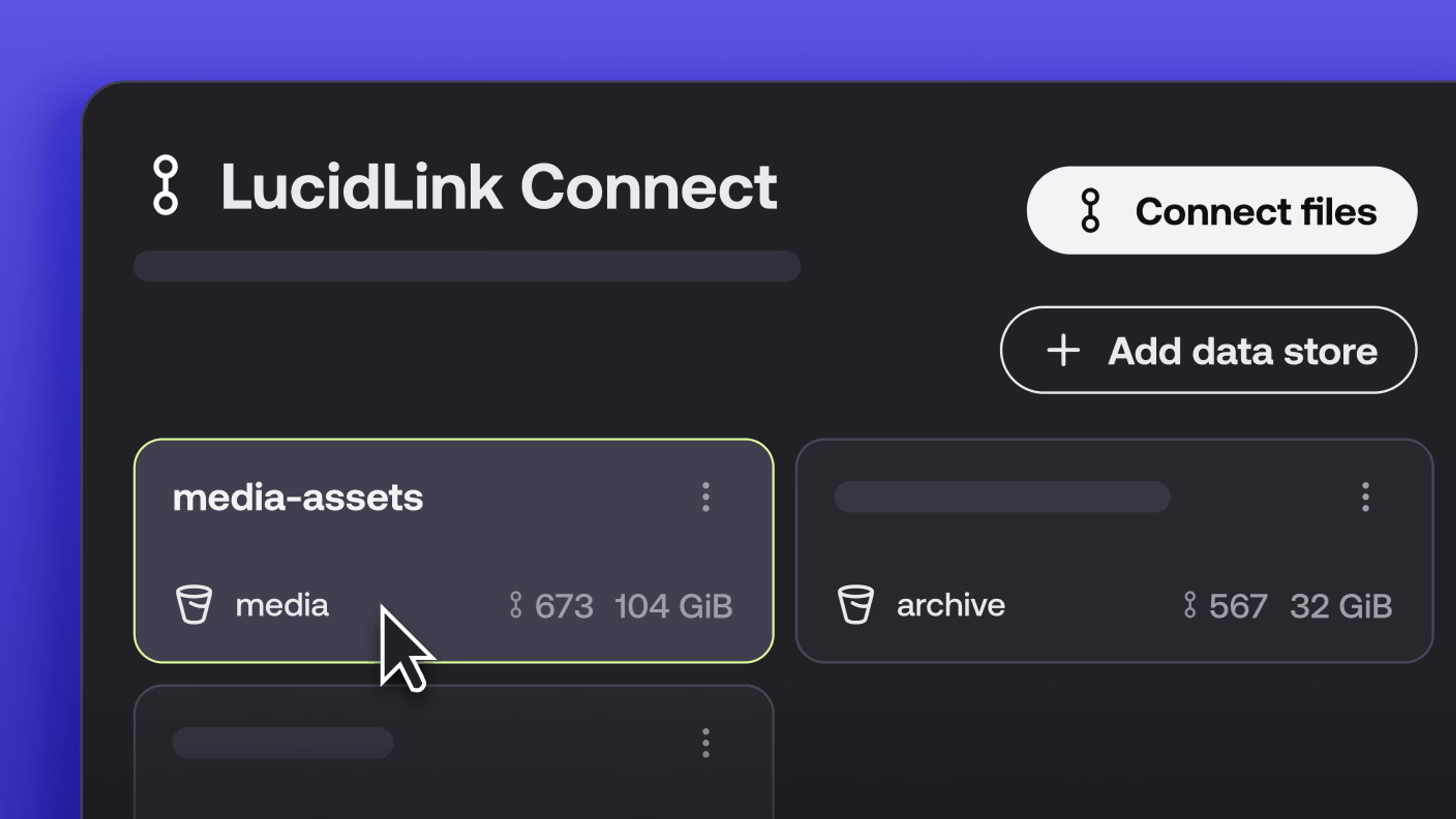
New in LucidLink Connect: simpler storage management
LucidLink Connect makes distributed storage easier to manage, with a new UI for connecting and managing data available through LucidLink.
06 October 2026, 2 mins read
Cloud storage
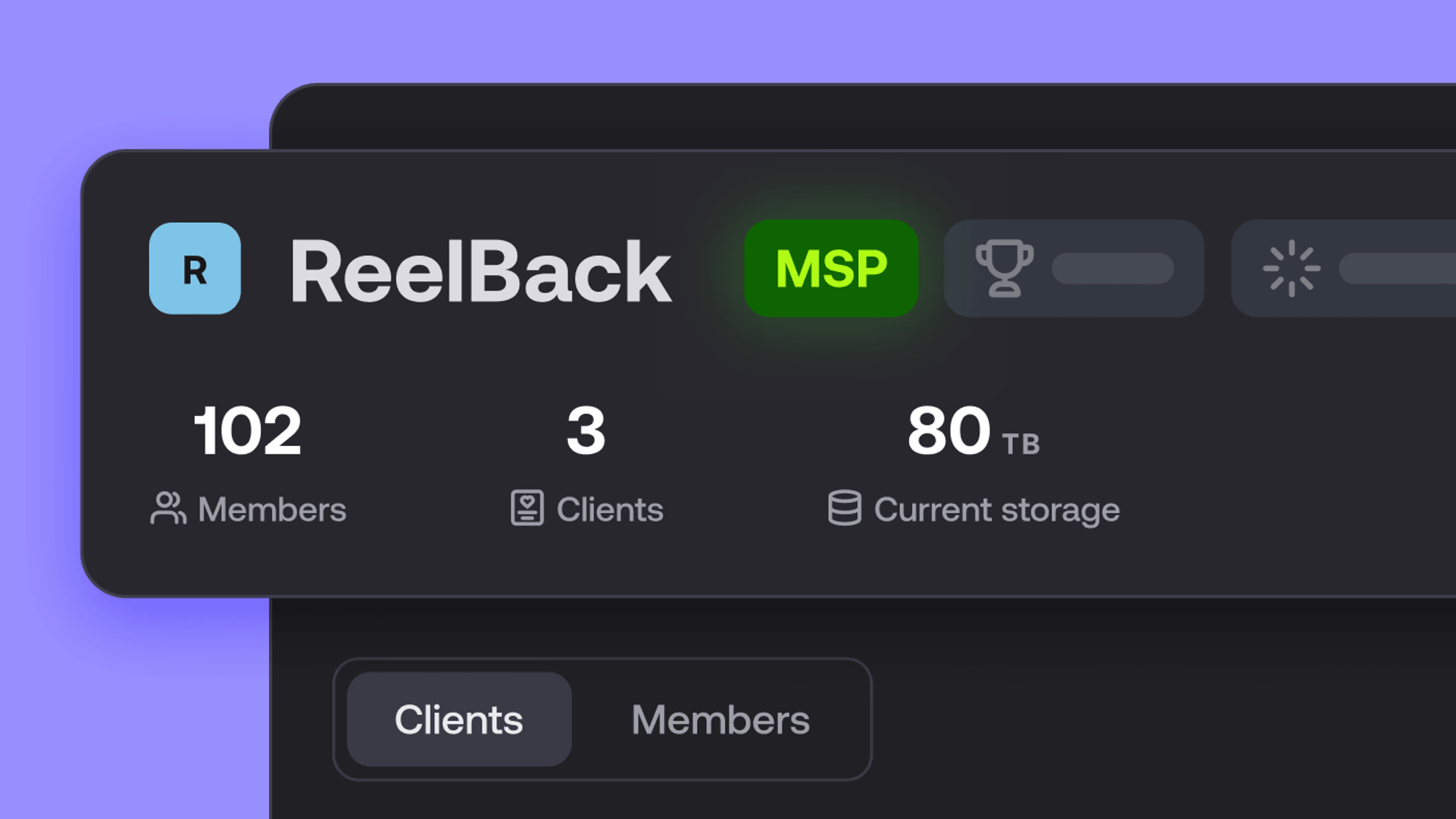
Introducing the new LucidLink MSP: one platform for your whole book
LucidLink MSP runs on the LucidLink Management Platform, giving MSPs centralized deployment management and pricing that scales with growth.
09 September 2026, 2 mins read
Join our newsletter
Get all our latest news and creative tips
Want the details? Read our privacy policy. Not loving our emails?
Unsubscribe anytime or drop us a note at support@lucidlink.com.