Product & news
Cloud storage
Beyond headline speeds: what cloud file streaming needs to succeed
Last updated 05 August, 2026
6 mins

Part two of our series on demystifying cloud performance
In our last post, we explored why vendors claiming 20Gbps headline speeds fall short when faced with the reality of home Wi-Fi, local hardware and IT constraints.
But this raises the practical question: if everyday internet connections vary so much, how can remote or office-based teams reliably collaborate on massive files?
Because network limitations don’t discriminate between a congested corporate HQ and an unpredictable home Wi-Fi setup.
There's a common misconception that heavy cloud workloads demand expensive pipe upgrades. That local-drive performance means every user needs a dedicated, commercial fiber line. This isn’t true, but it’s an understandable conclusion based on years of using legacy cloud storage architecture.
How LucidLink overcomes the legacy cloud storage bottleneck

Traditional cloud sync-and-share platforms treat cloud infrastructure as a bulk repository. To work on a file, they force full-file download-and-sync cycles.
When multiple users handle massive project assets, these large transfers choke network bandwidth and saturate local pipes, while also creating localized version control issues.
LucidLink works differently. Our cloud-native file system treats your network link as a continuous, on-demand stream rather than a bulk delivery pipe. This unique approach earned us an Engineering, Science & Technology Emmy® Award for changing the way teams working on real-world productions collaborate in the cloud.
By turning internet speed from a rigid bottleneck into a dynamic efficiency variable, LucidLink delivers local-drive performance over standard internet connections.
Let's take a closer look at LucidLink's architectural breakdown, including how we maximize your existing pipe, eliminate remote work latency and scale multi-user collaboration without upgrading your bandwidth.
1. Block-level streaming: local drive performance without network upgrades
LucidLink is structurally designed to maximize data throughput intelligently across any connection.
Our transport protocol adapts dynamically to your available internet speed, using open pipe capacity without starving other critical business tools like Zoom or VoIP.
This optimization is powered by block-level streaming.
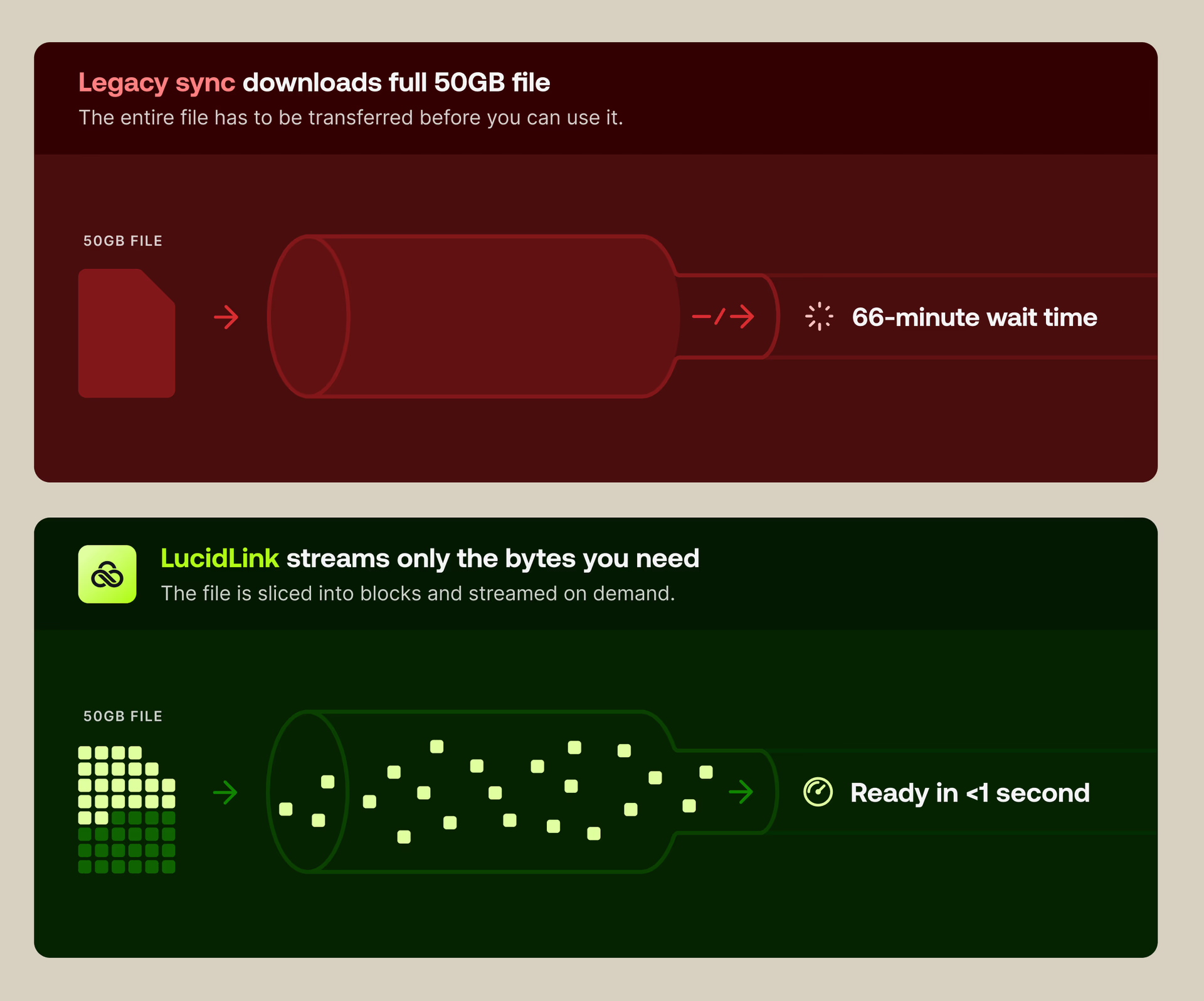
Instead of moving entire files, LucidLink pre-splits assets into granular byte blocks at upload. Crucially, the block segmentation happens strictly at the file system transport layer.
The location matters because it changes what streaming requires. Unlike traditional infrastructure that forces you to transcode, compress or alter your source media to achieve cloud mobility, LucidLink delivers streaming performance with bit-for-bit fidelity. Your original file quality, container format and bit-depth remain completely unaltered.
This is different from re-encoding or proxy-based workflows. There’s no need for a transcoding step, compression pass or format conversion. The block you receive on your workstation is the same block that exists in cloud storage. Nothing is regenerated or approximated to make it stream.
When an editor opens a project in Adobe Premiere Pro, LucidLink handles the filesystem metadata dynamically as they browse folders. Instead of downloading the underlying media assets, the transport protocol fetches only the specific, granular byte blocks demanded by the timeline layout at any given millisecond.
The bandwidth math: full-file sync vs block streaming
Let’s consider the math of a 50GB project file accessed over a standard 100Mbps connection:
Legacy sync tools: force a hard, linear wait time of approximately 66 minutes while the full asset duplicates down to the local drive.
LucidLink: bypasses full-file transfers entirely. When Premiere Pro opens that exact same 50GB file, the application only reads the file header index and starting layout data, roughly 5MB to 10MB of actual block data.
Over that same 100Mbps pipe, LucidLink retrieves that 10MB index in under one second, letting work begin instantly while the remaining 49.99GB stays securely in cloud storage.
Bandwidth no longer dictates whether you can work. It only dictates the latency of millisecond block fetches.
What this means in practice
Watch a colorist navigate a demanding 10Gbps EXR sequence in the DaVinci Resolve color page. LucidLink streams only the data needed to view a single frame at a time. Notice how the “CachedBytes” in the lower left corner barely changes as the colorist makes adjustments in the color node.
This access pattern gives artists consistent system performance on heavy VFX workflows without pinning first.

Note: to perform motion tracking or 24fps playback, Resolve will need to read many more frames resulting in a higher amount of cached data.
The creative & IT payoff
No wasted billable hours: you stop paying for expensive creative talent to sit idle. By decoupling project initialization from file size, talent goes from ingest to active, billable editing in seconds, regardless of the office's baseline internet speed.
No creative compromises: eliminate complex, quality-degrading proxy workflows or custom scripting. Block-level streaming delivers the exact bit-for-bit, uncompressed source block demanded by the application. Creatives can work with full-fidelity assets instantly, eliminating proxy generation overhead and final-conform errors.
2. Prefetching and caching: consistent playback over unstable connections
LucidLink’s engine combines two mechanisms to manage network latency: smart data prefetching with an intelligent local cache. Together, they mitigate cloud network latency to maintain a consistent application experience, even on unstable connections.
Smart prefetching (zero buffering)
LucidLink’s predictive engine anticipates application behavior, pre-fetching upcoming asset blocks before the application explicitly asks for them. Similar to how Netflix or YouTube buffer the next few minutes of a video in the background to prevent stuttering, this keeps playback consistent even over patchy Wi-Fi.
Intelligent local cache (instant replay)
Once a data block is streamed from cloud storage, it’s written to a designated local cache on the workstation. If an editor scrubs back across the same sequence in Premiere Pro, or opens a previously navigated asset layout, LucidLink serves the data instantly from the local cache. There’s no additional network strain or cloud egress fees.
What this means in practice
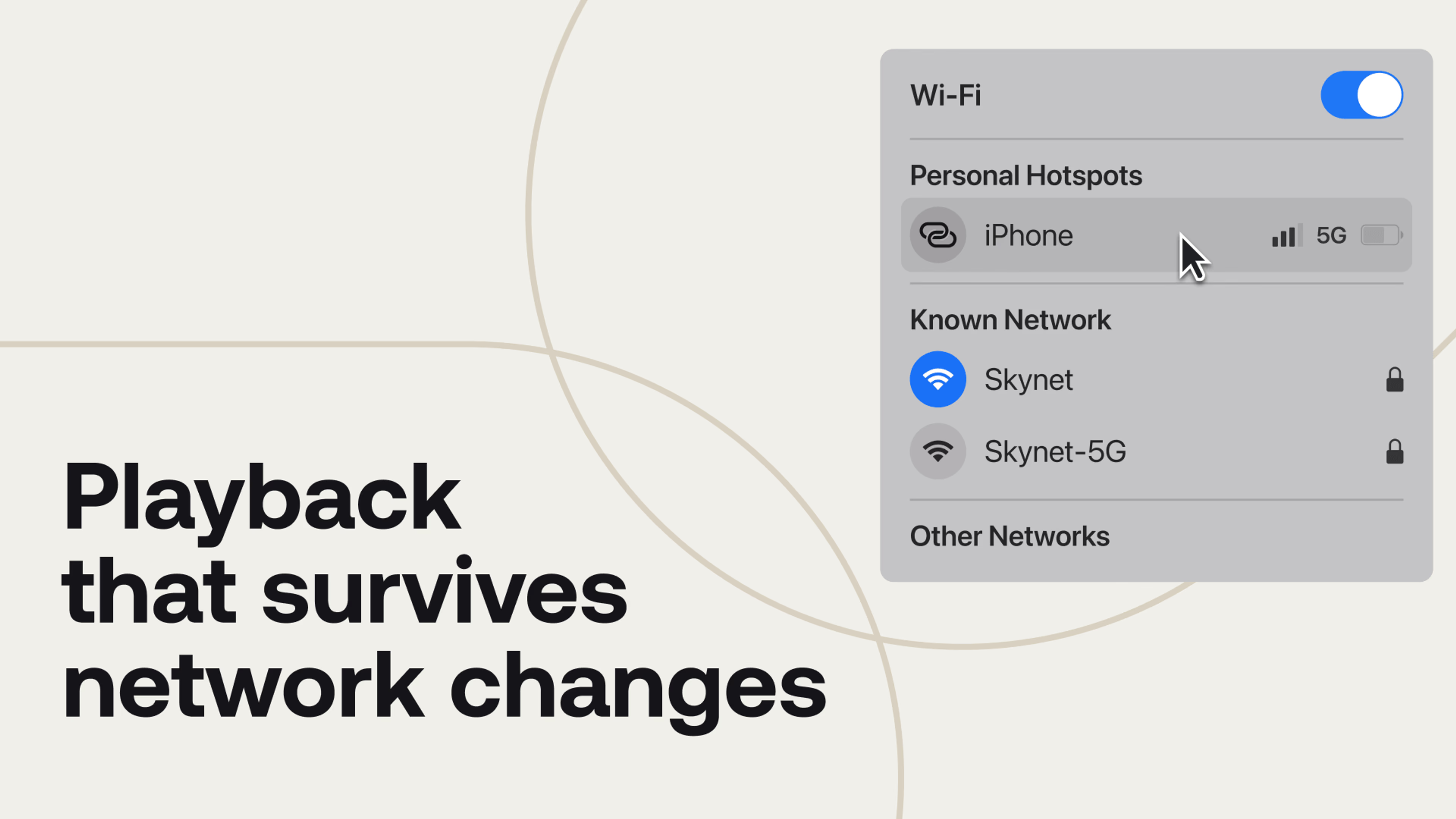
Watch an editor switch mid-timeline from a stable home network to an iPhone hotspot. LucidLink absorbs the fluctuating speeds, maintaining consistent playback without stalling the application or forcing the artist offline.
The creative & IT payoff
Operational continuity & data security: when remote connections fluctuate, the creative workflow stays uninterrupted. If a connection drops completely, edits are saved immediately to the local cache and automatically uploaded to the cloud the moment connectivity is restored.
Because local-drive performance remains consistent, remote users aren’t tempted to copy assets to insecure personal drives to avoid lag. Data stays where it should, reducing file sprawl and security risks, without disrupting creativity.
3. Metadata coordination: flattening the traffic footprint for large concurrent teams
In a traditional setup, ten editors working on the same project means ten concurrent downloads of the same heavy files, multiplying network congestion with every user.
LucidLink reframes multi-user collaboration by maintaining a single always-up-to-date cloud filespace as the shared source of truth. Only metadata block deltas (the tiny files that signal changes) are synced to and from LucidLink services to coordinate changes across users.
Meanwhile, a direct parallel connection to your cloud storage operates on the data layer. Each client streams only the blocks it needs, on demand, reducing outbound internet strain. This removes the bottlenecks teams with heavy concurrent use often face with traditional file syncing.
The creative & IT payoff
Scale multiple sites predictably: IT leaders can scale physical branch offices and headcount without a linear spike in network costs or buying expensive, hardware-heavy sync workarounds. By shifting concurrency management to the block level, enterprises avoid expensive commercial bandwidth upgrades while giving multi-site teams a unified workspace that feels local.
Emmy-winning performance built for production, not benchmarks
At LucidLink, performance means building a file system intelligent enough to optimize the connection you already have, not chasing theoretical metrics or asking customers to upgrade to a dedicated fiber line just to open a file.
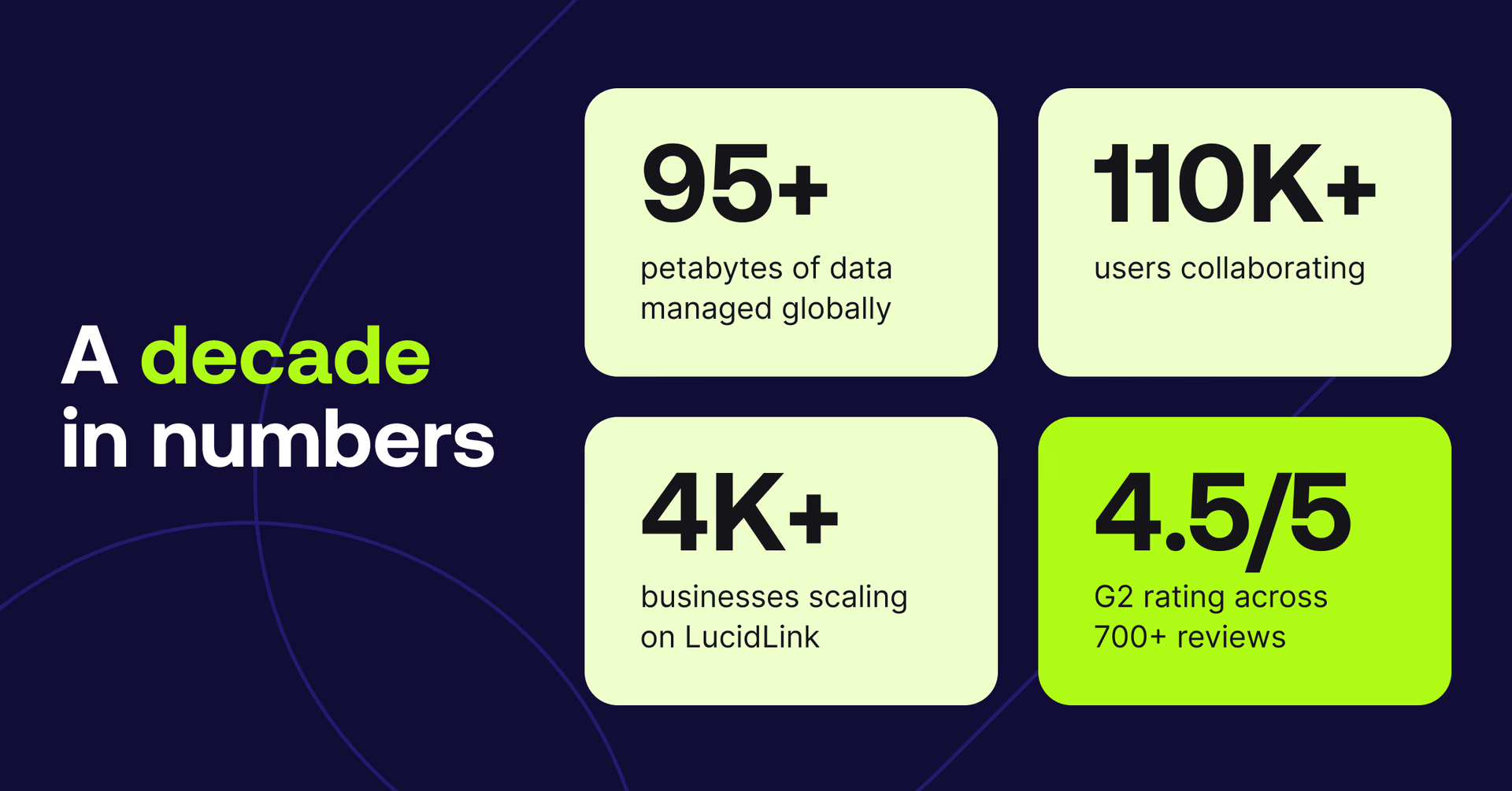
We’ve been doing exactly that for over a decade: streaming more than 95 petabytes of data for over 110,000 users across 4,000+ businesses. That track record won us an Emmy, five consecutive NAB Product of the Year Awards and a Leader ranking in G2’s Cloud File Storage report, with a 4.5/5 rating across 700+ reviews.
Most importantly, our performance is validated every day by our customers, including global studios and enterprises running the world's most demanding workflows.
Ready to put LucidLink to the test on your own network? Start your free trial today.
Keep reading

Product & news
LucidLink wins 2026 Inc. Power Partner Award in AI, Technology & Development
LucidLink has been named a 2026 Inc. Power Partner in AI, Technology & Development, recognizing the results we deliver with customers and partners.
23 October 2026, 3 mins read

For developers
Product & news
A dashboard for your filespace, built where your keys are
Build a dashboard for your LucidLink Filespace from its audit trail with an agent skill for Claude Code and Codex, without touching zero-knowledge encryption.
19 October 2026, 4 mins read

Cloud storage
New research: what your storage bill doesn’t tell you
New research from Situation Publishing explores the hidden costs around file infrastructure, from egress and duplication to lost time and manual work.
14 October 2026, 4 mins read
Join our newsletter
Get all our latest news and creative tips
Want the details? Read our privacy policy. Not loving our emails?
Unsubscribe anytime or drop us a note at support@lucidlink.com.