Collaboration
Creative production
The decision bottleneck: when AI output outpaces your workflow
Last updated 05 November, 2026
4 mins
Part of a joint series from LucidLink, Overcast, ccktech and AWS on creative workflow readiness
Our last piece looked at what happens once content is finished and waiting to be used. This one goes back a step, to the point where AI has helped create something and the rest of the workflow still has to catch up.
Making another version of an asset used to mean another brief, another edit and another round of production.
Now, AI can compress a lot of that work, especially in the hands of skilled creative teams who know what good looks like and how to direct the tools.
Your team can produce more variants, localize faster and explore more ideas without multiplying production effort in the same way.
While that saves time and money earlier in the creative process, it can also push some friction further down the workflow.
Someone still has to make the call
More output ultimately means more decisions.
You can automate parts of the process, but teams that care about consistency still need someone to review content, judge whether it fits the brand, check where it can be used and decide whether it deserves to move forward.
So, for many, the constraint is shifting from how much you can produce to how quickly you can review, approve and trust what gets produced.
A generated asset still needs context
Before someone downstream can use an AI-generated asset, they need to know what they’re looking at.
Identity: what is this, exactly? Which asset is it derived from, and is it a variant, a localization or something materially different? With a handful of assets, you can track this manually. With thousands of AI-generated derivatives, you can't.
Status: where does it sit? Draft, in review, approved, restricted, superseded. If that isn’t obvious, somebody has to stop and find out.
Permission: where and how is it allowed to be used? A talent agreement that covers owned channels doesn't automatically cover paid media. This information rarely lives inside the asset itself.
Purpose: why does this version exist? Which campaign, which market, which channel and what does it do that the last eleven versions didn't? Not every generated asset earns a place in the content you manage.
Together, those details give people enough context to trust and use the asset. AI can help surface or organize some of that information. But decisions with real brand, legal or rights implications still need clear rules and someone accountable for making the call.

Where to put AI to work
AI has plenty of work to do in the right places.
Tagging assets, sorting variants, spotting obvious anomalies, checking whether a rights window has expired or flagging content that falls outside a known rule are all repetitive tasks with relatively clear answers.
This is where agentic workflows can start to remove real operational work, especially when agents can work against the same files and context as the team.
We’ve seen this work in practice too. In a recent project, Diorama.studio used an AI agent connected to LucidLink to organize, check and rename incoming reality-capture files while the crew was still in the field.
Automating that work gives people more time for decisions that are harder to codify: whether something feels right for the brand, whether an exception is worth making or whether a piece of content is strong enough to put in front of a customer.
The problem starts when automation creates more material for people to review than it removes from their workload. If every generated variant still needs the same manual investigation, approval and rights checks as before, the team has just got a bigger queue.
The more useful question is which decisions are predictable enough to automate safely, and which still need someone accountable making the call.
Fast generation doesn’t mean much without fast access
For media teams, generation is only one part of the production loop. The output may point back to hundreds of gigabytes or terabytes of source footage that editors still need to inspect, cut, compare and reuse.
This means fast access to large files matters just as much as fast generation.
If someone has to download the source in full before they can verify a shot or continue the edit, the workflow has sped up in one place and stayed exactly the same everywhere else.
Measure beyond generation
If your team’s watching how fast content gets generated, you’re measuring the part of the workflow that we already know has gotten quicker.
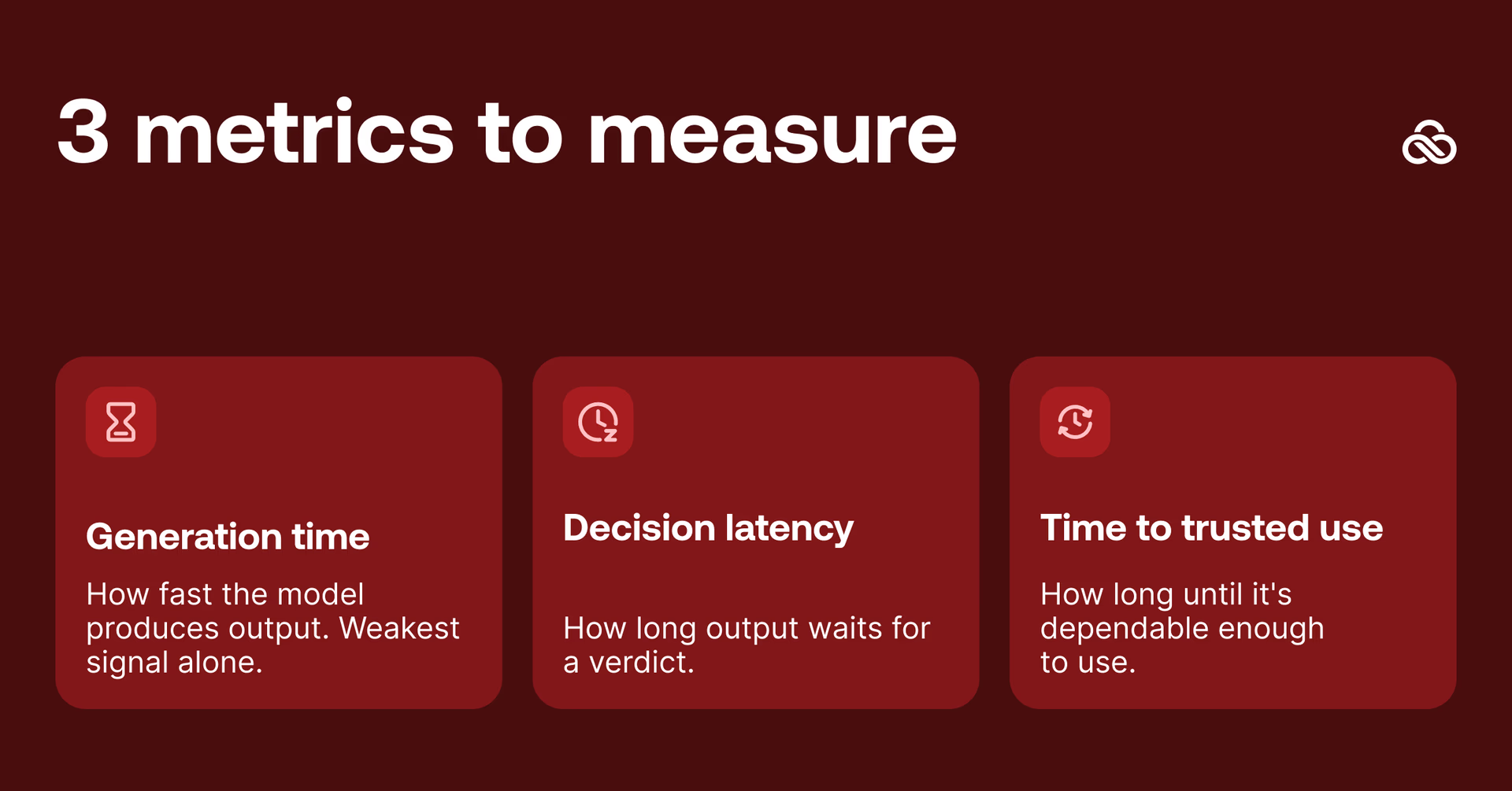
Measuring generation alongside two other timings can tell you more.
Generation time: how quickly the model produces something (least useful on its own).
Decision latency: how long an output waits to be reviewed, approved or rejected.
Time to trusted use: how long it takes before someone can confidently put that output to work for the job it was created for.
Generating something in three minutes doesn’t mean much if it then sits for three days waiting for review. A workflow that takes twenty minutes to generate and reaches trusted use within an hour is still moving useful content through the business much faster.
Time to trusted use is harder to measure, but it gets you closer to what matters: how quickly AI output becomes something your business can confidently use.
The Creative Workflow Readiness Assessment, built by Overcast, LucidLink, ccktech and AWS, is a five-minute way to find out where that gap sits in your own operation, try it today.
Keep reading
Collaboration
Creative production
The content readiness gap: why finished doesn’t mean ready
Content creation has never been faster. But here's why finished still doesn't mean ready to use, and what the readiness gap is costing your team.
27 October 2026, 4 mins read
In the field
Collaboration
Setting up AI agents for reality capture in AEC
How Diorama.studio used an AI agent connected to LucidLink to organize field data in real time, during a two-week deadline drone survey.
16 September 2026, 6 mins read
Collaboration
In the field
Access over movement: rethinking media infrastructure for distributed teams
Tim Burton from 7fivefive explores why the future of media infrastructure is less about moving data and more about making it accessible where it already lives.
08 September 2026, 6 mins read
Join our newsletter
Get all our latest news and creative tips
Want the details? Read our privacy policy. Not loving our emails?
Unsubscribe anytime or drop us a note at support@lucidlink.com.