Cloud storage
3 IT teams that took control of file infrastructure
Last updated 08 July, 2026
5 mins

Most file access infrastructure upgrades usually happen after the pain becomes impossible to ignore.
But the strongest IT teams tend to move earlier, before migrations become urgent or operational drag becomes systemic risk.
The signals usually appear gradually:
Rising support tickets
Workarounds becoming routine
Performance issues spreading across teams
Costs increasing without the experience improving
The organizations in this article recognized those patterns early and made architectural changes before the problem became harder and more expensive to solve.
When storage performance stops scaling: EVS Engineering

EVS Engineering reached a scaling limit.
Over six years, the company grew from 30 to 200 engineers, expanding across offices and time zones. What had worked as a simple, office-based setup (on-prem file servers with VPN access) started to break down under that growth.
“Opening or saving a file could take five to ten minutes,” said Wally Warwick, IT Manager at EVS.
For a team working with large AutoCAD and engineering design files, that delay was continual. And at scale, it compounded:
Engineers losing meaningful time every day just waiting on files
Productivity constrained by infrastructure, not expertise
IT pulled into ongoing VPN troubleshooting and file access issues
Nothing was technically broken. But the system was no longer viable for how the team worked.
EVS explored alternatives, including VDI environments and other cloud collaboration tools, but ran into new limitations: complexity, cost or tools that didn’t behave like a true filesystem. A planned $80K SAN upgrade was on the table, but it raised a bigger question:
Would more infrastructure actually solve the problem or just extend it?
That question became the turning point, a recognition that the system itself was no longer scaling with the organization. That’s when Wally found LucidLink.
The results:
File access reduced from 5–10 minutes to under 30 seconds
~200 billable engineering hours recovered per month
$80K SAN investment avoided
File-related IT workload significantly reduced
Remote file access was on my task list every week. Since switching to LucidLink, I haven’t thought about it once.
Wally Warwick,IT Manager, EVS
Files opened when needed, collaboration stopped being shaped by delays and IT could stop wasting hours managing workarounds.
This is what the performance tipping point looks like in reality. EVS’ systems weren’t failing, but they couldn’t keep up with how the team actually worked.

When multi-office file access becomes too complex to manage

Widseth’s environment didn’t fail either, but it became too complex to sustain.
With 250 users across 12 offices, the firm relied on a traditional multi-site setup: cloud-backed storage with caching appliances in every location, combined with VPN access for remote work.
On paper, it worked.
In practice, the cracks showed up in how the system behaved day to day:
Large CAD and BIM files were slow to open and save
Each office depended on a local appliance — creating single points of failure
Remote access relied on VPN performance that didn’t hold up under real workflows
Multiple users across locations introduced risk of file overwrites
IT had to manage and maintain hardware across every site
The visible issues were performance and reliability.
The underlying issue was structural: cost and complexity were increasing together.
Every new office meant:
Another appliance to deploy and maintain
Another failure point to account for
More time spent managing infrastructure instead of supporting teams
Widseth evaluated alternatives, including on-prem and WAN acceleration, but each added complexity.
The answer was removing the appliances entirely. LucidLink replaced the multi-site setup with a single cloud filespace, accessible from any location.
The outcome:
25% cost reduction compared to Nasuni
No branch hardware required across 12 offices
Consistent CAD performance regardless of location
Reduced support burden with fewer file-related and VPN issues
I asked a user working from a city office about performance. He said, ‘I didn’t even think about it — it just works like I’m there.’ That’s exactly what we want to hear.
Brent Morris, IT Manager, Widseth
Performance doesn’t depend on location, there’s no dependency on hardware and costs no longer scale with expansion.
Why Projective rebuilt file infrastructure at the architectural level
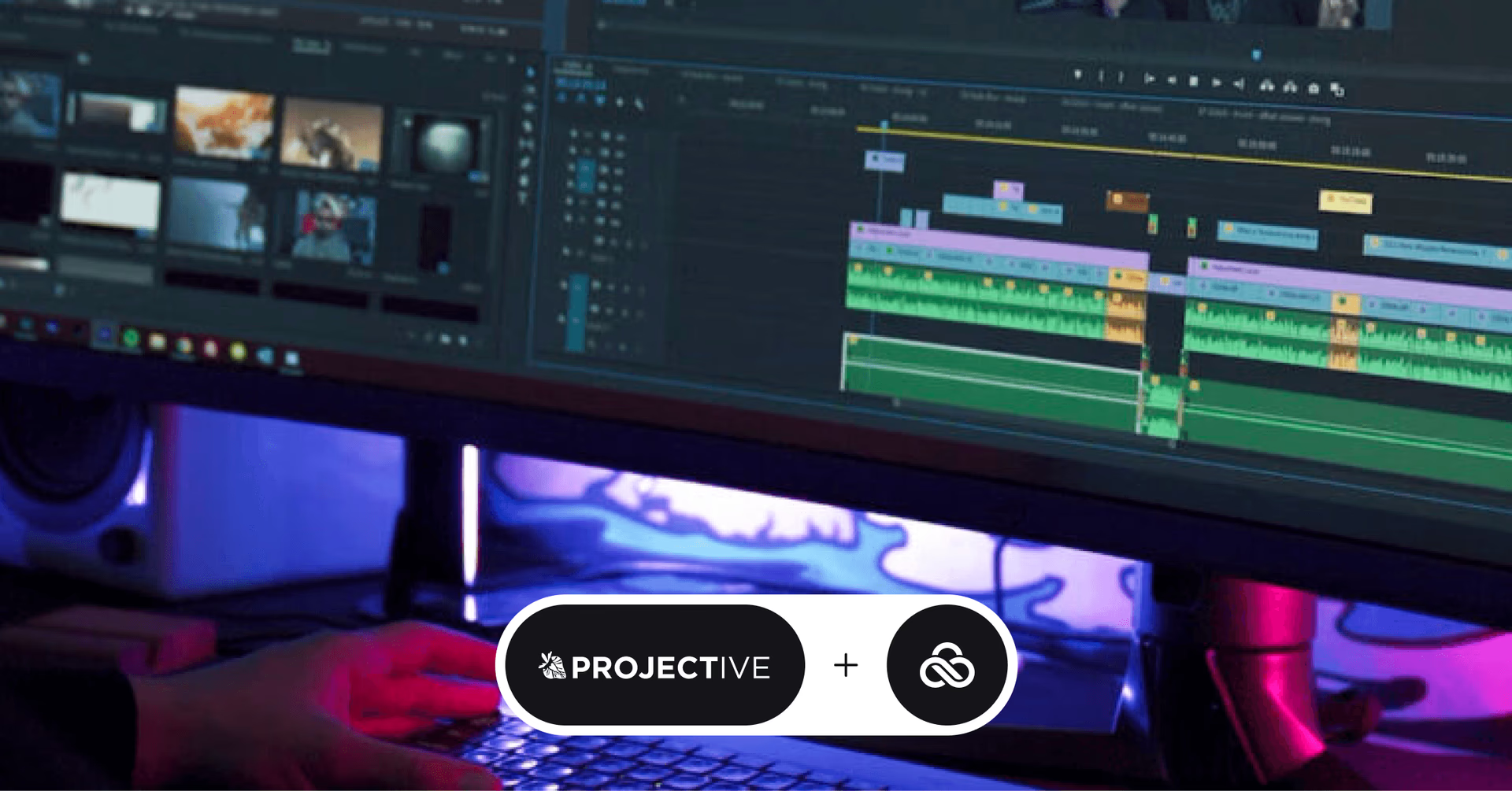
Projective needed to build a new environment from the ground up.
Strawberry Skies was designed as a fully managed cloud environment for creative production, bringing together storage, compute, applications and workflow into a single system that enterprise IT could govern and creative teams could actually use.
The solution needed a filesystem strong enough to support everything built on top of it.
As the team developed the platform, they evaluated more than 20 filesystems and storage systems.
Most worked in isolation. Few held up under real-world creative workloads:
Large media files accessed globally
Multiple users collaborating in real time
Professional tools like Avid, Adobe and Autodesk expecting consistent filesystem behavior
Systems that worked at a storage layer often broke down when exposed to production workflows.
Performance became inconsistent, permissions broke expected workflows and collaboration introduced delays.
For Projective, that level of unpredictability wasn’t compatible with the platform they were building.
The system needed to support two things simultaneously:
Enterprise IT governance, auditability and control
Creative team speed, access and simplicity
That meant finding a filesystem that behaved as both infrastructure and a backbone for secure creative workflows. LucidLink was the only solution that held up.
Outcome: a filesystem foundation for global creative infrastructure
A cloud file streaming platform for the core storage and access layer
Enterprise-grade governance and performance delivered together
Real-time collaboration across distributed creative teams
A consistent foundation underpinning the entire Strawberry Skies platform
LucidLink is the only cloud filesystem we found that actually behaves like a high-performance enterprise filesystem.
Andrew Wierzan,Solutions Consultant, Projective
Rather than adapting infrastructure to the platform, the platform was built on infrastructure that already matched how it needed to behave.
The shift happening across IT teams
As IT teams look for more modern ways to manage file access, there are common trigger points.
Sometimes it starts with friction. Workflows slow down, people find workarounds and over time those workarounds become part of how the team operates.
Other times, it’s a clean slate: a decision to build something new that won’t run into the same issues. Either way, there’s a moment where the existing approach no longer holds up.
You start to see it when:
Friction becomes routine
Workarounds become workflows
Complexity starts compounding
In the examples above, that’s when teams took action.
They stopped trying to optimize what they had, and started rethinking how it should work.
That led to a different way of working, where:
Files should stream, not sync
There should be a single source of truth
Data shouldn’t be replicated across endpoints
These are architectural decisions rather than features.
Where file access infrastructure change actually begins
Infrastructure rarely fails all at once. It degrades gradually, until the cost of waiting becomes higher than the cost of change.
None of these teams waited for something to break. They acted before the warning signs became a bigger problem.
If any of this feels familiar, it’s probably a sign your current setup isn’t keeping up with how your teams actually work.
For a deeper breakdown of how teams are modernizing file infrastructure, explore our enterprise IT file access modernization guide.
Keep reading

Cloud storage
New research: what your storage bill doesn’t tell you
New research from Situation Publishing explores the hidden costs around file infrastructure, from egress and duplication to lost time and manual work.
14 October 2026, 4 mins read
Cloud storage
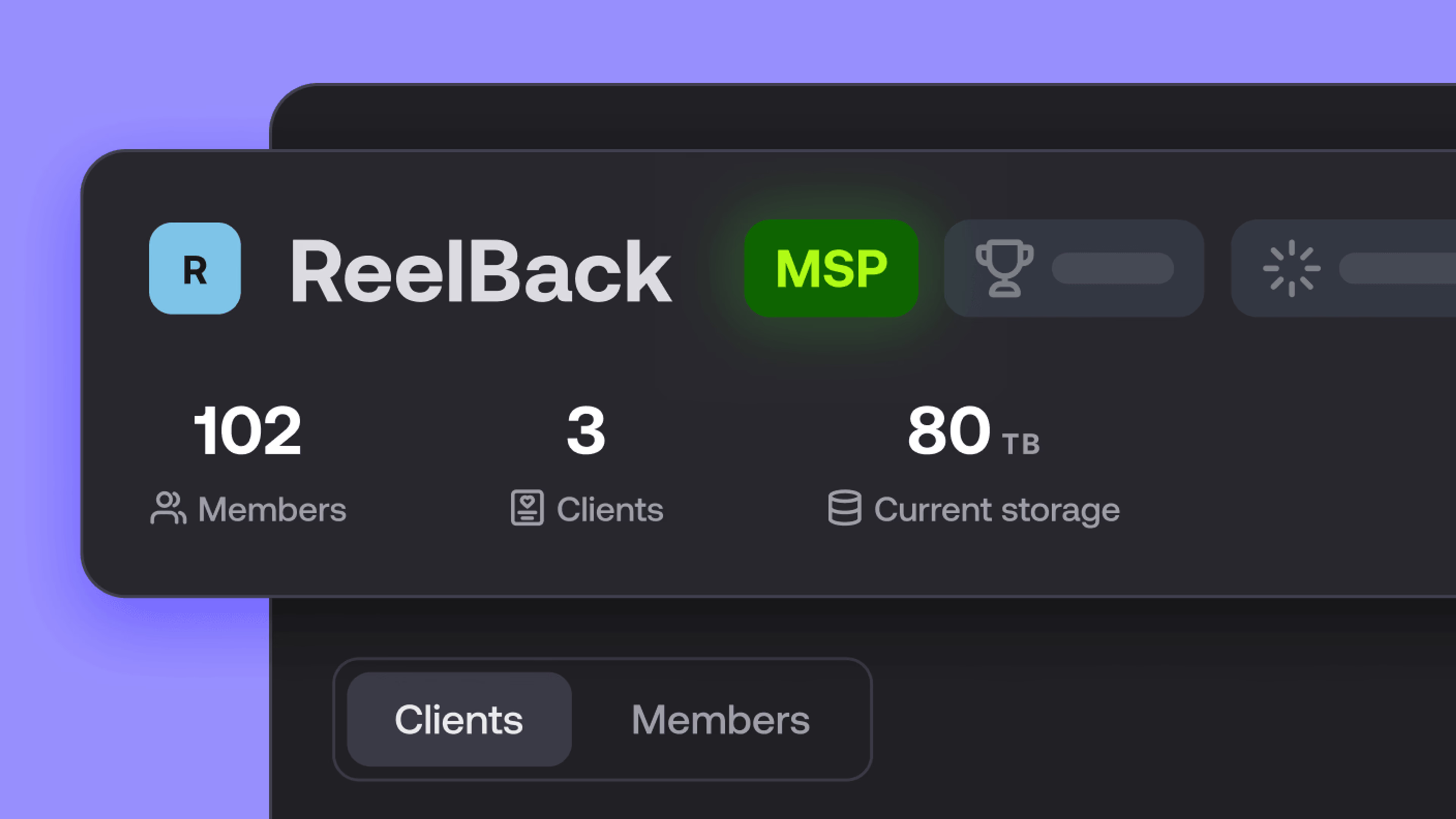
Introducing the new LucidLink MSP: one platform for your whole book
LucidLink MSP runs on the LucidLink Management Platform, giving MSPs centralized deployment management and pricing that scales with growth.
09 September 2026, 2 mins read

Product & news
Cloud storage
Beyond headline speeds: what cloud file streaming needs to succeed
Block-level streaming, smart prefetching and metadata coordination: here's the architecture behind how LucidLink performs on standard internet connections.
05 August 2026, 6 mins read
Join our newsletter
Get all our latest news and creative tips
Want the details? Read our privacy policy. Not loving our emails?
Unsubscribe anytime or drop us a note at support@lucidlink.com.