Collaboration
In the field
Access over movement: rethinking media infrastructure for distributed teams
by Tim Burton,
Managing Director , 7fivefive
Last updated 08 September, 2026
6 mins

Tim Burton, Managing Director at 7fivefive, recently joined us for a webinar on activating cloud data for distributed workflows. Read his thoughts on why the future of media infrastructure is less about moving data and more about making it accessible where it already lives.
Until relatively recently, post-production infrastructure was designed around a fixed operating model. Teams worked within facilities, storage was closely tied to compute and workflows were built around moving media between clearly defined stages of production. That model has shifted significantly.
Today’s media environments are far more distributed. Editorial teams may be spread across multiple locations, freelance talent is integrated into productions more often and infrastructure increasingly spans cloud, on-premises and hybrid environments simultaneously.
Organizations are now managing the complexity of larger content estates, tighter delivery timelines and more operational variables across production and supply chain workflows.
Cloud storage has solved many of the scalability challenges the industry faced previously. Object storage in particular has become a highly effective foundation for large-scale media archives and production environments. But scaling storage capacity alone does not automatically create efficient workflows.
What media organizations are now focusing on is how infrastructure behaves operationally across distributed teams and services.
Adapting to post-production demand
One of the more noticeable changes across media infrastructure is the move away from static provisioning models.
Historically, post-production environments were built around peak demand. Storage throughput, workstation performance and infrastructure capacity were sized for the largest expected workload, even if much of that infrastructure remained underutilized for significant periods of time.
Cloud infrastructure has introduced much greater operational flexibility. Compute, storage and network resources can now be provisioned far more dynamically around the requirements of individual workloads or productions.

In practice, that means infrastructure increasingly adapts to the operational realities of content development rather than forcing workflows to conform to fixed technical restrictions.
Not every workload behaves the same way, either. Some production functions scale very effectively within cloud-native environments, while others may still remain closer to specialist on-premises infrastructure depending on latency, finishing or operational requirements. Most organizations are now operating somewhere within that middle ground.
The challenge therefore becomes less about centralizing everything into a single environment and more about orchestrating infrastructure coherently across multiple locations, vendors and operational models.
Reducing unnecessary movement of media
Media workflows have traditionally relied heavily on duplication and transfer. Files were routinely copied between systems, departments, storage tiers and facilities in order to make them available to different users or applications. In distributed environments, that approach quickly becomes inefficient.
Large datasets moving repeatedly between cloud regions, local storage, virtual workstations and third-party vendors introduce operational overhead, additional costs and workflow friction. It also increases the likelihood of fragmented datasets and version inconsistency across teams.
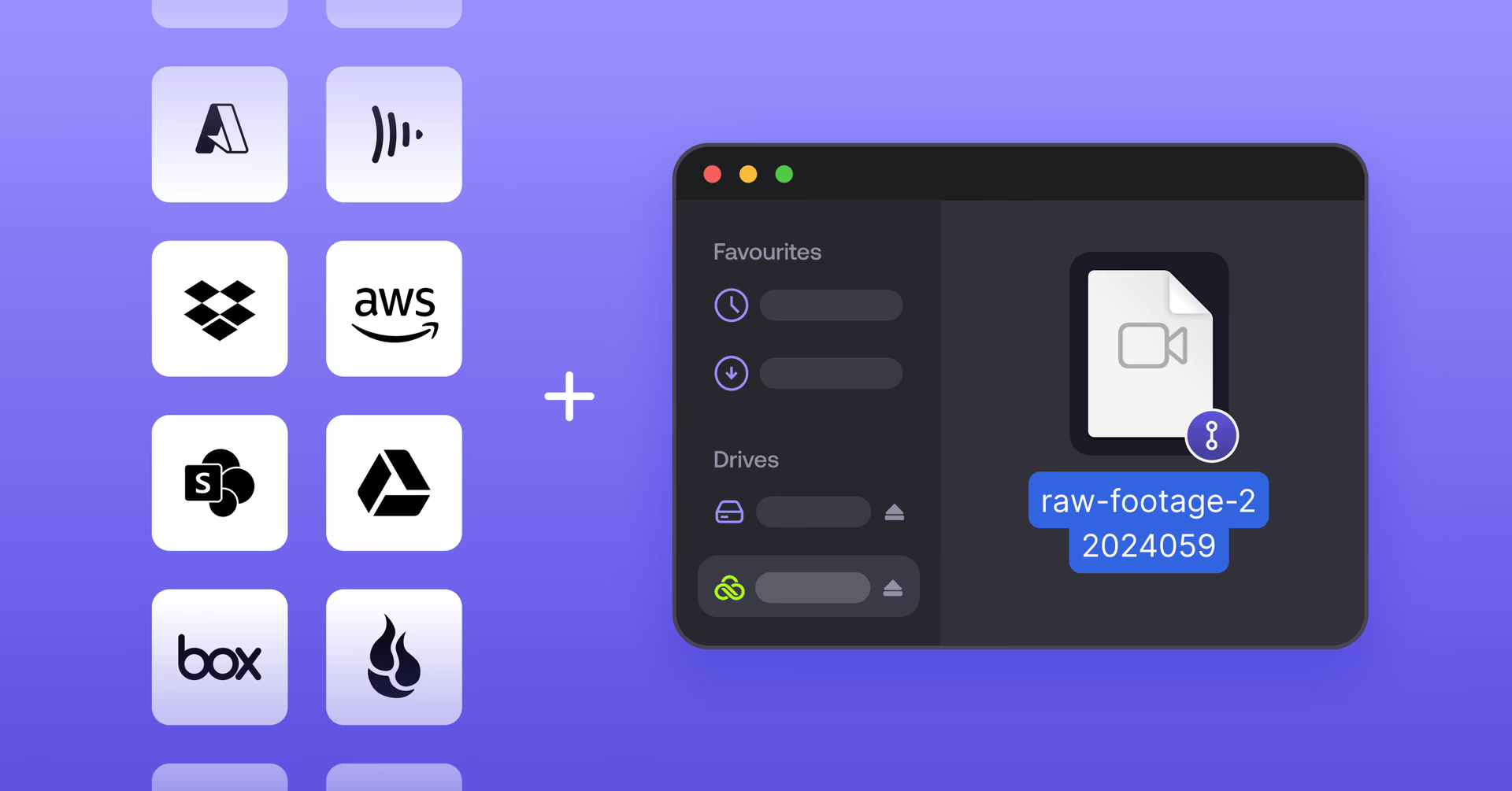
Increasingly, organizations are moving towards architectures where content remains in place while users and resources access those assets where they already reside.
That shift has important implications operationally. It reduces the need for unnecessary duplication, simplifies collaboration between distributed teams and allows machine-driven workflows and human users to interact with the same underlying datasets more efficiently. It also creates cleaner integration boundaries between systems, particularly within multi-vendor environments where different platforms may already rely on object storage as a common layer.
This becomes especially important within enterprise-scale media organizations where content ownership, permissions and infrastructure responsibilities are often distributed across multiple departments or external partners covering different regions.
Rather than rebuilding storage architectures or relocating large content estates at significant egress cost, organizations are increasingly looking for ways to make existing data more accessible operationally. If the existing infrastructure can be better connected to distributed workflows, it’s a win-win.
Storage architecture and user access
Object storage has become a highly effective long-term storage layer for media organizations, particularly because of its resilience and flexibility. However, production workflows still need to accommodate the expectations of creative applications and users.
Many creative tools were not originally designed around object-native workflows. They expect low-latency file access, familiar directory structures and immediate interaction with media assets.
At the same time, many enterprise content estates have evolved over years around machine-oriented storage structures that work perfectly well for automated services, archives or supply chain systems, but are not necessarily optimised for direct human interaction.
Organizations increasingly need abstraction layers that allow infrastructure to present content differently depending on the operational requirement without forcing large-scale migration or duplication of data.
This is particularly valuable in environments where multiple systems, cloud services and operational teams need to interact with the same underlying media libraries in different ways.
For creative teams, the priority is often visibility and responsiveness. For infrastructure and engineering teams, the priority may be operational consistency and interoperability. Next-generation workflow design needs to support both sides equally.
Interoperability as a core requirement
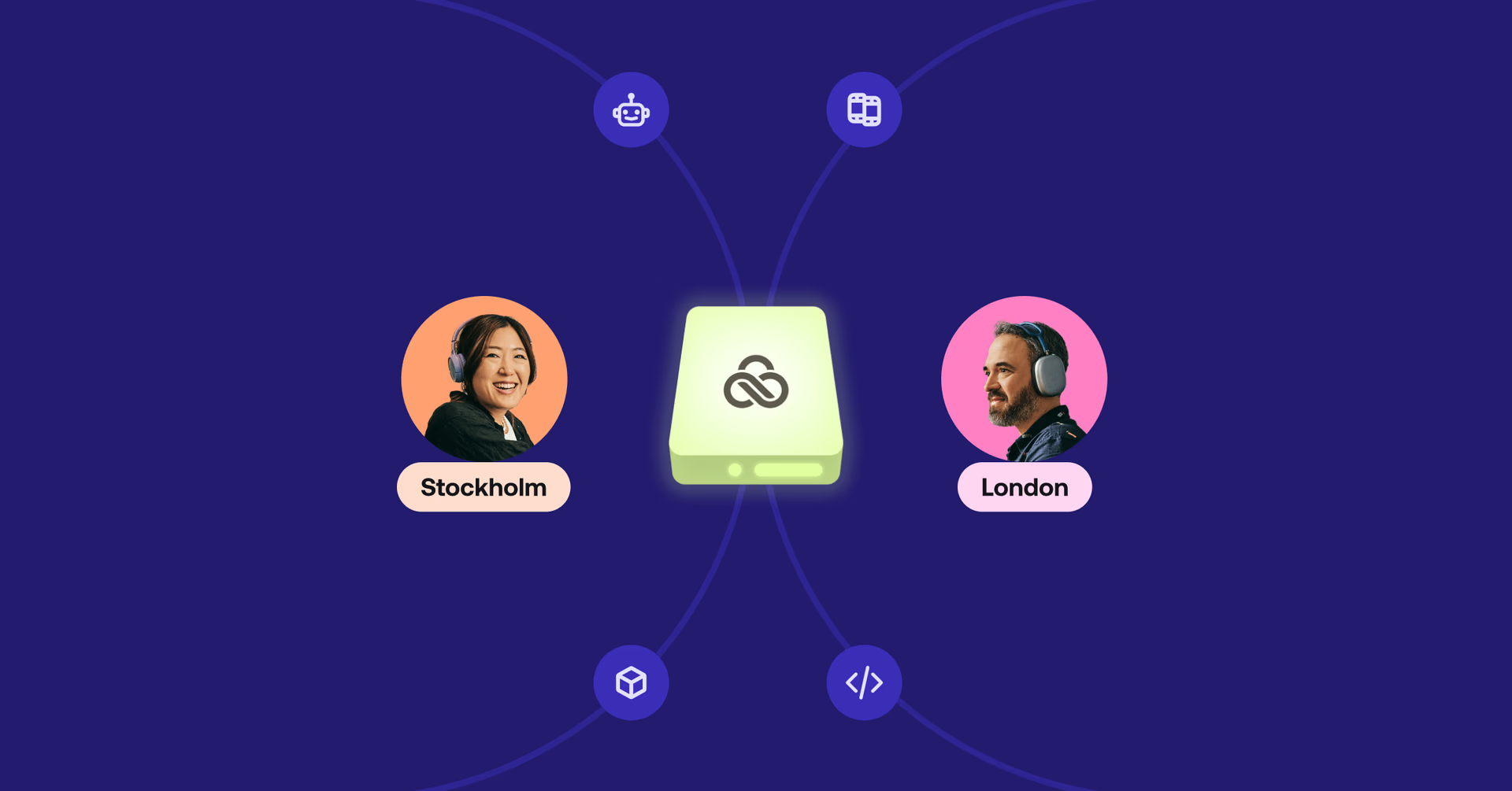
Most media organizations no longer operate within a single-vendor environment. A typical production ecosystem may involve multiple cloud providers, editorial platforms, asset management systems, automation tools, archive platforms and specialist service vendors all interacting with the same content workflows.
As a result, interoperability has become a critical infrastructure consideration. Large organizations rarely want to restructure or relocate petabytes of existing media simply to support a new workflow. Equally, post-production teams need the flexibility to adopt new tooling and services over time without additional operational silos or creating duplication of effort.
Open integration points, API-driven orchestration and clear separation between storage, compute and workflow layers all help support that flexibility.
This becomes particularly important in hybrid operating models where some workloads remain on-premises while others scale dynamically into the cloud. In many environments, infrastructure decisions are no longer purely technical. They are also influenced by cost management, security policies, data sovereignty requirements and operational governance.
The most effective environments are therefore not necessarily the most centralized. They are the ones that allow organizations to stay responsive to content demands, because the underlying infrastructure framework supports workflow flexibility.
Visibility in global environments
As infrastructure becomes more distributed, visibility becomes significantly more important. When workloads span multiple cloud regions, virtual workstations, on-premises systems and third-party services, understanding utilization, performance and cost attribution is more complex.

Raw infrastructure metrics alone are rarely enough. Organizations increasingly need operational context around how resources are being consumed, where costs are being generated and how workflows are behaving across the wider environment. Uniting management, monitoring and analytics has been a key focus for 7fivefive through the development of our Lens platform.
Providing teams with clearer insight into infrastructure usage, workload distribution and cloud economics allows environments to be managed more efficiently as production requirements evolve. Without that visibility, optimising distributed infrastructure becomes considerably more difficult.
Why distributed workflows change operations
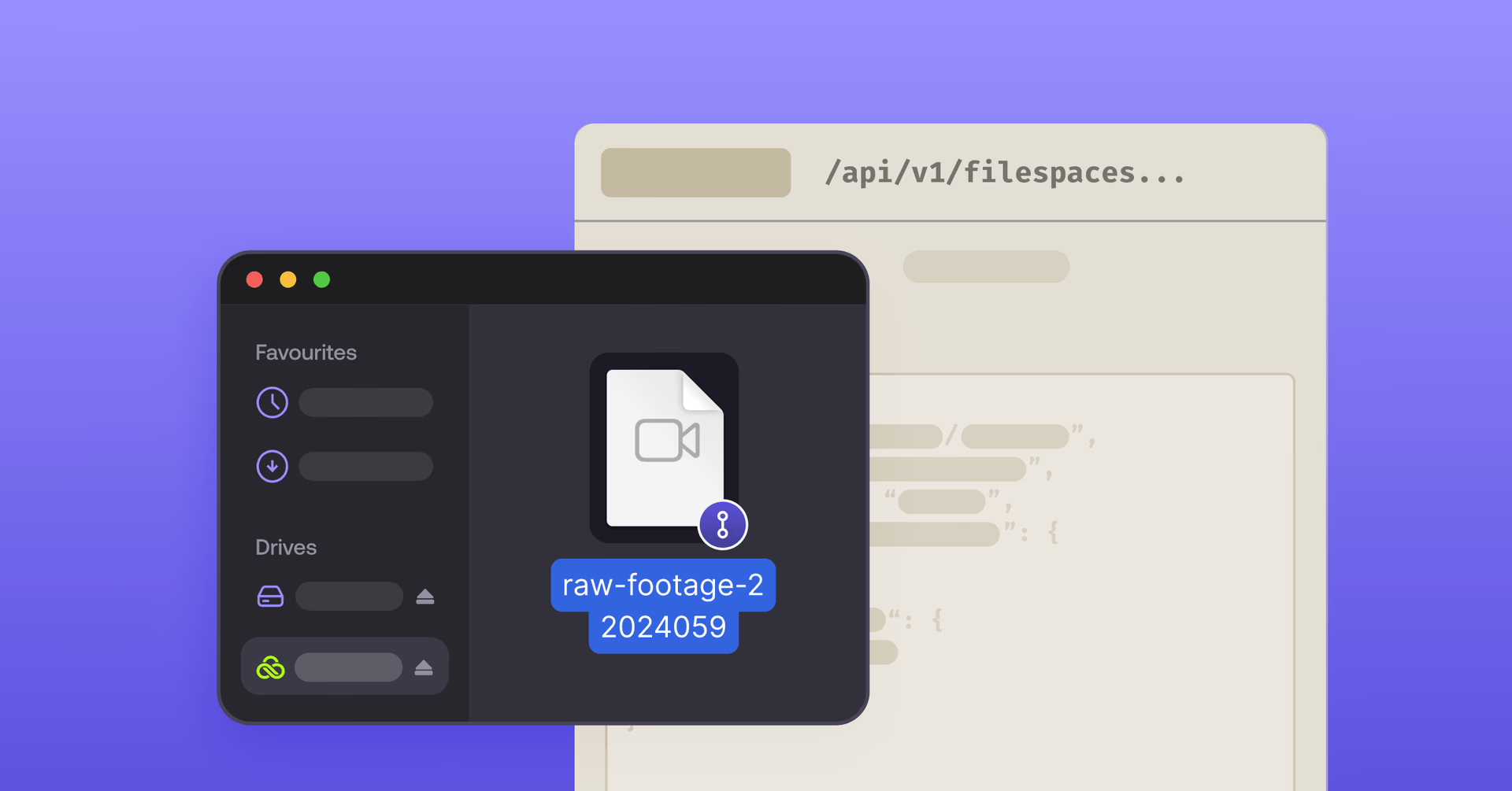
The media industry is no longer dealing with isolated facilities or tightly centralized systems. Environments increasingly combine cloud, on-premises infrastructure, distributed teams and automated services within the same operational landscape.
As a result, infrastructure design is becoming far more focused on adaptability, interoperability and operational efficiency. So, for media organizations, the objective is to reduce friction between users, services and storage while maintaining the flexibility to evolve workflows over time.
The ability to support creative teams effectively depends on how well infrastructure is orchestrated and accessed, as opposed to where the assets sit. Systems will succeed or fail based on how seamlessly they fit around the realities of this new media landscape.
Want to see how 7fivefive and LucidLink are putting these principles into practice? Watch the recording of our joint session on activating cloud data with LucidLink Connect.
Keep reading
In the field
Collaboration
Setting up AI agents for reality capture in AEC
How Diorama.studio used an AI agent connected to LucidLink to organize field data in real time, during a two-week deadline drone survey.
16 September 2026, 6 mins read
Collaboration
Creative production
Video editing workflow: a guide for collaborative teams
Discover how to create a collaborative video editing workflow. Get tips on how to turn your editing process into a seamless, team-based experience.
31 August 2026, 14 mins read

Collaboration
Revit Cloud Worksharing: how it works, where it falls short and alternatives
Understand how Revit Cloud Worksharing works, where it falls short for distributed teams and what AEC firms use for remote BIM collaboration.
18 August 2026, 8 mins read
Join our newsletter
Get all our latest news and creative tips
Want the details? Read our privacy policy. Not loving our emails?
Unsubscribe anytime or drop us a note at support@lucidlink.com.